Trump scales back China tariffs after trade war hits limits
Trump’s tariff blitz on China climbed to 125% in April before collapsing into a 90-day truce, exposing how market pain and retaliation narrowed his leverage.

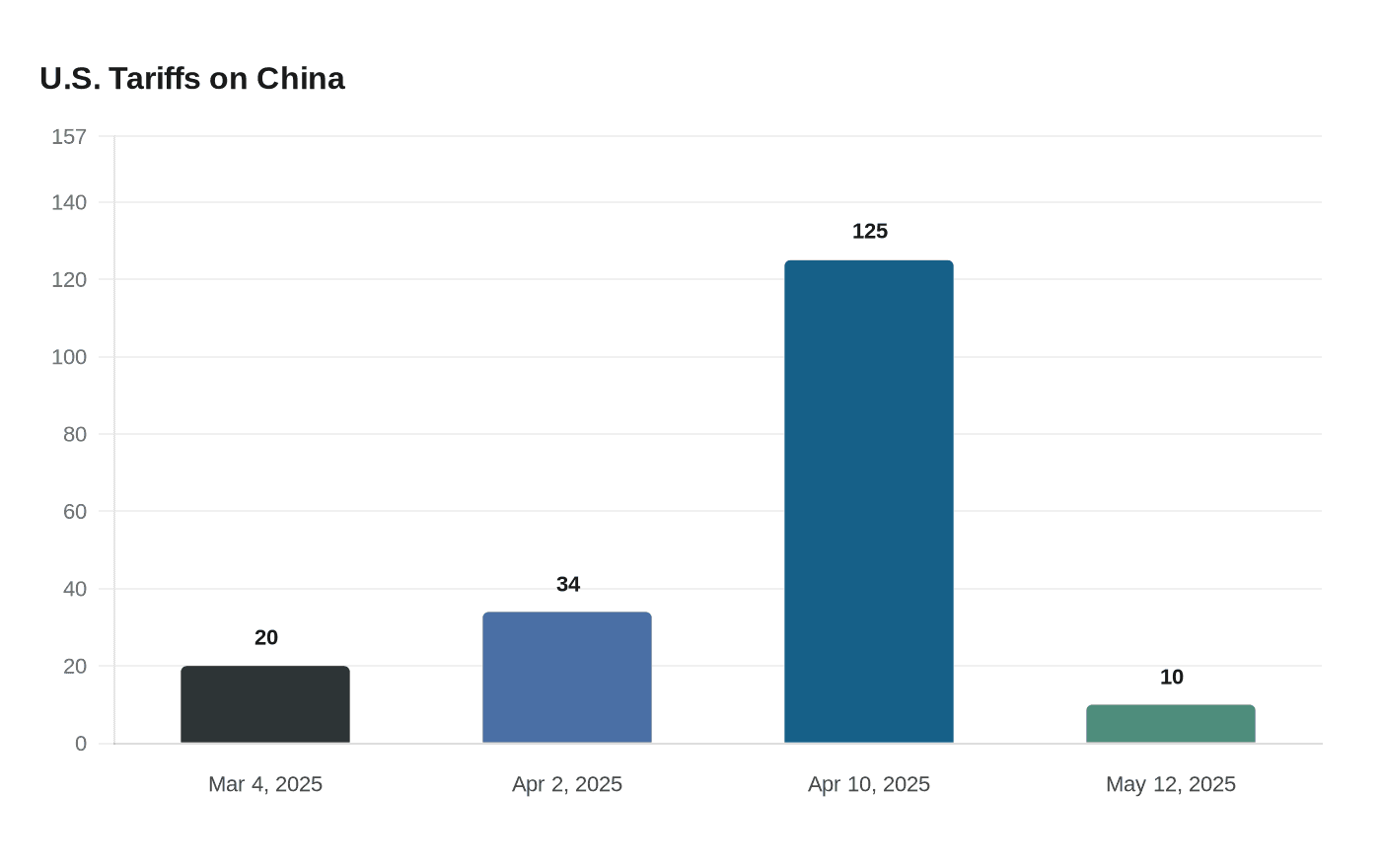
Donald Trump entered the White House promising a tougher break with China than with any other trading partner, but the campaign-style threat quickly ran into the realities of markets, diplomacy and supply chains. By the time Washington and Beijing agreed to a 90-day tariff truce on May 12, 2025, the administration had already pushed tariffs on Chinese goods to 125% under emergency powers, then pulled them back to 10% after talks in Geneva.
The escalation moved fast. On March 4, Trump doubled the tariff on Chinese products to 20%, and on April 2 he announced a 34% tariff on imports from China alongside a 10% baseline tariff on imports from all countries. China answered on April 4 with a 34% tariff on U.S. imports and other reciprocal measures, then raised its tariffs on U.S. goods to 125% on April 11. By April 10, U.S. tariffs on China under the International Emergency Economic Powers Act had reached 125% total.
That sequence exposed the limits of all-out confrontation. The Associated Press said the April tariff action risked pushing U.S. tariff levels toward Smoot-Hawley-era highs, and the political backlash came with real economic consequences. Beijing retaliated in March 2025 with tariffs of up to 15% on a wide array of U.S. farm exports, while also expanding export controls and restrictions on about two dozen U.S. companies. Farmers, manufacturers and importers faced the squeeze first, as higher costs and retaliation rippled through supply chains already strained by uncertainty.
The Trump administration later described the mid-2025 arrangement as a temporary tariff truce with China, even as broader negotiations continued with other trading partners. The Congressional Research Service said that between April and August 2025, the administration reached preliminary agreements with seven partners and kept negotiating with others, a sign that China was only one front in a wider, constantly shifting trade war. The White House also relied on both IEEPA and Section 232, reflecting a more piecemeal strategy than the sweeping confrontation Trump had initially projected.
A year later, the fight had settled into narrower bargaining. Reuters reported on May 13, 2026, that the United States and China were expected to consider tariff cuts on roughly $30 billion of imports in a managed-trade mechanism for non-sensitive goods, while U.S. officials said Trump’s current China trip was also touching on rare earths, artificial intelligence, Taiwan, Iran and nuclear issues. The retreat did not end the conflict, but it showed how market turbulence, inflation fears and Beijing’s retaliation had forced the administration away from maximal pressure and toward constrained deals.
This article was produced by Prism’s automated news system from verified source data, official records, and press releases, then run through automated quality and moderation checks before publishing. The system is built and supervised by the people who set the standards it runs under. Read our full AI policy.
Did this article answer your question?

