Trump's Cuba Policy Starves Civilians Without Clear Strategic Purpose
Sixty years of U.S. sanctions haven't toppled Cuba's government, but they have fueled a record migration surge that lands directly at America's border.
A Policy Without an Endgame
Since returning to office in January 2025, the Trump administration has severely limited oil shipments to Cuba, sparking fuel shortages, sharp price increases, and prolonged power outages, with the country experiencing three nationwide blackouts in March alone. Cuba's economic and energy crises stem from a combination of long-standing structural challenges, but Trump's hard-line policies and economic sanctions have exacerbated these difficulties since he returned to office. Against that backdrop, the administration has yet to articulate a credible mechanism by which these measures produce political change in Havana, leaving analysts and regional allies asking the same uncomfortable question: what, exactly, is the plan?
Several Trump administration policies since January 2025 have targeted the Cuban government's economic lifelines, including maintaining Cuba's designation as a State Sponsor of Terrorism and subjecting it to related financial restrictions; imposing visa restrictions on Cuban and foreign officials involved in Cuba's labor export program; and issuing directives for executive agency heads to adjust regulations regarding transactions with Cuba, including tightening travel and remittance restrictions. President Biden had removed Cuba from the SSOT list on January 14, 2025, but Trump reversed that decision almost immediately upon taking office, re-designating Cuba as a state sponsor of terrorism in early 2025, a move that triggers sweeping banking and trade restrictions that further isolate the island from international commerce.
Six Decades of Failure, Codified Into Law
The U.S. embargo against Cuba was first imposed by President Eisenhower in 1960, formally codified by President Kennedy in February 1962, and locked deeper into American law by the Helms-Burton Act of 1996. That act made it significantly harder for any future president to unilaterally lift the embargo, ensuring that what began as Cold War policy became structural American foreign policy regardless of the strategic landscape. The result is a blockade now stretching over six decades, one that the Cuban Communist Party has outlasted through 11 U.S. presidents.
That durability is not a coincidence. Experts at the Council on Foreign Relations and the Brookings Institution have consistently argued that the Cuban government has exploited U.S. pressure to rally nationalist sentiment, use Washington as a scapegoat for domestic economic failures, and justify its one-party political system. The SSOT designation and embargo do not weaken the Cuban state's grip; they provide it with a ready-made narrative. Some experts, former U.S. officials, and Cuban religious organizations have expressed concern about the potential humanitarian and migration ramifications of increased economic pressure on Cuba, which is experiencing an economic crisis characterized by food, medicine, and fuel shortages that have contributed to daily power blackouts.
The UN General Assembly has registered its judgment annually since 1992, voting 185-2 in 2023 to condemn the U.S. embargo. The near-universal international consensus has done nothing to alter Washington's course.
Civilians Pay the Price the Government Does Not
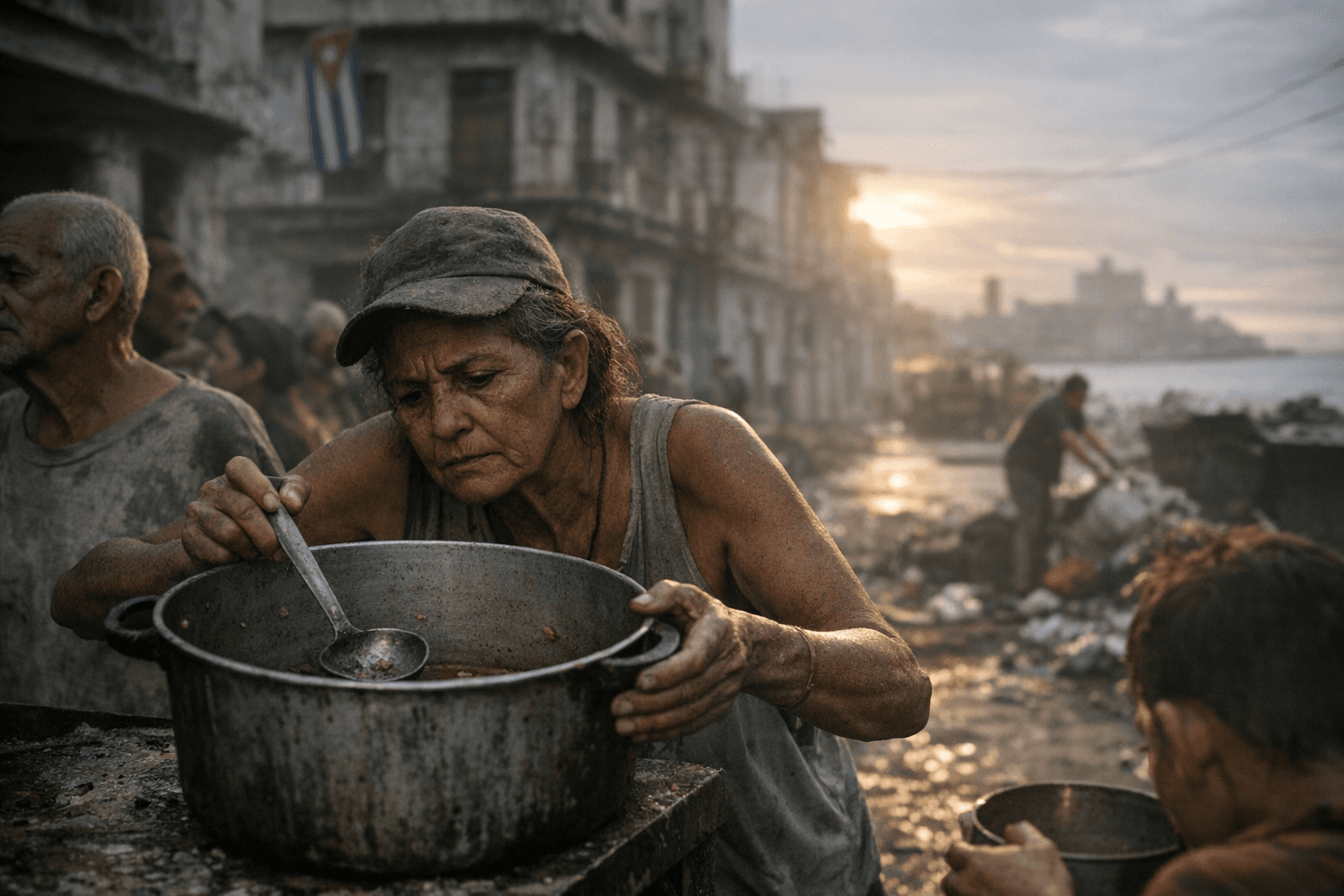
In March 2026, Cuba's national electricity grid collapsed entirely, leaving roughly 10 million people without power, knocking out water pumps, darkening hospitals, and bringing the island's already strained economy to a standstill. The causes are layered: a grid built on Soviet-era technology, near-total dependence on imported oil, decades of underinvestment, and an escalating geopolitical conflict that has choked off the country's fuel supply. Tourism, one of the island's few sources of hard currency, has been hit hard as hotels run on expensive, unreliable generators or not at all. Food processing and cold-storage facilities lose inventory during prolonged outages.
The UN World Food Programme and other international bodies have documented rising malnutrition, particularly among children and the elderly. Humanitarian aid organizations have consistently warned that tightening sanctions exacerbates civilian suffering without applying meaningful pressure to the Cuban government, which controls all resource distribution on the island. The people who cannot access food, medicine, or electricity are not senior Communist Party officials. They are ordinary Cubans with no leverage over Havana and no way to exit the political system.
The Migration Paradox
The most concrete and measurable consequence of worsening conditions in Cuba is a surge in migration, much of it flowing directly to the United States, which is precisely the outcome the administration's border policy purports to prevent. More than 600,000 Cubans are estimated to have entered the United States between 2022 and 2024 alone, representing one of the largest Cuban emigration waves on record. By 2025, over a million individuals had fled the island since 2021, dwindling Cuba's population from 11.3 million to an estimated 8.6 to 8.8 million, reminiscent of mid-1980s figures.
Dozens of members of Congress have written to presidents drawing the same conclusion: sanctions on Cuba are driving irregular migration. Nearly 600,000 Cubans attempted to enter the United States since 2021, a figure higher than the refugee wave of the early 1960s, the 1980 Mariel boatlift, and the 1994 rafter crisis combined. Historically, periods of restriction in U.S.-Cuba migration policy were accompanied by at least one legal release valve, whether family reunification, parole programs, or refugee admissions; the current moment is distinct in that nearly all such mechanisms have been curtailed simultaneously. The cumulative effect pushes migration into irregular channels, increases family separation, and heightens humanitarian risk, all of which generate downstream costs for U.S. border and immigration infrastructure.
The Tools Used and the Stated Goals
Senior U.S. officials have indicated that the end goal of these policies is to bring about political and economic liberalization in Cuba, including the potential removal of President Miguel Díaz-Canel from power. President Trump has repeatedly called on Cuban officials to "make a deal" with the U.S. government. Cuba's Ministry of Foreign Affairs rejected U.S. accusations and proposed to "renew technical cooperation with the United States" in areas including counterterrorism and money laundering. Trump reportedly stated in February 2025 that the United States was in talks with "the highest people in Cuba" to negotiate, but provided no details on what terms or concessions Washington would accept.
The stated tools of maximum pressure include the SSOT designation, oil shipment restrictions, tightened travel and remittance rules, and visa restrictions on Cuban officials. None of these measures come paired with a diplomatic track, an incentive structure, or an off-ramp for Havana. The island's "severe economic hardship, energy shortages, and growing humanitarian strain" prompted outgoing CARICOM Chair and Jamaican Prime Minister Andrew Holness to warn that if crisis conditions in Cuba persist, the situation "will affect migration, security, and economic stability across the Caribbean basin." Regional allies, including Mexico, Brazil, and the broader CELAC bloc, have opposed U.S. Cuba policy as counterproductive. Mexico has reportedly continued supplying Cuba with oil during the current crackdown.
What a Coherent Alternative Requires
The Obama administration's diplomatic opening between 2014 and 2016 demonstrated that engagement can produce tangible shifts: the two countries restored diplomatic relations, reopened embassies, and Obama visited Havana in March 2016, the first sitting U.S. president to do so since Calvin Coolidge in 1928. That opening did not end the Cuban Communist Party's rule, but it produced measurable improvements in travel, remittances, and commercial exchange. Trump reversed most of those measures during his first term, re-designating Cuba as a state sponsor of terrorism in January 2021 in his final days in office, and has doubled down again in his second term.
A coherent alternative to maximum pressure would require, at minimum, a stated theory of change: what specific Cuban actions would trigger sanctions relief, what diplomatic channels are open, and what the United States is prepared to offer in exchange for political or human rights reforms. Cuba is entering its fifth consecutive year of recession, leaving many citizens struggling with shortages and rising costs, and policy changes are unfolding against a backdrop of deepening economic hardship on the island. Without a credible offer on the table, the pressure falls entirely on civilians who have no mechanism to translate their suffering into political change.
Florida's Cuban-American hardliner constituency, anchored politically by figures such as Secretary of State Marco Rubio, has long driven the maximum-pressure consensus in Washington. That constituency's influence is real and its concerns about human rights abuses, including the mass arrests of protesters following the historic July 11, 2021 demonstrations, are legitimate and documented by Amnesty International and Human Rights Watch. But political legitimacy for a constituency does not equal strategic effectiveness for a policy. Sixty-plus years of the same approach have produced a Cuba still governed by the same party, a region increasingly alienated from U.S. leadership, and a migration surge landing at America's own border. The cost is measurable. The gain is not.
This article was produced by Prism’s automated news system from verified source data, official records, and press releases, then run through automated quality and moderation checks before publishing. The system is built and supervised by the people who set the standards it runs under. Read our full AI policy.
Did this article answer your question?


