Trump's "Greenland Hospital Ship" Quietly Docked in Portland for a $90 Million Overhaul
The USNS Mercy arrived in Portland for a scheduled six-month drydock, not Greenland, exposing the gap between Trump's social media claims and reality.
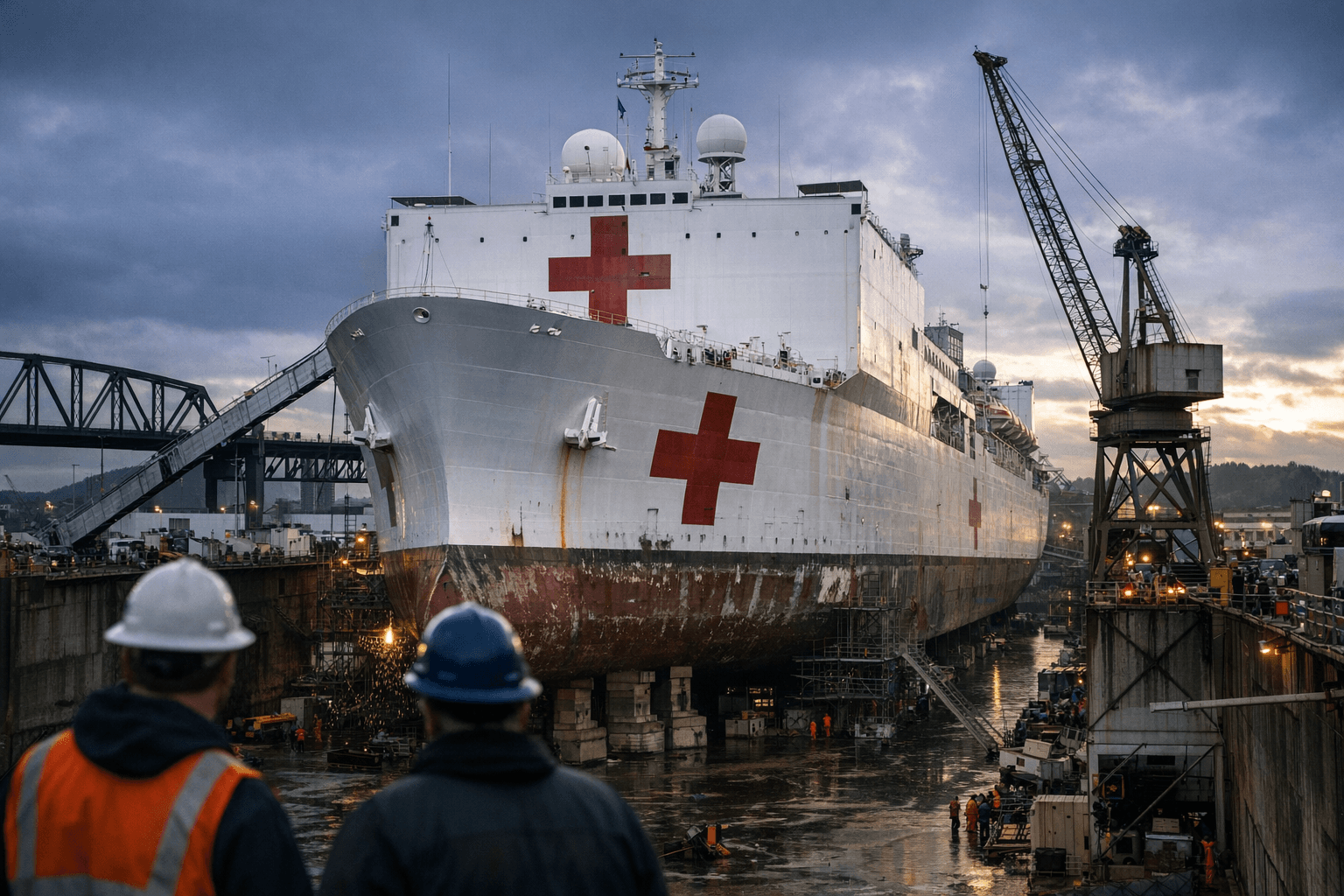
The USNS Mercy, the hospital ship President Donald Trump declared was "on its way" to Greenland, arrived instead at Vigor Industrial's Swan Island shipyard in Portland, Oregon, on March 19-20 to begin a scheduled six-month overhaul worth roughly $89 million to $90 million, according to maritime tracking data and industry reports.
The vessel's routing, recorded in real time by Automatic Identification System tracking and corroborated by commercial maritime intelligence firm Pole Star Global, told a straightforward story: a southbound transit through the Yucatan Channel in late February, a passage through the Panama Canal in early March, then a steady northbound run along the Pacific coast toward Portland. "Nobody expected the Northwest Passage approach," one user joked on social media, a wry acknowledgment that the ship's actual course had nothing to do with the Arctic.
Trump announced on social media that his administration would "send a great hospital boat to Greenland to take care of the many people who are sick, and not being taken care of there," saying the vessel was already on its way. He shared an illustration of the Mercy alongside the post. Greenland's leadership pushed back publicly, stating no such mission had been requested. Defense officials told the Wall Street Journal that no deployment orders had been received.
The ship's actual orders were considerably more mundane. According to The Maritime Executive, the Department of Defense paid $89 million to arrange the drydocking, which was scheduled to begin March 20 and run through September 20 if started on time. GCaptain, the maritime news outlet that first reported the arrival, described the contract as "part of an approximately $90 million yard availability program." The discrepancy between the two figures reflects different sourcing; both point to a long-planned, large-scale maintenance commitment.
The Mercy had departed Alabama Shipyard in Mobile in late February after completing emergent repairs, work that addressed immediate mechanical needs but fell short of the comprehensive inspections required in a standard five-year drydocking. That deeper maintenance is what the Portland yard period is designed to provide. The ship's sister vessel, USNS Comfort, has also entered a yard period at Alabama Shipyard and is currently unavailable for operations.
The ship's physical limitations made a Greenland deployment logistically implausible from the outset. The Mercy is not ice-strengthened and has no history of Arctic operations. Late-winter sea ice, iceberg hazards and the near-absence of port infrastructure along Greenland's coast would pose significant challenges for a vessel of its size, and at the Mercy's sea speed, reaching Portland from Mobile alone required more than 20 days of continuous sailing plus transit time through the Panama Canal.
The Portland arrival caps what became an unexpected exercise in public maritime tracking. AIS data, normally the province of shipping analysts and port planners, became a live fact-check on a presidential announcement. The Mercy is now out of operational service for the next six months, scheduled to return to readiness around September 20.
This article was produced by Prism’s automated news system from verified source data, official records, and press releases, then run through automated quality and moderation checks before publishing. The system is built and supervised by the people who set the standards it runs under. Read our full AI policy.
Did this article answer your question?

