Trump's H-1B Visa Changes Threaten America's Global Tech Talent Pipeline
Trump's $100,000 H-1B fee, up to 5,800% above previous costs, sent Amazon's visa filings down by a third and pushed tech R&D jobs toward Canada and Germany.
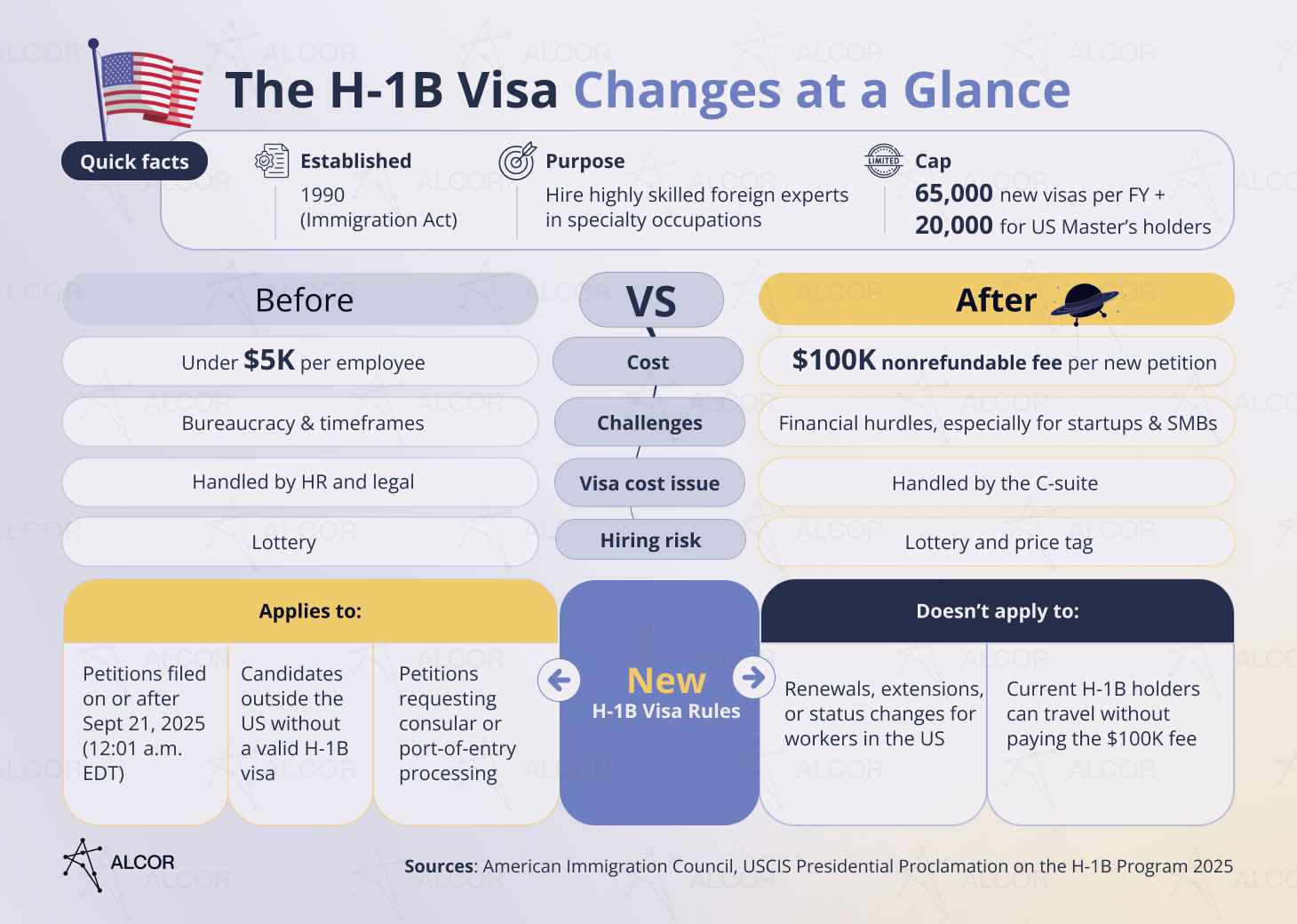
A $100,000 fee that replaced what had been a $2,000 to $5,000 petition cost immediately reshuffled how major tech companies approach global hiring. Certified H-1B applications at Amazon fell from 4,647 in the first quarter of fiscal 2025 to 3,057 a year later. Meta and Google each roughly halved their filings. Apple, Microsoft, IBM, Salesforce, and Tesla all recorded declines, according to Department of Labor data.
The fee stems from a presidential proclamation signed September 19, 2025, titled "Restriction on Entry of Certain Nonimmigrant Workers," which took effect two days later. It applies only to new petitions for workers residing outside the United States, carving out renewals and F-1 status changes already in progress. That distinction split the program into two tracks: companies recruiting internationally now face a six-figure upfront payment, while those hiring graduates already on campus can still avoid it.
A second overhaul compounded the disruption. The Department of Homeland Security finalized a wage-weighted lottery system on December 29, 2025, effective February 27, 2026, replacing the long-running random draw. Workers offered the highest prevailing wage now enter the lottery four times, giving them a 61 percent selection probability. Entry-level workers at the lowest wage tier enter only once, cutting their odds to 15 percent, a 48 percent drop from the old random lottery. The Consumer Technology Association warned in October 2025 that the new system would "disproportionately harm the F-1 pipeline," since recent graduates starting at Wage Level I face the steepest disadvantage of all.
Together, the two changes drove overall H-1B registrations down 29.6 percent for fiscal 2026, from roughly 470,000 to approximately 344,000. Texas-based immigration attorney Jason Finkelman summarized the behavioral shift: "Companies are being more selective in who they sponsor."
The administration has defended both changes as protections for American workers. Commerce Secretary Lutnick put the case plainly: "Train Americans. Stop bringing in people to take our jobs." The White House pointed to a company approved for 5,189 H-1B workers in fiscal 2025 while simultaneously laying off roughly 16,000 U.S. employees as evidence the program required reform.
Economists warned the trade-off carries serious costs. Berenberg, the German investment bank, cut its U.S. growth forecast for 2025 from 2 percent to 1.5 percent after the September fee announcement. A February 2026 Center for Strategic and International Studies report found corporations now hire between 0.4 and 0.9 employees abroad for every rejected H-1B application, accelerating the offshoring of research and AI positions to Canada and Germany. The American Hospital Association reported on April 1, 2026 that 64 percent of hospitals had paused or limited international recruitment, with rural providers facing the sharpest shortages.
Other countries moved quickly to absorb redirected talent. China launched a new K visa on October 1, 2025 designed to attract STEM professionals without requiring employer sponsorship. Canada and several European nations simultaneously expanded their own high-skilled immigration pathways. Nvidia CEO Jensen Huang, who has said his own family's immigration to the United States "would not have been possible" under the current rules, actually increased his company's H-1B filings from 369 to 434. He stands as the exception. For most of the industry, the cumulative cost of the fee and the lottery overhaul has converted the H-1B program from a broad talent pipeline into a tool only the largest and wealthiest companies can reliably afford.
This article was produced by Prism’s automated news system from verified source data, official records, and press releases, then run through automated quality and moderation checks before publishing. The system is built and supervised by the people who set the standards it runs under. Read our full AI policy.
Did this article answer your question?