Trump's Steep Spending Cuts Face Tougher Congressional Battle This Year
Trump's $1.5 trillion FY2027 defense budget, released Friday, again targets domestic and health agencies that Congress restored on a bipartisan basis just months ago.

The White House released its fiscal year 2027 budget proposal Friday, built around a $1.5 trillion defense request and deep cuts to domestic programs, setting up what could be the sharpest congressional standoff yet over federal spending priorities. The budget lands at a politically treacherous moment: an unpopular Iran war, rising gasoline prices, and a Republican caucus still scarred by last year's bipartisan rejection of nearly identical cuts.
The scale of the defense ask is without modern precedent. The $1.5 trillion Pentagon budget would represent the largest year-over-year increase in defense spending since World War II, with funding earmarked for Trump's proposed $185 billion "Golden Dome" missile defense shield, additional Lockheed Martin F-35 jets, and new warships. Further details on the defense breakdown are expected April 21.
To offset those increases, the administration again targeted the domestic agencies that Congress refused to cut the last time around. Last May, Trump's "skinny budget" for fiscal year 2026 proposed slashing non-defense discretionary spending by $163 billion, a 22.6 percent reduction covering everything from education and housing assistance to scientific research and public health. Congress rejected that framework on a bipartisan basis. Lawmakers not only refused the proposed cuts but actively restored funding: the final 2026 appropriations package increased allocations for the National Institutes of Health and the Centers for Disease Control and Prevention rather than cutting them, while also reversing proposed reductions to medical research, refugee assistance, and the Department of Education.

Congress also responded to the administration's pattern of attempting cuts without legislative approval by embedding guardrails in the 2026 bills, explicitly limiting the executive branch's ability to withhold, impound, or rescind appropriated funds.
Those guardrails reflect a central tension that will define this year's fight. The Trump administration has moved aggressively to reduce agency personnel and reshape programs even when Congress left funding intact, leaving lawmakers across both parties skeptical that appropriated money will actually reach its intended programs regardless of what the bills say.
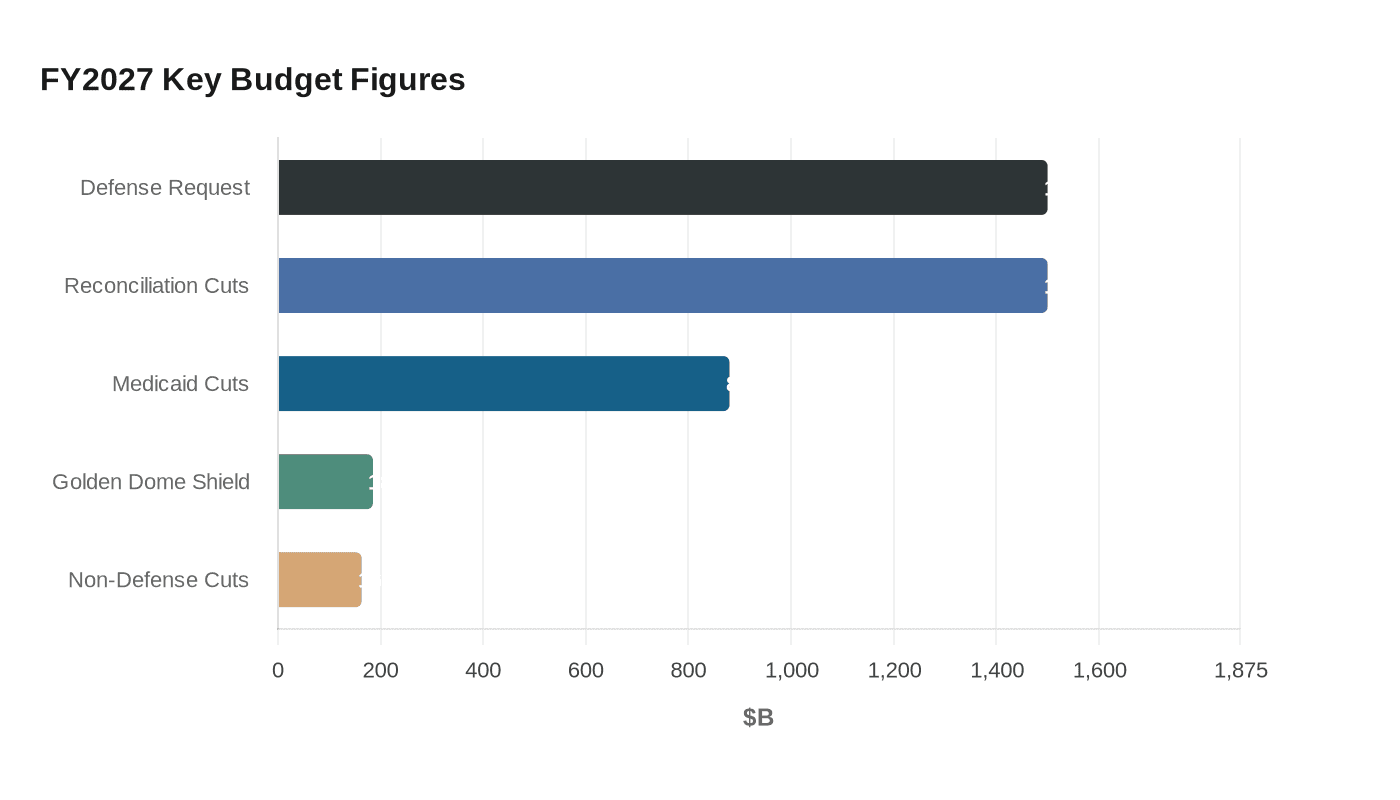
The FY2027 budget is also being released against the backdrop of the Republican reconciliation effort, through which the party is pursuing at least $1.5 trillion in mandatory spending cuts, including roughly $880 billion in reductions to Medicaid. That parallel track complicates the annual appropriations math considerably: Republican members being asked to support Medicaid cuts through reconciliation may be reluctant to simultaneously endorse deep cuts to health and science agencies through the appropriations process.
The White House has framed the new budget around midterm election messaging, casting the defense buildup as a national security imperative. But a governing vision that shifts hundreds of billions of dollars toward the Pentagon while shrinking health research and domestic assistance carries a compounding political risk when gas prices are rising and an ongoing war is generating sustained public opposition. Senate Republicans who pushed back against similar cuts last year have not signaled any change in position.
This article was produced by Prism’s automated news system from verified source data, official records, and press releases, then run through automated quality and moderation checks before publishing. The system is built and supervised by the people who set the standards it runs under. Read our full AI policy.
Did this article answer your question?

