Uber lets employees test Nuro-powered Lucid robotaxis in San Francisco
Uber’s latest San Francisco test lets employees hail Nuro-powered Lucid SUVs in-app, with a safety driver still behind the wheel and a luxury launch still ahead.

Uber has started letting selected employees hail Nuro-powered Lucid Gravity robotaxis in San Francisco, a controlled step that shows how far the company is from a true public rollout. The rides began last week in the San Francisco Bay Area, and each vehicle still carries a safety driver, even though the SUV is operating in autonomous mode.
The test matters because it moves the service from closed development into live rider conditions, but only for a narrow group. Select Uber employees can request the rides directly through the Uber app, giving Uber and Nuro a chance to study everything from routing and pickup timing to the passenger experience before opening the program more widely. Uber and its partners have said the service is expected to launch in the San Francisco Bay Area later in 2026.
The company is treating the project as a premium robotaxi play, not a low-cost transit substitute. Uber invested $300 million in Lucid Group Inc. and has said it aims to deploy 20,000 or more Lucid vehicles through the program over six years. Uber and Nuro have said Uber will own and operate the vehicles itself or through third-party fleet partners, underscoring a capital-heavy model that will likely depend on affluent riders willing to pay for a human-supervised autonomous service before it can scale.
Nuro says it now has 100 Lucid Gravity SUVs outfitted with its autonomous system in its engineering fleet. Lucid said the first vehicles were delivered to Nuro in September 2025 for testing and validation, with more test vehicles slated for closed-course work in Las Vegas and supervised on-road development across the San Francisco Bay Area. Uber said autonomous on-road testing began in December 2025, marking another step toward launch.
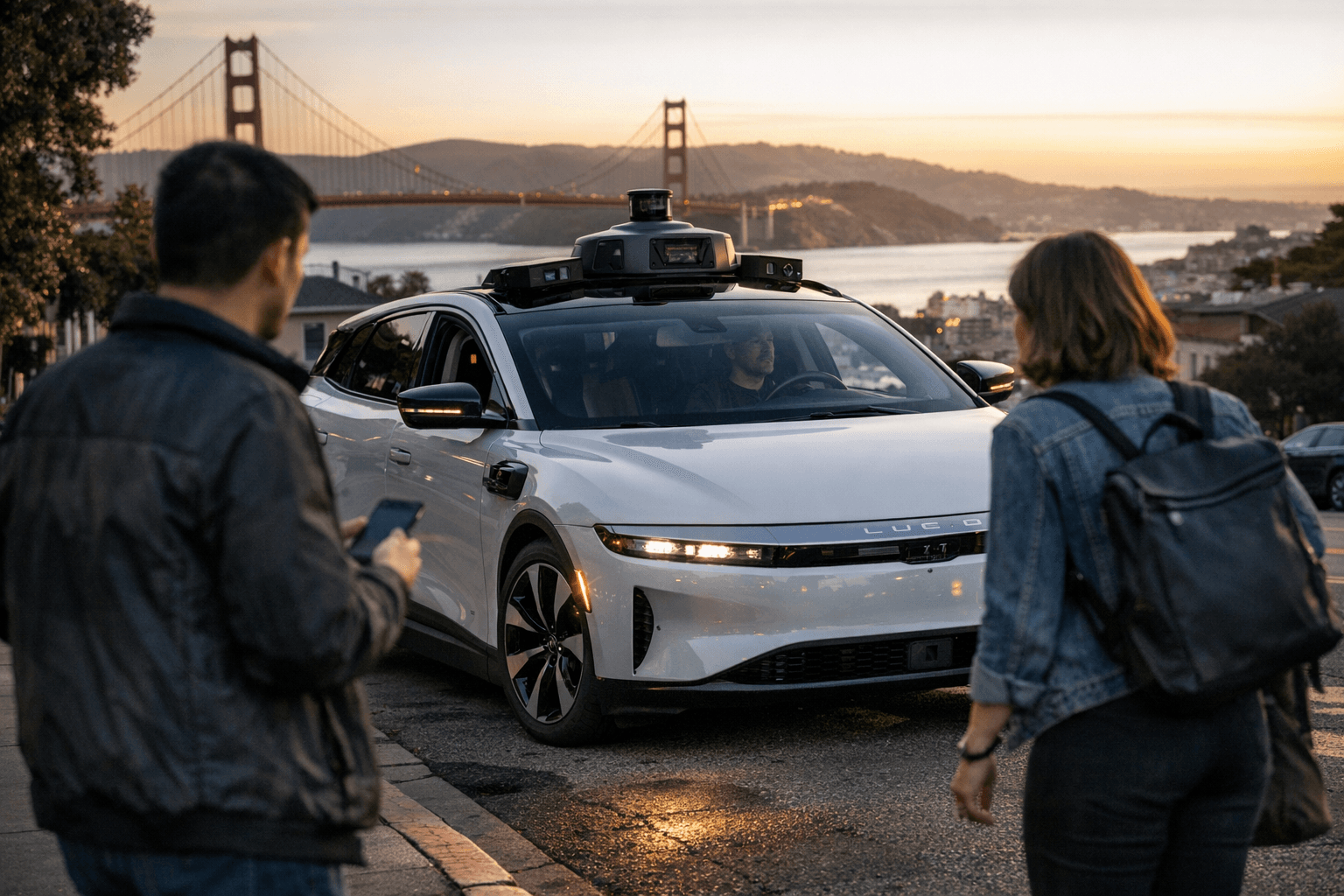
The hardware stack reflects the size of the bet. Nuro and Uber have said the robotaxis use Nvidia Corporation’s Drive AGX Thor compute platform, along with cameras, solid-state lidar and radar, while Lucid’s redundant electrical and controls architecture and long range are part of the pitch. The companies are trying to solve the hardest parts of ride-hailing at the same time: autonomy, pickup and drop-off, comfort and reliability.
San Francisco is the proving ground, and California’s Department of Motor Vehicles still controls the permits that govern testing and deployment on public roads. That regulatory gatekeeping, combined with the safety driver still required in the vehicle, shows the service remains in an expensive proving phase. For now, the early riders are not just testing robotaxis. They are helping determine whether a luxury autonomous ride can become a profitable business before it becomes anything like mass transit.
This article was produced by Prism’s automated news system from verified source data, official records, and press releases, then run through automated quality and moderation checks before publishing. The system is built and supervised by the people who set the standards it runs under. Read our full AI policy.
Did this article answer your question?