UHERO: High-Spending Visitors Drive Recent Tourism Revenue Gains in Kauai
Kaua‘i saw visitor spending fall in 2025 even as statewide real tourism spending rose about 3%, driven by higher-spending visitors and a Maui resurgence that lifted late-2025 revenues.
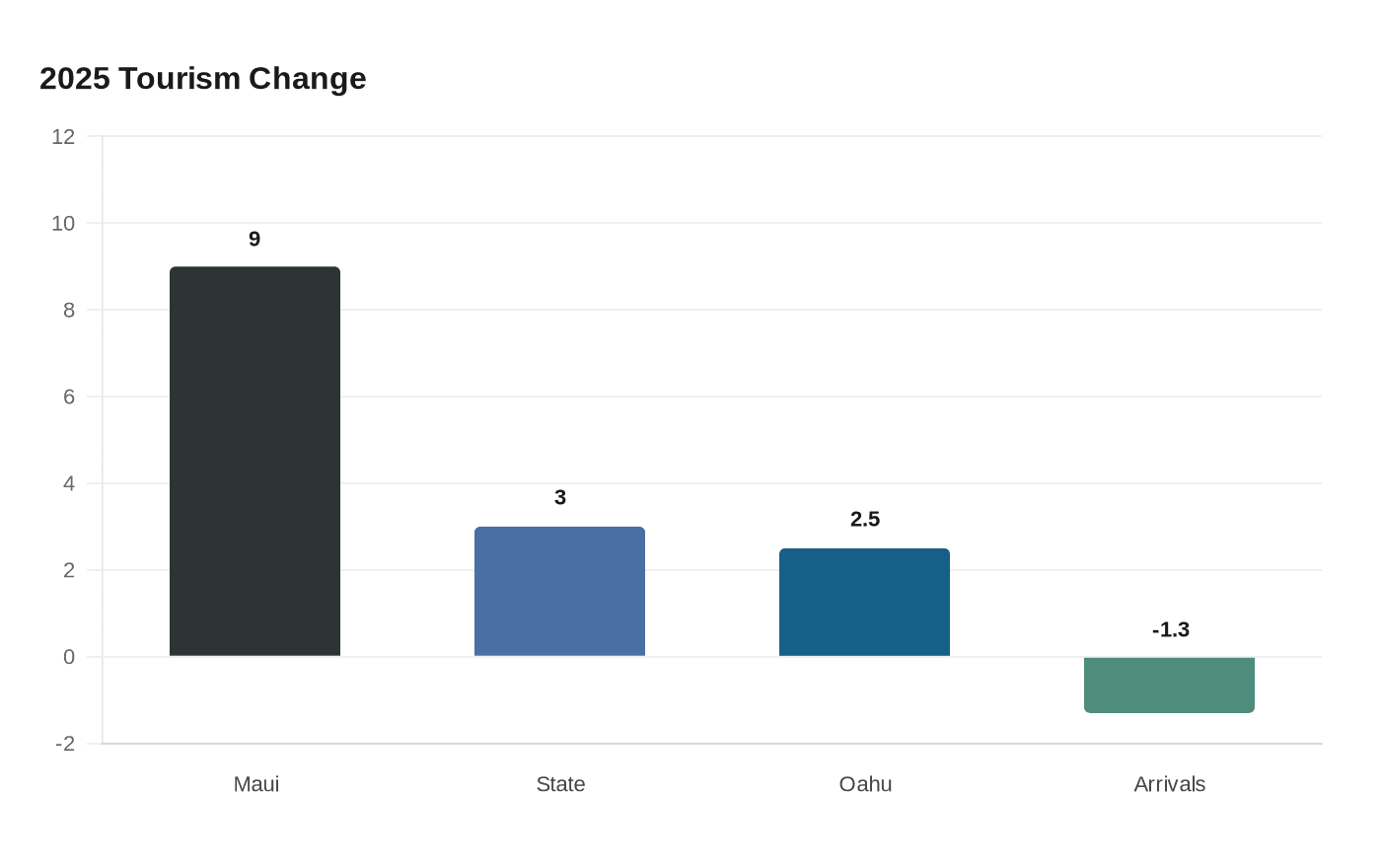
Kaua‘i County recorded a decline in visitor spending in 2025 while Hawai‘i as a whole posted roughly a 3% increase in inflation-adjusted visitor spending, UHERO data show. Visitor arrivals statewide fell 1.3% year-over-year in 2025 even as per-person spending accelerated late in the year, with nominal per-person daily tourism expenditure reaching $279 in October 2025, DBEDT preliminary figures cited by UHERO indicate.
After adjusting with the Honolulu CPI, UHERO finds October–December 2025 daily spending roughly matched a $276 peak in February 2013 in 2025 dollars, but remained about 25% below the February 2001 peak of $367 in 2025 dollars. UHERO’s materials frame the late-2025 uptick as notable yet fragile: “We are seeing an unusually large share of spending by the highest income folks, supported by stock market gains. This has buoyed spending even as weak labor markets, moderate income growth, and high prices have held back spending by lower-income households.”

Island-level patterns were uneven. Maui posted a 9% increase in daily visitor spending in 2025, a rebound UHERO says is largely responsible for pulling statewide numbers up after the island’s tourism collapse following the Aug. 8, 2023 wildfires. O‘ahu saw daily spending rise about 2.5%, with Waikīkī and most luxury properties on O‘ahu reporting gains in occupancy and RevPAR in Q4 2025. Kaua‘i and Hawai‘i (the Big Island) experienced declines in visitor spending for the year.
Hotel-market performance was concentrated at the high end. UHERO reports Q4 2025 occupancy remained stable while RevPAR rose 2% in the quarter, driven by luxury and upscale hotels and premier Maui resorts. For the full year 2025, statewide RevPAR fell about 1% after inflation adjustment, with discounting in mid- and lower-tier properties offsetting gains at top-end properties.
UHERO researchers caution about concentration risk. Associate Professor Steven Bond-Smith said, “So the increase in real spending statewide of roughly 3% was really very much dominated by Maui and then in total by the higher-spending visitors.” He added that the rise “is really coming from high-end visitors - people who are staying in luxury and upscale properties,” and that “we don’t expect to continue long term.” UHERO Executive Director Carl Bonham warned that “Relying on the top 20% of income earners to continue to drive tourism can be ‘risky when you’ve got all of your eggs in the high-consumer basket.’”
Broader economic context remains mixed. UHERO counts about 4,000 jobs lost in Hawai‘i during the first half of 2025 and projects real GDP growth near 1.6% in 2026. Official BLS data show roughly 2% job growth in 2025; Bonham said UHERO’s post-revision estimate will be about a half of 1%, underscoring weaker-than-appearing employment gains. Bonham also linked recent stock-market swings and policy uncertainty to visitor spending, noting volatility tied to tariffs and AI developments and that “That spending occurs all across the US, including on their vacations to Hawaii.”
Policy risks complicate the outlook. UHERO highlights a near-term constraint from the multi-year closure of the Hawaii Convention Center for renovations and flags uncertainty after a recent Supreme Court decision affecting the administration’s tariffs. UHERO materials state that at least 90% of tariff costs “are being borne by the U.S. - either by U.S. importers or U.S. consumers,” and that some tariff impacts, notably on metals, have not yet fully fed through into prices.
Longer term, UHERO emphasizes a structural challenge: visitors’ inflation-adjusted spending peaked decades ago, with UHERO noting the long-run peak in 1988. The late-2025 boost tied to high-income visitors and Maui’s recovery has improved near-term revenue metrics in places such as Waikīkī and Maui County, but UHERO and local economists urge caution as Hawai‘i awaits April BLS revisions and ongoing DBEDT monthly data to confirm whether the gains are sustained.
Sources:
Know something we missed? Have a correction or additional information?
Submit a Tip