Unastella raises $24 million to advance South Korea rocket launches
Unastella turned a delayed test program into South Korea’s first successful private rocket launch, then added $24 million to push toward orbit.

Seoul-based Unastella is emerging as one of South Korea’s clearest bets in the race to build sovereign launch capability, after closing a $24 million Series B that brought total funding to $44 million and followed the country’s first successful private rocket launch from its own soil. The four-year-old company is still small, with 22 employees and no revenue yet, but its technical progress has put it inside South Korea’s broader industrial push to localize space hardware rather than depend on foreign launch services.
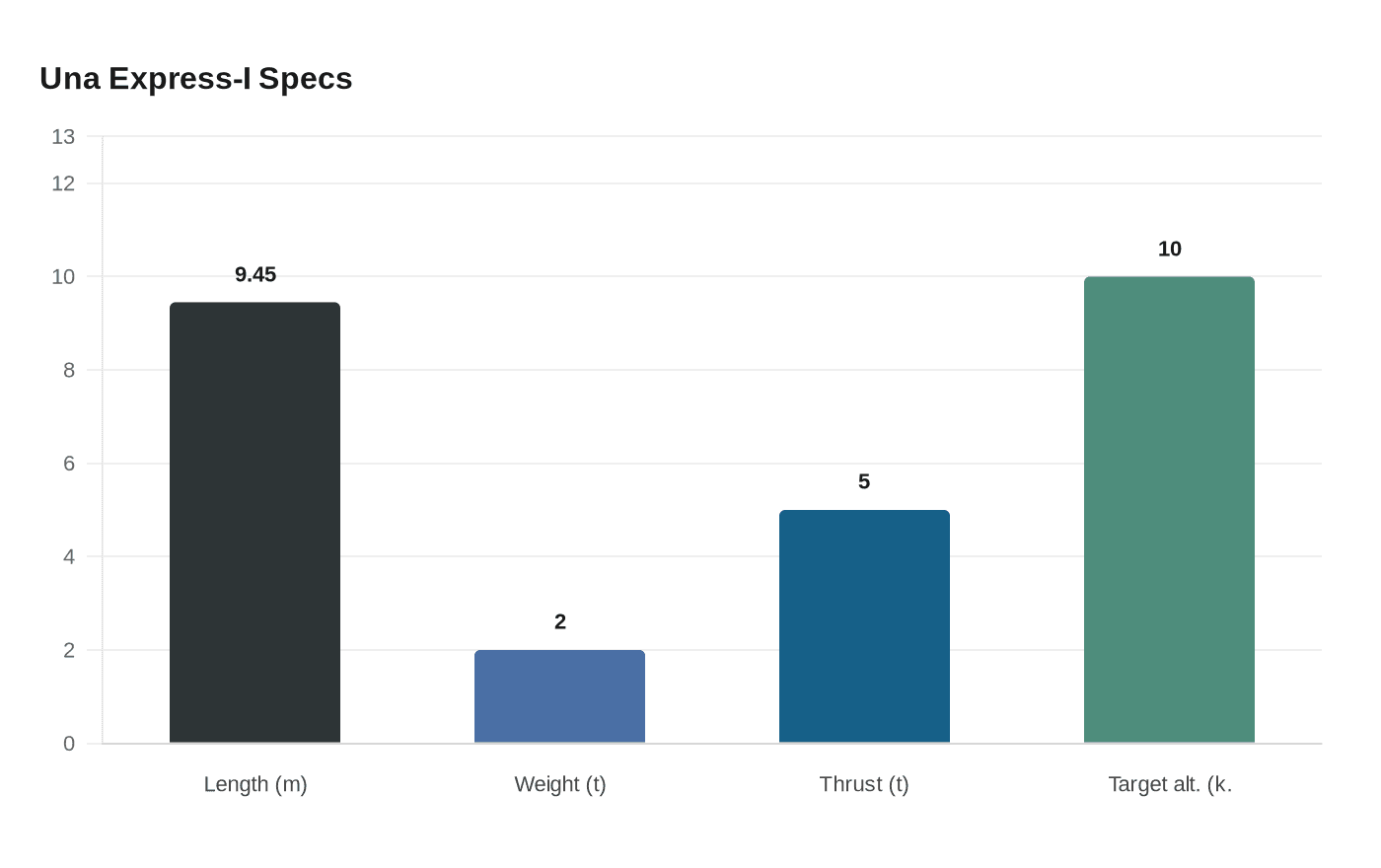
The company’s May 28, 2025 flight of Una Express-I from a private launch site in Bongnae-myeon, Goheung-gun, Jeollanam-do, marked a milestone for the domestic space sector. The 9.45-meter rocket, weighing 2 tons and powered by a 5-ton-thrust engine, reached its 10-kilometer target altitude before splashing down in a designated maritime safety zone. It carried a microgravity testing device developed by teams from the Korea Aerospace Research Institute, the Korea Institute of Machinery and Materials, the Korea Basic Science Institute, the Korea Research Institute of Bioscience and Biotechnology, and Chungnam National University.

For South Korea, the significance extends beyond one flight. The launch was tied to the Korea AeroSpace Administration’s Space Pioneer Program, which is designed to localize core space-industry components through the qualification-model stage. That makes Unastella part of an industrial-policy effort as much as a venture-backed startup story, with launch vehicles, engines, and ground systems treated as strategic capabilities.
Founder and chief executive Jae Park has built the company around that logic. He previously worked on combustion systems for Korea’s Nuri rocket, then on launch vehicle engines at the German Aerospace Center in Berlin, before joining another rocket startup and founding Unastella. The company says it designs and manufactures core propulsion parts in-house, including igniters, combustors, and electric motor pumps, and it has chosen kerosene and liquid oxygen propellants with an electric motor pump instead of a traditional turbo pump. That approach sacrifices some payload capacity in exchange for lower cost and simpler engineering.

The path to the May launch was anything but smooth. Unastella’s first attempt in November 2024 was aborted after an engine ignition delay, and a later try was postponed because of a valve problem in ground fuel-supply equipment. Park has said the company is trying to move quickly as a commercial launch business, not just an R&D program.
Altos Ventures led the Series B, joined by Korea Development Bank, Strong Ventures, and Hana Ventures. Unastella’s next launch, Una Express-II, is targeted for later in 2026 and is intended to reach 100 kilometers, a threshold Park says could open the door to partnerships with major South Korean aerospace and defense firms. Against larger and better-funded private-space rivals in the United States, Japan, India, Australia, and elsewhere in Asia, Unastella still looks early. But in a market long dominated by the United States and China, South Korea now has a homegrown launch company with one verified private success behind it and a clearer path toward orbit.
This article was produced by Prism’s automated news system from verified source data, official records, and press releases, then run through automated quality and moderation checks before publishing. The system is built and supervised by the people who set the standards it runs under. Read our full AI policy.
Know something we missed? Have a correction or additional information?
Submit a Tip