UNM-Los Alamos to host lecture on finding exoplanets March 10 in Wallace
UNM‑Los Alamos will present “Signals in a Sea of Stars: Finding Exoplanets” with Lorraine Bowman, Ph.D., 4:00–5:30 p.m. Tuesday, March 10, in Wallace.
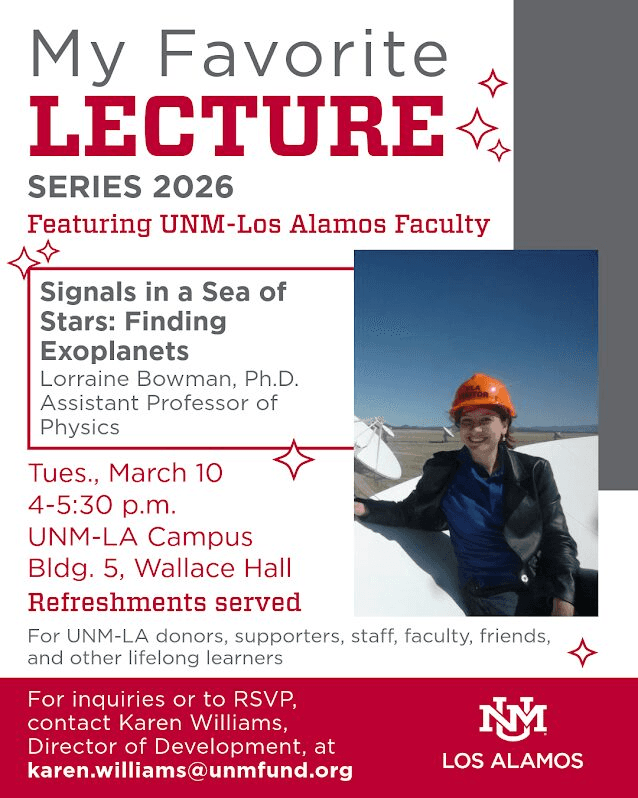
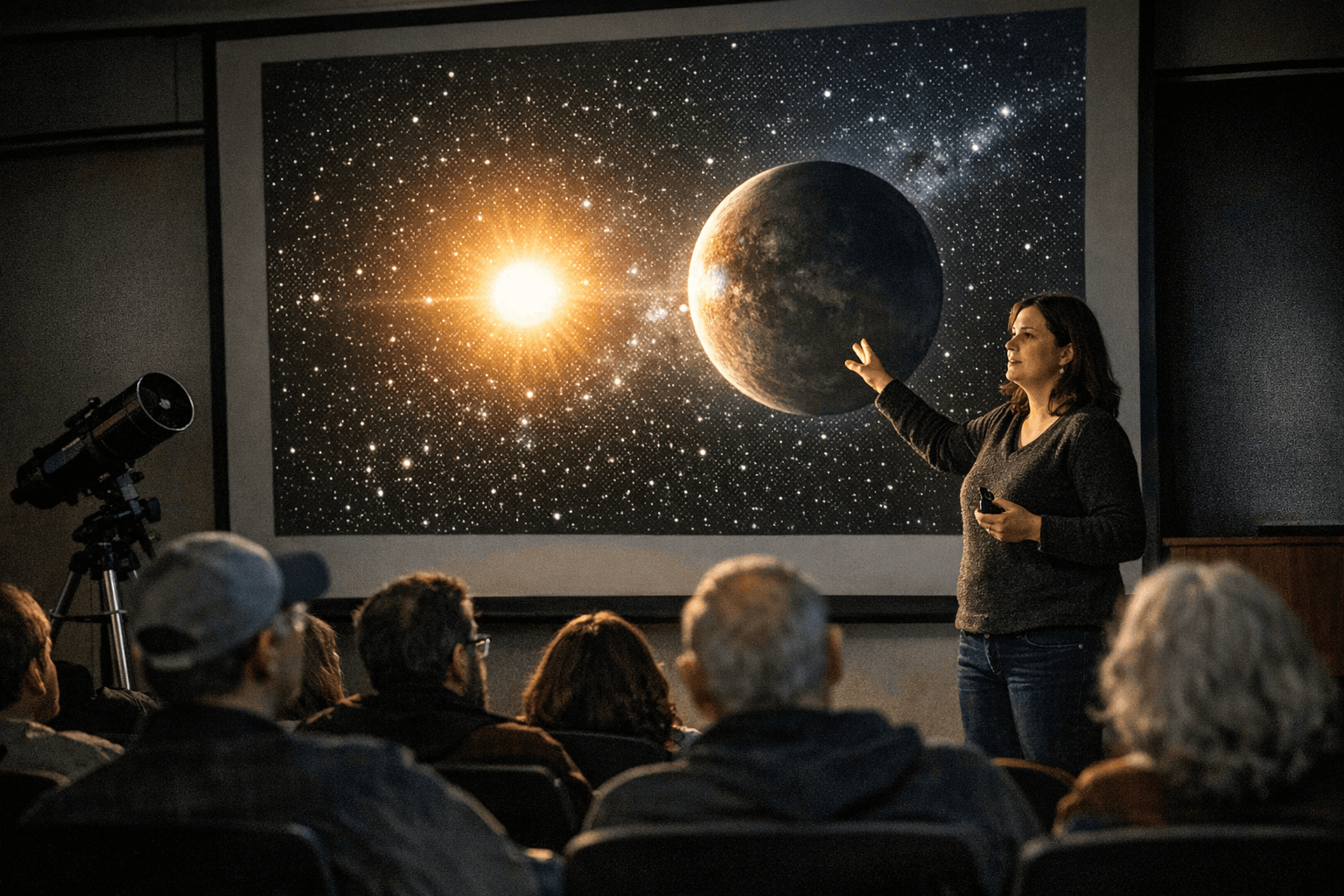
UNM‑Los Alamos announced that Lorraine Bowman, Ph.D., assistant professor of physics at UNM‑LA, will present “Signals in a Sea of Stars: Finding Exoplanets” from 4:00–5:30 p.m. on Tuesday, March 10, 2026, with the single location line in the announcement listed as “Wallace.” The lecture is part of UNM‑Los Alamos’s “My Favorite Lecture” series and the campus notice provides the title, speaker and time but does not include a room number, registration details or whether the event will be livestreamed.
The UNM‑LA announcement lists Bowman’s affiliation exactly as “Lorraine Bowman, Ph.D., assistant professor of physics at UNM‑LA.” The release contains no abstract or planned talking points beyond the event title, and it does not state whether the lecture is free, requires tickets, or is open to the public; the announcement’s limited venue information is the only location detail provided.
Nearby and nationally, recent science seminars have also made significant claims. A NOAA Library Seminar presented by Melanie Prentice, Research Scientist at the Hakai Institute, carried the title “Identifying the bacteria responsible for sea star wasting disease in the sunflower sea star (Pycnopodia helianthoides)” and ran online on December 17, 2025, 2:00–3:00 p.m. ET. NOAA’s seminar text opens with “Beginning in 2013, a prolific epidemic of sea star wasting disease (SSWD) swept the Pacific Coast of North America,” and states that “Today, outbreaks of SSWD in this region continue.” The NOAA material reports that “Across the two dozen asteroid species suspected to be afflicted by SSWD, the sunflower sea star has experienced the greatest losses, >90% of the global population of P. helianthoides has been lost in the last decade,” and it summarizes the research claim: “In this talk we present data leveraged from controlled challenge experiments and natural field outbreaks of SSWD in P. helianthoides to identify Vibrio pectenicida strain FHCF-3 as a causative agent of this disease.” NOAA’s seminar page notes that “Recordings will be shared 24 hours after the event on the NOAA Library YouTube channel,” that captions are available, and provides contacts Nicole Miller (nicole.miller@noaa.gov) and library.seminars@noaa.gov plus subscription instructions for the series.
In Los Alamos Laboratory programming, the Los Alamos Dynamics Summer School is described as “a very selective summer school in which upper-level US-citizen undergraduate students from universities around the nation attend lectures and work in teams of three with a Los Alamos mentor on research projects related to the Engineering Institute’s technology focus.” The LANL material names David Mascarenas, Stuart Taylor, and Eric Flynn as “examples of top-notch alumni who were recruited to the Laboratory with support from LDRD (through Postdoctoral Research and Development projects) and converted to staff,” and it characterizes the program: “The LDRD program is a key resource for addressing the long-term science and technology goals of the Laboratory, as well as enhancing the scientific capabilities of Laboratory staff.”
The LANL excerpt highlights Eric Flynn’s career path and awards with specific lines: “Flynn was converted to an R&D Engineer at Los Alamos in 2013 after joining the Lab as Director’s Funded postdoc in 2011.” It further lists his research areas and honors: “His research focuses on nondestructive testing, signal processing, ultrasonics, applied statistics, optimization and structural dynamics,” and “Flynn won a 2014 R&D 100 Award for the Acoustic Wavenumber Spectrometer (supported by LDRD), leads a 2015 Early Career Project, was recently honored with the Achenbach medal for his contributions in the field of SHM, and was on the team that developed SHMTools.” On program outcomes, Los Alamos Muon Tomography Team Leader Chris Morris is quoted: “Early on, LDRD provided the resources to develop the proof of principle that is foundational to pRad. Now a key capability for maintaining the nation’s nuclear stockpile, pRad is the direct result of the synergy between the Laboratory’s defense mission and basic R&D scientists.”
Taken together, the UNM‑LA lecture announcement for March 10, NOAA’s December 17 seminar findings about sea star wasting disease, and LANL’s summary of the Dynamics Summer School and LDRD outcomes document active scientific programming and workforce development connected to the Los Alamos region. UNM‑Los Alamos supplied the lecture title, presenter and time but listed only “Wallace” as the venue; NOAA provided seminar recordings and contact emails nicole.miller@noaa.gov and library.seminars@noaa.gov; LANL provided the program descriptions and the Flynn and Morris passages quoted above.
Know something we missed? Have a correction or additional information?
Submit a Tip