U.S. and Israeli strikes on Iran send global markets lower, oil surges to $82
U.S. and Israeli attacks on Iran rattled markets Monday: futures fell roughly 1–1.7%, WTI jumped about 9% to $73 and Brent spiked as high as $82, prompting safe-haven flows.

U.S. and Israeli attacks on Iran over the weekend rattled global markets on Monday, pushing stock futures lower, driving oil prices sharply higher and sending investors into Treasuries and gold. S&P and Dow futures fell in a range from about 1.1% to 1.7% depending on the reporting snapshot (AP/ABC; CNBC; Fortune), while U.S. crude (WTI) rose roughly 9% to $73 a barrel and Brent rallied toward $80, spiking as high as $82 in early trading (AP/ABC; The Guardian; Fortune).
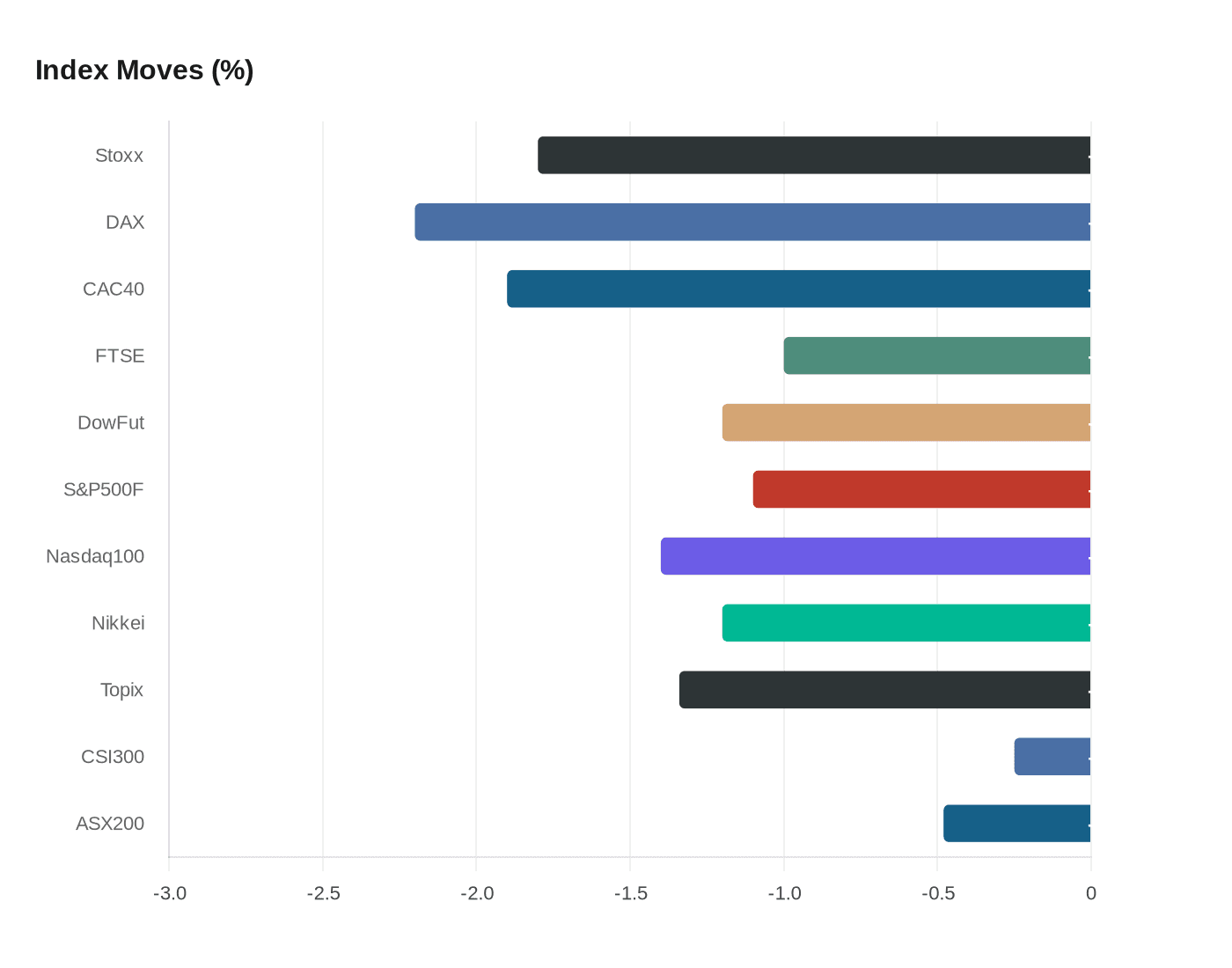
The rout extended across equity markets. The pan-European Stoxx 600 was down about 1.8% in early London trading (CNBC), with Germany’s DAX off 2.2% at 24,737.47 and France’s CAC 40 down 1.9% to 8,413.91 (AP/ABC). Britain’s FTSE 100 slipped about 1% to 10,800.63 in AP/ABC’s midday snapshot while Fortune reported a smaller intra‑day move for the FTSE before lunch. In the United States, CNBC recorded Dow futures falling 576 points, or about 1.2%; S&P 500 futures lost roughly 1.1% and Nasdaq 100 futures declined about 1.4%.
Asia traded lower as well. Japan’s Nikkei 225 fell about 1.2% while the Topix dropped 1.34% according to CNBC and Fortune. Hong Kong’s Hang Seng opened more than 1% lower, mainland China’s CSI 300 was down about 0.25% and Australia’s S&P/ASX 200 lost roughly 0.48% (CNBC; Fortune). In several markets, gains in oil and defense names helped limit broader losses; Norway’s Vår Energi and Equinor each gained more than 9% and led the Stoxx 600 (CNBC).

Commodities and volatility reflected acute supply concerns. Brent’s early spike to $82 represented a 14‑month high in some reports (The Guardian; Fortune). Analysts and traders said markets were pricing the risk that the conflict could disrupt exports through the Strait of Hormuz, a choke point that carries about a fifth of global oil and seaborne gas flows according to The Guardian and SPI Asset Management strategist Stephen Innes, who said, “Roughly one-fifth of global oil and LNG flows squeeze through the Strait of Hormuz. This is not an obscure canal. It is the aorta of the global energy system” (The Guardian; AP/ABC).
Maritime security incidents heightened those worries. The United Kingdom Maritime Trade Operations reported attacks on two vessels in the strait, one off Oman and another off the UAE, as cited by The Guardian. The Guardian also reported Tehran had warned tankers they would not be allowed to pass, and Wood Mackenzie analysts warned the disruption could create a “dual supply shock” that would constrain access to OPEC+ spare capacity while the waterway remained closed.
Risk-off flows were clear in fixed income and volatility gauges. Treasury yields fell as money moved into safer assets, gold futures jumped nearly 3% and the CBOE Volatility Index rose to its highest level of 2026 so far (AP; CNBC). Stephen Innes summed market fragility succinctly: “When markets are fragile, they do not need a knockout blow. They just need another weight on the bar” (AP/ABC).
Markets had partly anticipated escalation after a large buildup of U.S. forces in the region, a factor analysts said muted some effects (AP/ABC). Still, strategists at Wells Fargo warned that a sustained energy shock could produce a sharp downside for equities, and forecasters cautioned that a prolonged conflict would lift fuel and gasoline prices and feed through to broader production costs (CNBC; AP/ABC). A Fortune photo caption dated March 1 linked the strikes to Feb. 28 operations and reported the deaths of Iran’s supreme leader and top military figures; that account is attributed to Fortune/AFP.
This article was produced by Prism’s automated news system from verified source data, official records, and press releases, then run through automated quality and moderation checks before publishing. The system is built and supervised by the people who set the standards it runs under. Read our full AI policy.
Did this article answer your question?
%3Amax_bytes(150000)%3Astrip_icc()%2FCertificate-of-deposit-2301f2164ceb4e91b100cb92aa6f868a.jpg&w=1920&q=75)