U.S. Army Awards Fortem $18M Three-Year AI Counter-Drone Contract
Fortem landed a three-year, $18 million U.S. Army deal to field its SkyDome systems and DroneHunter interceptors, with a first task order worth nearly $4 million.

Fortem Technologies will supply the U.S. Army with its SkyDome Family of Systems and DroneHunter interceptors under a three-year, $18 million contract announced in a February 26, 2026 release, and the company said it has already received a first task order valued at nearly $4 million. The award covers counter-drone solutions and field-support services at Army sites worldwide and names DroneHunter interceptors and related equipment as deliverables.
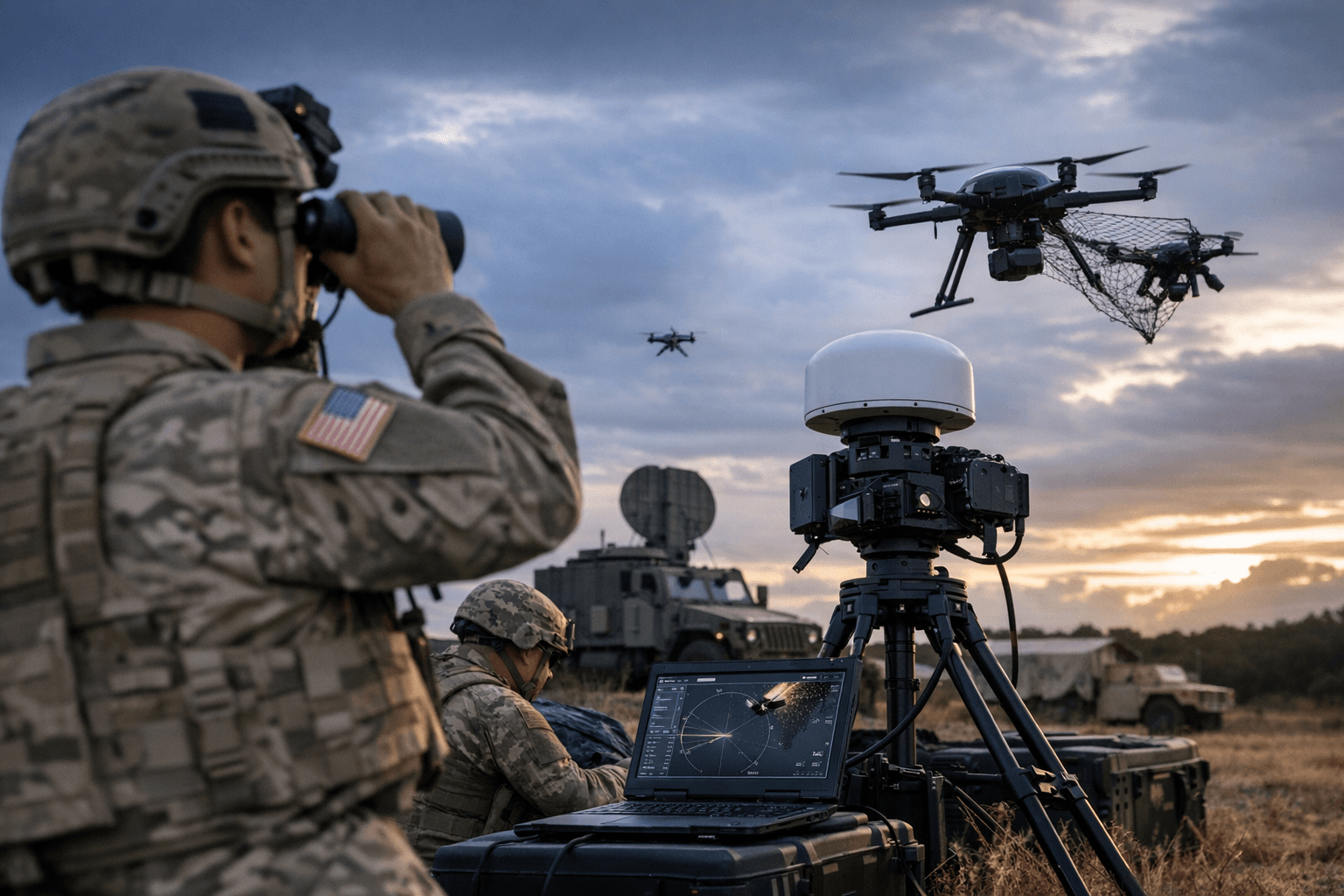
SkyDome is described in the company release as a package made up of TrueView sensors, command-and-control software, and autonomous DroneHunter interceptors that “autonomously capture intruding drones safely with a net, and lower them safely to the ground.” Fortem identified specific DroneHunter variants in coverage: DroneHunter F700 and DroneHunter 5.0, and the company framed the interceptors as an “AI-powered net-capture” approach to countering small unmanned aerial threats.
Fortem and trade outlets highlighted recent demonstrations and operational claims. Fortem announced deliveries of DroneHunter 5.0 and said the system achieved an industry-first 5 on 5 autonomous drone swarm takedown, a capability outlets described as detecting, tracking, and neutralizing multiple hostile drones simultaneously without collateral damage. Dronexl Co framed the award as reflecting “a structural shift in how the Pentagon is thinking about small unmanned aerial threats,” adding the rhetorical line “At 56 miles per hour.”
The company release also recorded operational validation claims for deployments in Ukraine, the Middle East, and East Asia, and included CEO Jon Gruen’s statement: “Protecting soldiers and materiel from the growing drone threat is one of the most urgent defense challenges of our time. This award highlights the U.S. Army’s trust in Fortem’s unique ability to move beyond detection and deliver safe, effective drone interception in real‑world environments.” Fortem described itself as “the global leader in airspace security” and listed headquarters in Lindon, Utah, a privately held status, and investors including Lockheed Martin, DCVC, Toshiba, and AE Industrial Partners.
Trade reporting also tied the Army award to other federal selections that underscore Fortem’s growing footprint. TechBuzzNews reported that the Pentagon selected DroneHunter as its first purchase under the Replicator-2 initiative in January, and DroneXL reported that the Department of Homeland Security authorized Fortem as a kinetic counter-drone provider for U.S. venues during the 2026 FIFA World Cup. DroneDJ summed the operational shift succinctly: “The United States Army is doubling down on a new way to stop hostile drones, not just with missiles or jammers, but with AI‑powered nets in the sky.”
Several claims in the release are company-attributed and flagged for verification, including Fortem’s assertion that it is the only firm authorized to deploy a drone-on-drone kinetic interceptor in U.S. airspace and the specifics behind the nearly $4 million task order. Follow-up questions for the Army, DHS, and Fortem include integration plans for base defenses, the composition and delivery schedule of the initial order, and documentation for the operational deployments Fortem cites. The award cements a low-collateral approach to countering small drones that industry observers say is reshaping procurement priorities across military and public-event security.
Know something we missed? Have a correction or additional information?
Submit a Tip