U.S. small-business confidence slips as more owners plan price increases
More owners plan to raise prices as NFIB optimism slips to 95.3, while hiring and investment plans weaken.
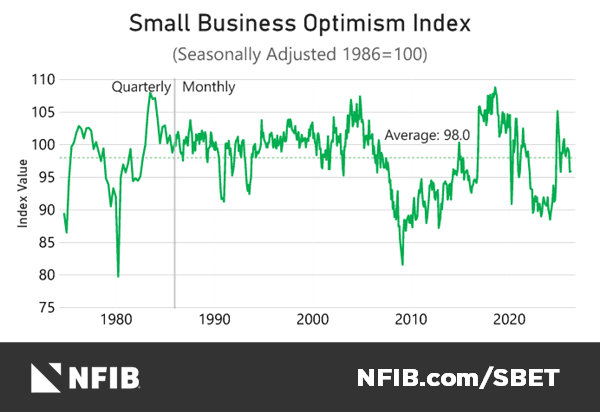
Small-business confidence softened in May even as the broader economy continued to show resilience, underscoring the widening gap between strong headline data and the caution felt on Main Street. The National Federation of Independent Business said its Small Business Optimism Index fell 0.6 point to 95.3, the lowest since October 2024 and still below its 52-year average of 98.0.
The NFIB’s uncertainty gauge moved higher as well, rising 3 points to 91, far above its historical average of 68. That matters because the survey has tracked Small Business Economic Trends quarterly since 1973 and monthly since 1986, making it one of the clearest long-run measures of how entrepreneurs are reading the economy. In May, that reading pointed to a business climate that is uneasy and defensive, not confident.

Inflation pressure remained central to that caution. NFIB said 34% of owners planned to raise prices over the next three months, the highest share since July 2022, while the net share of owners raising average selling prices climbed 6 points to 36%, the highest since March 2023. Another 36% said they had already raised prices, also the highest since March 2023. Those plans came as the U.S. Bureau of Labor Statistics said consumer prices rose 3.8% from a year earlier in April 2026, the fastest annual pace since May 2023, with energy a major contributor.
The pressure is feeding directly into hiring and investment decisions. NFIB said its Employment Index was 100.3 in May, little changed from 100.4 in April and below the 2025 average of 101.2. A seasonally adjusted net 9% of owners expected to create new jobs in the next three months, the weakest reading since May 2020, while 29% reported job openings they could not fill, also the lowest since May 2020. Capital spending plans weakened too, with just 16% planning outlays in the next six months, the lowest since March 2009.

Bill Dunkelberg, NFIB’s chief economist, said artificial intelligence investment spending had added some excitement to the economy, but he said the picture was divided and that more small-business owners were wrestling with significant, unpredictable fuel price increases. Those costs are especially hard for small firms to absorb, and 70% of owners said supply chain disruptions affected their business to some extent, up 6 points from April.

The survey also showed a shifting hierarchy of pain points. Labor quality was cited by 13% of owners as their single most important problem, down 5 points and the lowest since December 2016. Labor costs, by contrast, were named by 14%, the highest reading in the survey’s history. For policymakers, that mix is a warning sign: inflation may be cooling unevenly, but for many small firms, the need to protect margins is still shaping prices, payrolls and plans for growth.
This article was produced by Prism’s automated news system from verified source data, official records, and press releases, then run through automated quality and moderation checks before publishing. The system is built and supervised by the people who set the standards it runs under. Read our full AI policy.
Know something we missed? Have a correction or additional information?
Submit a Tip