U.S. strikes on Iran threaten up to 1.6 million b/d of exports, CSIS says
U.S. strikes raise the risk of cutting Iranian exports and Strait of Hormuz flows, potentially driving oil prices up and raising costs for households and health services.

U.S. strikes on Iran have raised the prospect of disrupting as much as 1.6 million barrels per day of Iranian crude exports, CSIS modeling shows, an immediate supply risk that could push global prices higher and increase fuel costs for households and essential services. Analysts say the scale of the impact depends on whether attacks remain limited to shipments or escalate to strike energy infrastructure.
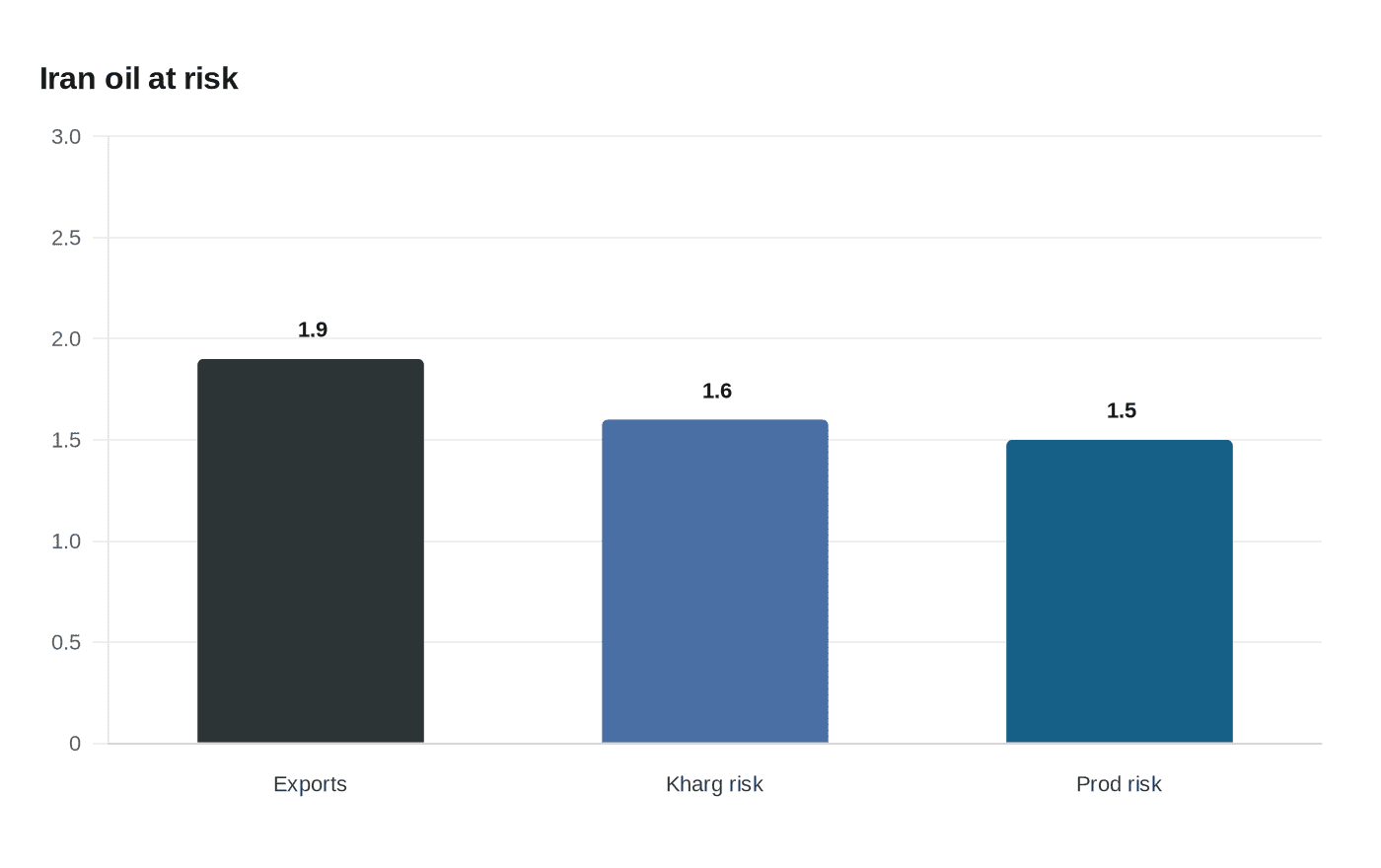
The International Energy Agency, cited by NPR, put Iranian exports at about 1.9 million barrels per day as of December. CSIS frames a narrower vulnerability in its scenario work: up to 1.6 million barrels per day could be disrupted if damage is limited to Kharg, an export terminal, and an additional 1.5 million b/d of domestic production could be at risk if platforms or fields are targeted. CSIS warned that a loss of Iranian barrels would likely prompt China to bid for substitutes and could lift global crude by at least $10 to $12 per barrel in that reversible scenario. If infrastructure is damaged, CSIS projects prices could move above $100 per barrel; a broad attack on Gulf facilities could produce a historic spike potentially higher than the roughly $130 per barrel touched in 2022, CSIS adds.
The Strait of Hormuz remains the central chokepoint. The U.S. Energy Information Administration estimates roughly 20 million barrels of oil and oil products from countries such as Saudi Arabia and Iraq transit the strait each day, a flow NPR notes is about 20 percent of global oil demand. Raad Alkadiri, managing partner at 3TEN32 Associates, summarized market nervousness: "The issue will be sort of what that does in the longer term and the potential spillover effects." NPR also reported that "Halff says a worst-case scenario for oil markets revolves around Iran striking its neighbors."

Markets have already been sensitive to regional fighting. Bloomberg reporting on earlier episodes noted that oil "surged the most in more than three years during the June war, with Brent crude rising above $80 a barrel in London" before gains faded when key infrastructure proved undamaged. Bloomberg and Yahoo Finance also said prices have surged this year and that wider concerns about oversupply had kept longer-term moves in check. NPR cautioned that "trading markets are currently closed, so the effect on oil prices won't be easy to quantify until they open late on Sunday."
Iran exports much of its crude to China, often carried on so-called "shadow ships" that conceal activities to evade sanctions, NPR reported, and the United States has stepped up enforcement against that shadow fleet. CSIS warned insurance and war-risk premiums could keep prices elevated even after any physical supply interruption is reversed, and it likened the reversible loss of shipments to the rebound seen following a past U.S. quarantine on Venezuelan oil shipments.
Possible Iranian responses range from harassment of shipping to GPS jamming, sea mines, and targeted strikes on facilities. Bloomberg and Yahoo Finance noted that nearly 1,000 vessels a day had GPS signals jammed near Iran's coast during last year's fighting, and pointed to the 2019 Abqaiq attack that halted production equal to roughly 7 percent of global supply as a reminder of how regional strikes can spike markets.
Beyond commodity markets, rising oil prices have tangible public health and equity consequences. Higher fuel costs raise prices for food and transport, increase operational costs for hospitals and emergency services, and disproportionately burden low-income and rural communities that spend larger shares of income on energy and transit. Policymakers and health systems will be watching shipping notices, insurance and war-risk premium moves, Chinese buying behavior, and the reopening of trading when markets resume as immediate signals of how sustained any shock may become.
This article was produced by Prism’s automated news system from verified source data, official records, and press releases, then run through automated quality and moderation checks before publishing. The system is built and supervised by the people who set the standards it runs under. Read our full AI policy.
Did this article answer your question?

