Utah expands Supreme Court to seven justices amid redistricting fight
Governor Spencer Cox signed SB134 to raise the Utah Supreme Court from five to seven justices, effective immediately after a supermajority vote; critics warn of timing and cost.
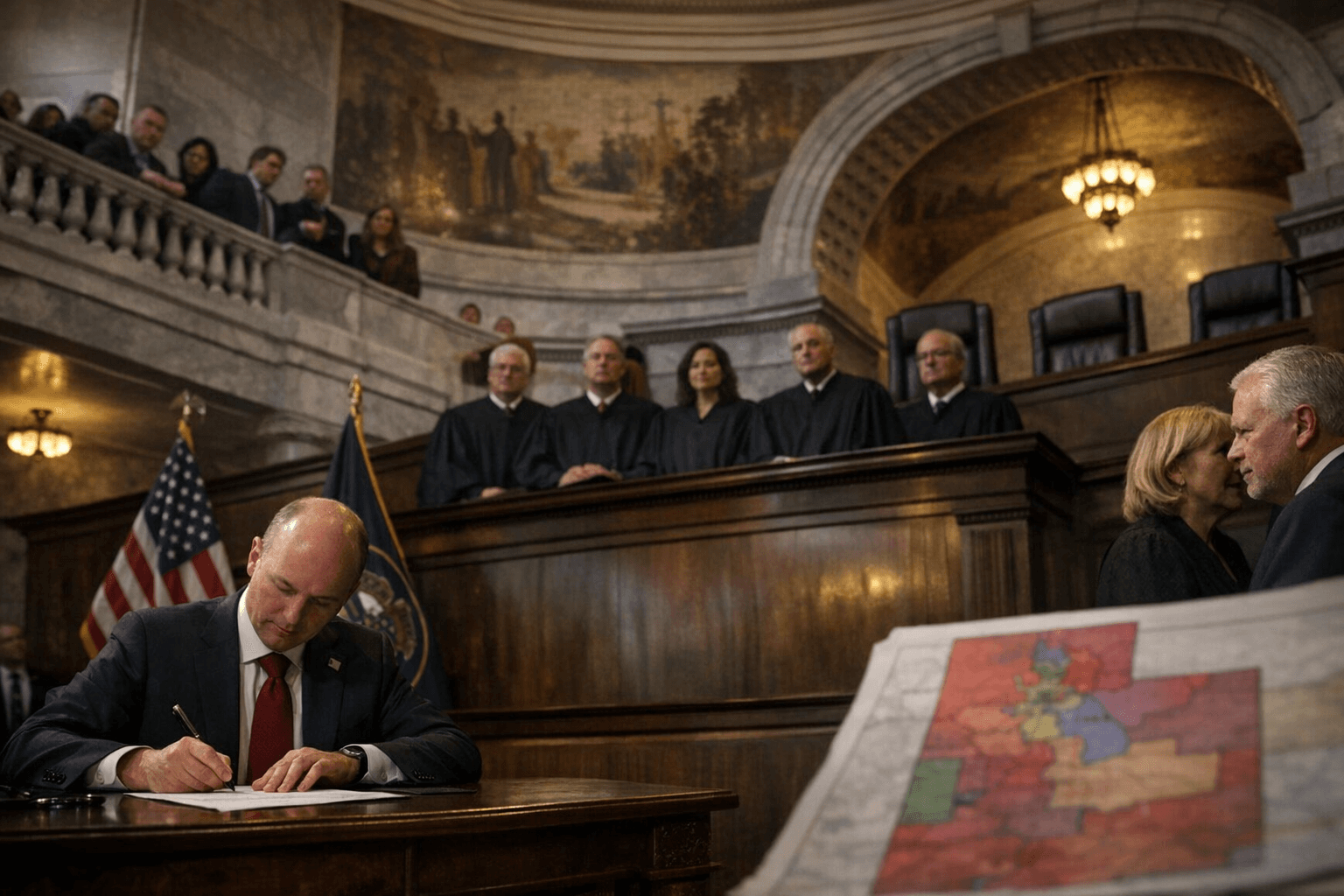
Governor Spencer Cox signed SB134 on Jan. 31, 2026, increasing the Utah Supreme Court from five to seven justices and triggering immediate effect because the measure passed the Legislature with more than a two thirds majority. The House approved the bill 57 to 18, and sponsors said the expansion responds to growing demands on the judiciary while also adding judgeships in lower courts.
SB134 does more than enlarge the high court. It increases the number of judges on the Utah Court of Appeals, creates one additional district court judgeship each in Salt Lake City, St. George and Provo, and provides for extra clerks and staff that sponsors added after earlier criticisms. The appointments to the two new Supreme Court seats are controlled by the governor and must be confirmed by the state Senate. Once Gov. Cox fills the openings, he will have appointed five of the seven sitting justices.
Republican backers framed the measure as an administrative reform to improve efficiency and to align Utah’s judiciary with peers in similarly sized states. Sen. Chris Wilson called SB134 the “biggest commitment” Utah lawmakers have made to their law‑interpreting counterparts. Rep. Casey Snider said he hopes public perception sees the bill as “in the spirit with which it is offered, which is that of one in hopes of being helpful.” Gov. Cox denied the change was politically motivated and said additions would put the state in line with others of its size.
Democrats and judicial observers pushed back, warning that the timing and cost raise questions about motive and priorities. Rep. Grant Amjad Miller said he voted against the bill despite supporting some provisions, arguing the expansion represents “the great expense” and that the judiciary had not asked for additional Supreme Court justices: “Nowhere in their wish list have they asked for two Supreme Court justices.” Rep. Andrew Stoddard said adding more judges could complicate the process.
Chief Justice Matthew B. Durrant told legislators the high court had “essentially no backlog” and urged lawmakers to shift resources to lower courts where case loads are heavier. The Utah State Bar raised concerns that the expansion and related proposals could weaken judicial independence, and legal experts warned that enlarging a court bench amid interbranch tension could be counterproductive to efficiency.
The enactment comes as the Legislature prepares an appeal in a redistricting case that could reshape Utah’s congressional map and give Democrats a chance at one of the state’s four House seats. Observers noted that new justices could be seated in time to weigh that appeal, a prospect Democrats called suspicious and critics say could affect both political control and policy predictability. Republicans are also pursuing a ballot initiative path aimed at altering how districts are drawn.
Key fiscal details were not released with the vote. Legislators and analysts will need the bill’s fiscal note and the Office of the Legislative Fiscal Analyst’s estimates to quantify the ongoing personnel and operating costs of enlarging the courts. Beyond immediate budget pressures, the shift raises longer term questions about judicial independence, institutional norms and the role of state courts in politically charged disputes, factors that can influence investor confidence and the policymaking environment over multiple election cycles.
The next steps are procedural. Gov. Cox may begin nominating candidates immediately and the Senate will consider confirmations; no timeline for those actions has been announced.
This article was produced by Prism’s automated news system from verified source data, official records, and press releases, then run through automated quality and moderation checks before publishing. The system is built and supervised by the people who set the standards it runs under. Read our full AI policy.
Did this article answer your question?