Venus Williams granted Australian Open wild card, set to make history at 45
Venus Williams received the eighth and final women's wild card into the 2026 Australian Open, poised to become the oldest woman to play the tournament’s singles main draw. Her return reshapes narratives about longevity, legacy and marketability in women’s tennis.

Venus Williams has been awarded the final women’s singles wild card into the 2026 Australian Open, tournament organisers announced, a move that will make the 45-year-old seven-time major champion the oldest woman to compete in the event’s main draw. The Australian Open frames the milestone as an event-specific record, surpassing Kimiko Date, who was 44 when she played Melbourne Park in 2015.
Williams’s return to Melbourne Park will be her 22nd main-draw appearance at the Australian Open, where she owns a 54-21 record. Her history at the tournament stretches back to 1998, when the 17-year-old Williams beat sister Serena in the second round and reached the quarterfinals before losing to Lindsay Davenport. She has been runner-up twice at the Australian Open, losing finals to Serena in 2003 and 2017.
This wild card follows a comeback that began in July 2025 after roughly 16 months away from tour competition. Williams collected a notable tour-level singles win at the Mubadala Citi DC Open, beating Peyton Stearns 6-3, 6-4, and later reached the quarterfinals of the US Open doubles alongside Leylah Fernandez. She returned to the hard-court swing in the southern hemisphere with wild cards in Auckland and Hobart; she lost in the first round in both events, falling to world No. 53 Magda Linette in Auckland and to 38-year-old Tatjana Maria in Hobart in a match noted for one of the highest combined ages in WTA history.
Williams will use the Hobart International as a final warm-up before Melbourne Park, having accepted a Hobart wild card and the organisers’ invitation to play the week prior to the Australian Open. The tournament runs Jan. 12 to Feb. 1, and organisers placed Williams among late additions intended to strengthen the main draw as matches progress and storylines develop.
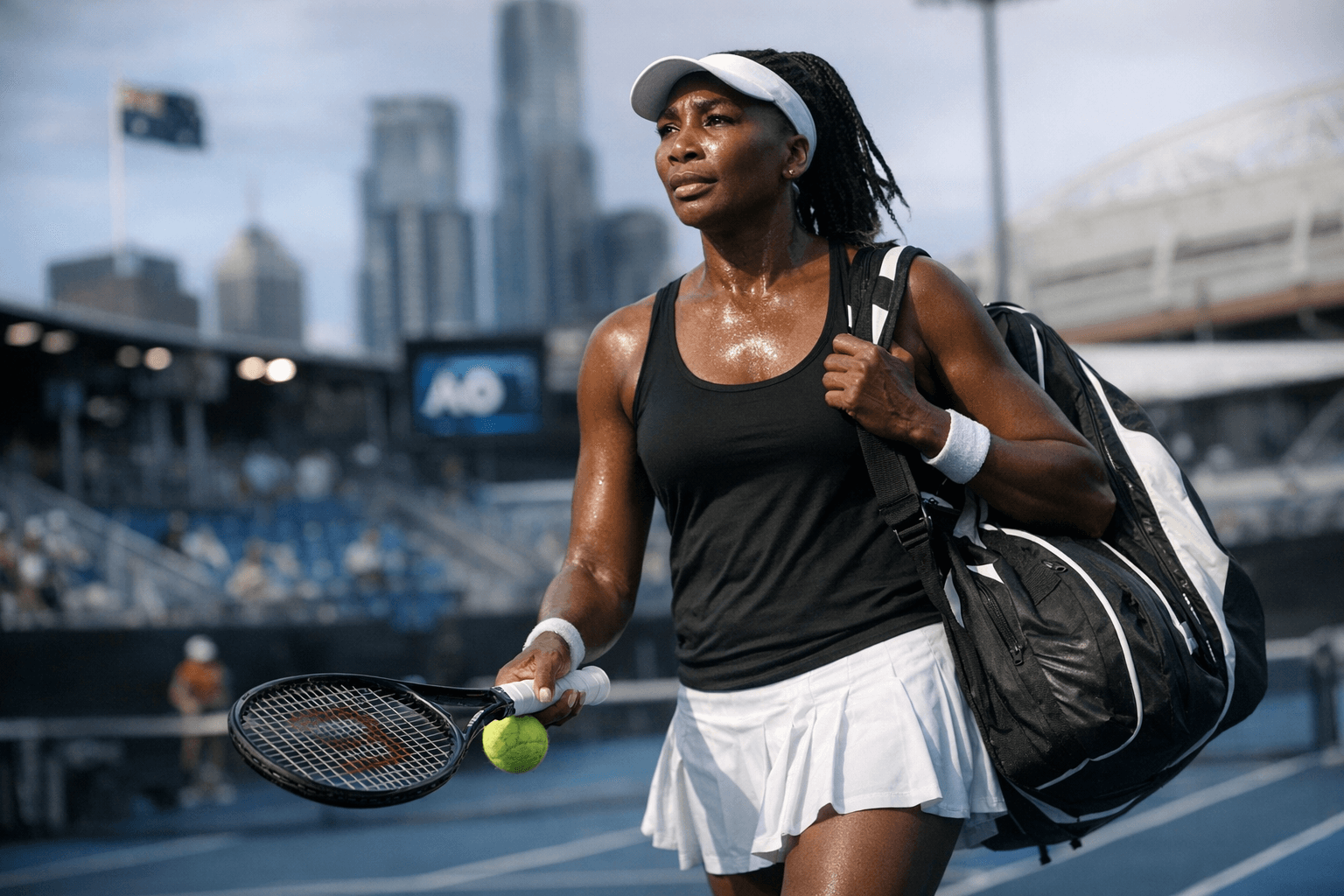
The sporting significance of Williams’s return is clear: she remains a standard-bearer for longevity in a sport defined by early peaks and rapid turnover. Her presence at Melbourne Park is likely to amplify attention on the first two weeks of the tournament and to create commercial value for broadcasters and sponsors who have long associated her with the sport’s global growth. Her marriage in late December 2025 to Andrea Preti in Palm Beach, Florida, adds a personal chapter to the comeback narrative that will draw lifestyle as well as sports interest.
Peers greeted the announcement as a celebration of career durability and cross-generational appeal. “I’m excited to be back in Australia and looking forward to competing during the Australian summer. I’ve had so many incredible memories there, and I’m grateful for the opportunity to return to a place that has meant so much to my career,” Williams said in tournament social posts and news reports. World No. 3 Coco Gauff called Williams “a legend of the sport” and said “it will be cool to see her back in action,” underscoring the symbolic continuity between a pioneer generation and rising stars.
Beyond headlines, Williams’s wild card spot spotlights broader trends in women’s tennis: evolving attitudes about career length, strategic use of wild cards to boost experience and viewership, and an increasing willingness of tournaments to showcase veterans alongside emerging talent. Her return to Melbourne Park will test how performance, history and market dynamics intersect when a global icon seeks one more run at a major title.
This article was produced by Prism’s automated news system from verified source data, official records, and press releases, then run through automated quality and moderation checks before publishing. The system is built and supervised by the people who set the standards it runs under. Read our full AI policy.
Did this article answer your question?