Venus Williams Granted Wildcard to Become Oldest Australian Open Competitor
Venus Williams was awarded a main-draw wildcard for the 2026 Australian Open, a decision that will make the 45-year-old the oldest woman to compete at Melbourne Park and adds a high-profile narrative to the tournament. Her return, following wildcard appearances in Auckland and Hobart, underscores shifting norms around longevity in women's tennis and carries commercial and cultural weight beyond the scorelines.

Tournament organisers announced on 2 January 2026 that Venus Williams has been awarded a wildcard into the main draw of the Australian Open, setting up a return to Melbourne Park that will reframe the early slam of the season. The tournament begins on 18 January, and Williams, at 45, will become the oldest woman ever to compete in an Australian Open main draw, surpassing Japan’s Kimiko Date, who was 44 when she played in 2015.
Williams’s wildcard closes a chapter that began with her first Melbourne appearance in 1998, a debut that saw her defeat her younger sister Serena in the second round before falling to Lindsay Davenport in the quarterfinals. Her career at the Australian Open has included two finals, in 2003 and 2017, both times finishing runner-up to Serena. Her most recent Melbourne outing was in 2021, when she lost to Italy’s Sara Errani in the second round. Across a career that spans three decades, Williams is a seven-time Grand Slam singles champion and a figure whose influence has extended beyond the baseline.
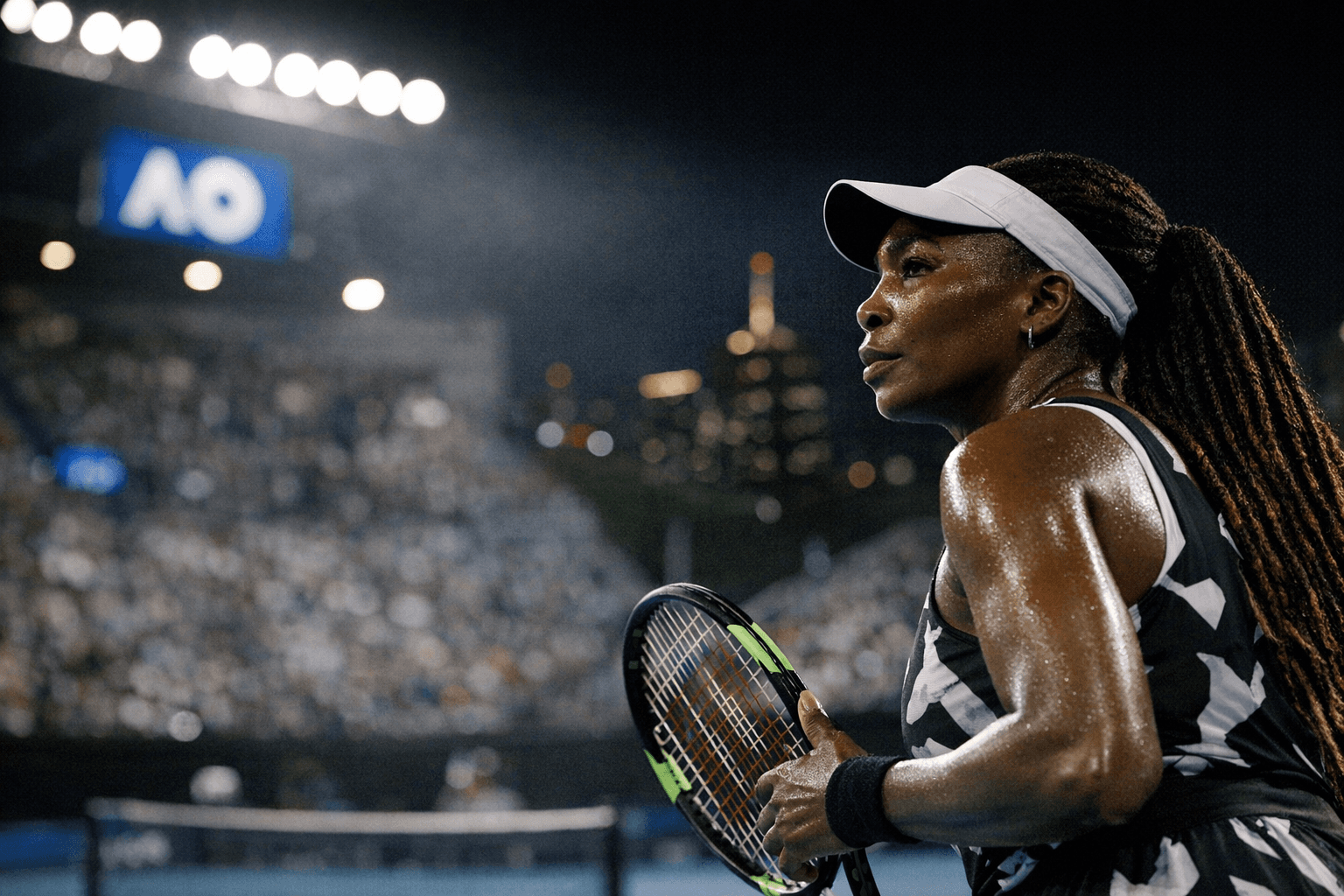
The wildcard is part of a deliberate lead-up program. Williams accepted wildcards into Auckland, scheduled roughly two weeks before the Australian Open, and into the Hobart International, which begins on 12 January. Those entries are designed as match practice in the short Australian summer swing and to provide additional competitive rhythm before Melbourne Park.
The competitive significance of Williams’s return is measurable but symbolic weight may be greater. On paper, a 45-year-old in the main draw faces long odds against the tour’s top-ranked, younger opponents. In practice, her presence changes the tournament’s arc: draws, broadcasting slots, ticket sales and media attention will be affected by her name and legacy. Organisers have long used wildcards to balance sporting integrity and spectacle; this allocation underscores the continuing commercial calculus that elevates veteran stars alongside rising talents.
Beyond dollars and ratings, Williams’s wildcard has cultural resonance. Her career has been central to the diversification and globalization of tennis, and her longevity reframes conversations about age, gender and athletic prime in women’s sport. “I’m grateful for the opportunity to return to a place that has meant so much to my career,” she said, capturing the personal dimension of a return that links her early breakthrough to a late-career chapter. For younger players, her decision to compete signals a model of sustained professionalism and adaptive scheduling that increasingly characterises the WTA Tour.
The entry also touches on broader industry trends: advances in sports medicine, individualized scheduling, and a marketplace that rewards star power make extended careers more feasible and commercially attractive. As tournaments balance the meritocratic logic of ranking-based entry with the commercial benefits of marquee names, Williams’s wildcard will be scrutinised both as a sporting experiment and as a barometer of how tennis values experience against emerging talent.
Whether the 2026 Australian Open will add another memorable run to Williams’s résumé or simply provide a ceremonial capstone, her return guarantees a storyline that transcends match results and invites reflection on the evolving life cycle of elite athletes.
This article was produced by Prism’s automated news system from verified source data, official records, and press releases, then run through automated quality and moderation checks before publishing. The system is built and supervised by the people who set the standards it runs under. Read our full AI policy.
Did this article answer your question?
.jpg&w=1920&q=75)