Verify Hyped Sneakers: Check SKU Codes, Match Boxes to Retailer Listings
Start by matching the SKU on the box to the retailer listing and confirm the UPC — these two codes catch the bulk of fakes before you buy.

Practical evergreen guide (no publication date): a concise, high‑utility checklist designers, buyers and resellers use to confirm authenticity before purchase."
1. Check the SKU/style code — match the box to official retailer listings
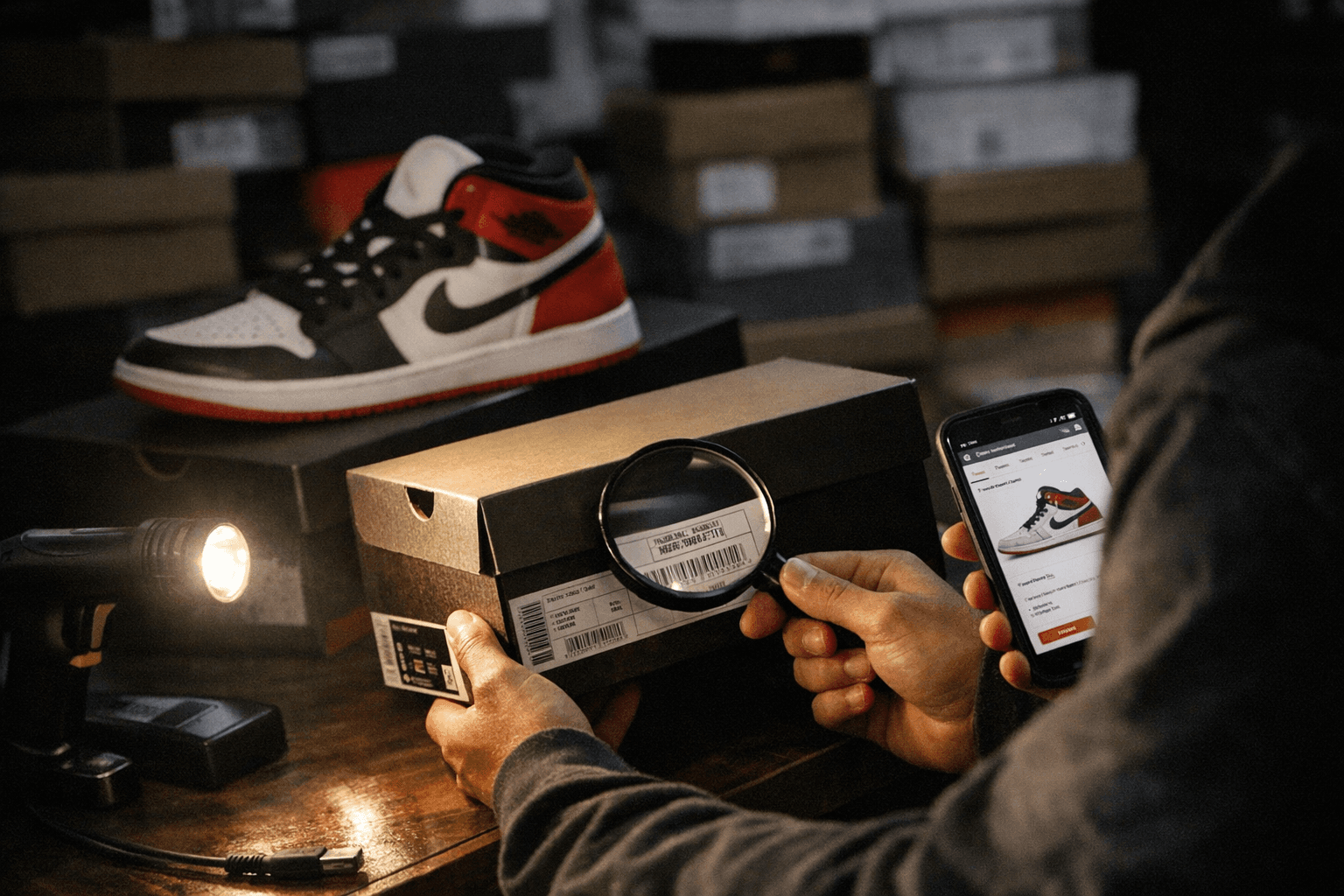
Verify the SKU or style code printed on the shoebox against official brand images and retailer product pages before you commit. The Original Report's first step is explicit: "Check SKU/style code — verify the code on the box matches official brand images and retailer listings." That means copy the full code from the box and compare it character for character with the brand or store listing; any mismatch — extra digits, different hyphenation, or a missing prefix — is a red flag. Treat the SKU as your first line of defense: reputable retailers and brand product pages rarely mislabel a code, so a mismatch usually indicates the seller supplied a different box or a swapped label.
2. Confirm the UPC and compare tags
"Tags are among the most common mistakes with replica sneakers. Few things can give away authenticity quicker." Start by confirming the UPC barcode on the box and tag: "The first thing you should do is confirm the UPC code. This number will be the same for EVERY shoe of the same size." Use the Goat app to scan and compare UPCs, or compare tags directly with a friend who owns a confirmed pair. If the UPC on the box and the UPC on the shoe tag disagree — or if the UPC doesn't correspond to the model and size listed by retail pages — consider it a major strike against authenticity.
3. Inspect production information and plant codes
"Next is the production information. All manufactured products are held to regulations. Shoes are made in specific plants (XC), within specific dates and contain uniform production numbers (bottom left). The numbers should be relatively close for all productions within the same plant (for large releases there are multiple plants)." Look for production codes and dates on the sewn-in tongue tag, inner label or box label and confirm they follow the expected format for that brand. Production numbers that are wildly different between supposedly identical pairs, or plant codes that don't match known examples, usually mean the pair was mixed from different runs — a common replica giveaway.
4. Inspect materials an...
The Original Report’s second step begins "Inspect materials an" but the text is truncated and the remainder is not provided. Because the source terminates here, do not assume the missing guidance — instead treat this as a mandatory follow-up item: physically check leather grain, stitching, glue, foam density and scent against known authentic examples and documented brand standards once you retrieve the full guidance. Note for journalists and meticulous buyers: obtain the full Original Report to replace this placeholder with its intended, explicit materials checklist.
5. Do your research — stop relying on hearsay
"### Step 5: Do Your Research" — "This is an important step that many people overlook. Stop relying on the opinions of others to verify your purchase. Watch some tutorials, study your current inventory, go to a sneaker shop... Don't ask random friends and Facebook peers." Do the homework: watch video tutorials, study your warehouse of confirmed pairs, and go into a brick-and-mortar sneaker shop where staff handle releases daily. "Leave speculation to the people who take the time to research these items. It is far too often I see online groupies yelling "fake", "FUFU" and "reps." If they can't give you a reason why, don't trust their opinion." In short: trained, documented observation beats loud, unsubstantiated claims in comment threads.
6. Use consignment shops as a free legit check
"If you really want to know if a shoe you purchased is fake, bring it to a consignment shop and tell them you're interested in selling. Don't tell them you are unsure of the legitimacy, let them do the leg work. Sit back and enjoy your free legit check. They won't buy a fake shoe!" Professional consignment buyers inspect provenance, tags and construction every day, and their livelihoods depend on not accepting fakes. Take the shoes in as if you’re consigning — they'll often point out inconsistencies you’d miss at home and refuse to take anything that fails their checks.
7. Treat receipts and the paper trail with caution
"A receipt does not mean that something is authentic. In fact, fake receipts get passed around the internet frequently. However, if someone has a receipt with their name on it, it's a good start." Ask the seller if they personally bought the shoes and request proof of purchase tied to a name or reward account. Remember: "In today's day and age, it is nearly impossible to escape a purchase without any form of receipt.With shoes, nearly every store offers reward programs. They ask for email, send confirmations, ask for blood type, requests social security, asks for waist measurements, ACT scores... The paper trail is endless. So ask the seller if they purchased the shoes themselves. If they say yes, ask to see proof of purchase." A personalized receipt and matching reward-program confirmation make forgery harder and strengthen the seller’s claim.
8. How SKU, UPC and physical checks fit together
Both SKU/style codes and UPCs are independent identifiers to verify: the Original Report focuses on SKU/style code matching to retailer listings while Hypestew emphasizes the UPC and tag comparisons. Reconciliation is simple in practice — check both. If the SKU on the box matches the brand's retail listing but the UPC on the tag points to a different model or size, you have a mismatch that deserves deeper inspection. Use the SKU to confirm model and colorway on retailer pages and the UPC/tags to confirm production and size consistency.
- Tag swaps and label misprints: "Tags are among the most common mistakes with replica sneakers."
- Overreliance on crowd opinion: don't trust someone yelling "fake" without specifics — "If they can't give you a reason why, don't trust their opinion."
- Forged receipts: "fake receipts get passed around the internet frequently."
- Plant/production anomalies: production numbers should cluster for the same plant and run; inconsistent numbers suggest mixing parts from different batches.
9. Common pitfalls to watch for
10. What we still need to confirm (follow-up items)
The excerpts leave several explicit gaps you should resolve before publishing or before relying entirely on the checklist: the Original Report cuts off at "Inspect materials an" and Hypestew includes bracketed omissions ("[...]") that may contain more checks. Clarify exactly what "bottom left" refers to for production numbers, whether "(XC)" is an example format or a real plant code, and brand-specific variations in tag layout. These unresolved items matter — material inspection protocols and precise tag locations are the difference between a solid buy and a costly mistake.
Final word If you only do two things before you hit purchase, copy the SKU/style code from the box and confirm it with retailer listings, then scan and compare the UPC on the tag with a trusted app or a verified pair. Add a pro legit-check (consignment shop) when in doubt, and treat receipts and loud online opinions as supporting evidence — never the final answer. Armored with SKU, UPC and a little offline verification, you’ll turn the odds in your favor every time you shop hyped drops.
Know something we missed? Have a correction or additional information?
Submit a Tip