Washington follows Beijing’s AI policy playbook
Washington is embracing Beijing-style AI controls, from procurement rules to industrial planning, as the real contest shifts to governance, not nationality.
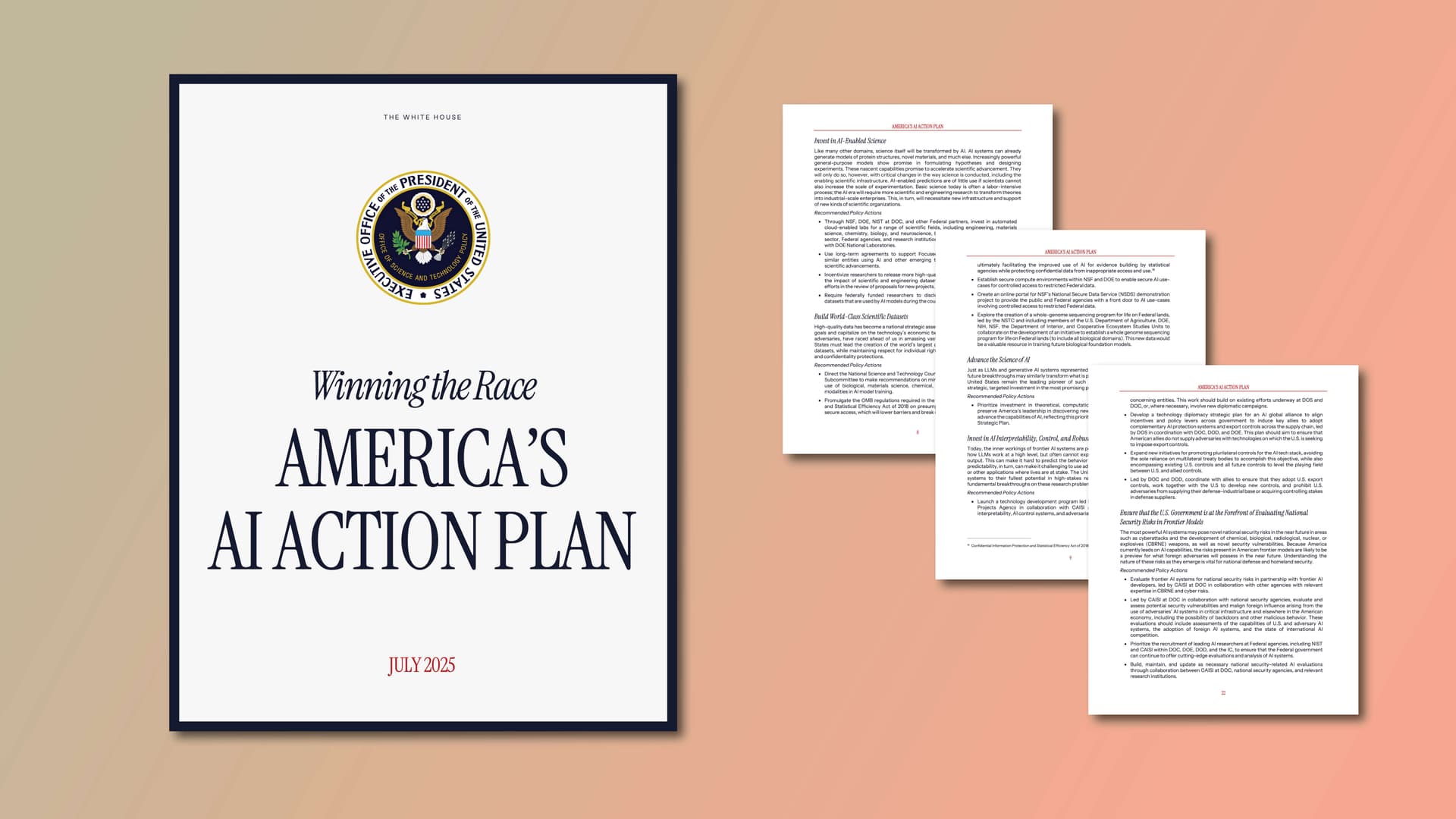
The White House’s July 2025 AI Action Plan maps more than 90 federal policy actions across innovation, infrastructure, and international diplomacy and security. OMB’s April 2025 guidance created a high-impact AI category and pushed agencies toward tighter procurement and oversight. That approach increasingly resembles Beijing’s long-standing habit of pairing promotion with rules on acceptable use, safety reviews, and standards-setting.
Washington’s new industrial policy for AI
The shift began with President Donald Trump’s January 23, 2025 order removing barriers to American leadership in artificial intelligence, followed by OMB Memorandum M-25-21 on April 3, 2025. That memo told agencies to accelerate AI use while keeping privacy, civil rights, and civil liberties in view, and it gave chief AI officers a central role in agency-wide adoption, spending, and risk management. It also pushed agencies toward performance-based procurement techniques, an online shared repository of AI resources, and maturity assessments to track progress.
Washington is also using diplomacy as a market-shaping tool. The State Department’s enterprise data and AI strategy frames data and AI as part of an American First foreign policy, and the department’s current Pax Silica effort is building an AI and supply chain security coalition around compute, minerals, and allied capacity. At the June 26, 2026 summit in Washington, ten additional partners joined the Pax Silica Declaration, including Argentina, Chile, Costa Rica, El Salvador, the European Union, Germany, Greece, Kazakhstan, the Netherlands, and Panama.
Beijing’s long-running mix of promotion and control
China has been doing this longer and more explicitly. In July 2023, regulators issued interim rules for generative AI services, and earlier algorithm recommendation rules barred systems from generating fake news, spreading unauthorized information, influencing public opinion, evading supervision, or engaging in monopoly and unfair competition. The same rules also pushed providers to promote mainstream values, making clear that AI development would be judged not only by technical performance but by political and social compliance.
That regulatory structure has only deepened. In 2024, Chinese authorities set a goal of formulating more than 50 national and industrial AI standards by 2026, and in 2025 Beijing published a Global AI Governance Action Plan along with an AI Capacity-Building Action Plan aimed at helping the Global South develop AI infrastructure and interoperability. In 2025 and 2026, the State Council’s “AI Plus” push extended the policy into science, industry, consumption, services, governance, and global cooperation, with a target of deep integration across six key sectors and a penetration rate above 70 percent for next-generation intelligent terminals and AI agents by 2027.
Where the playbooks converge
The clearest overlap is in the willingness to steer strategic technology rather than merely regulate after the fact. In May 2025, the Commerce Department’s Bureau of Industry and Security warned that access to advanced computing chips used to train AI models can enable military-intelligence and weapons-of-mass-destruction end uses in China and Macau, and it moved to tighten semiconductor controls even as it rescinded the Biden-era AI diffusion rule. The White House then followed with an executive order to promote full-stack American AI exports and another order to accelerate permitting for data-center infrastructure, including the transmission lines that power it.
China’s own 2026 enforcement posture looks strikingly similar in form, if not in ideology. Regulators launched a campaign to clean up improper AI content, examining model registration compliance, safety review mechanisms, and the security of training datasets, while a separate April 2026 ethics guideline from ten government departments focused on human well-being, fairness, justice, controllability, and trustworthiness. In June 2026, Beijing also issued 17 measures to speed “AI plus consumption,” pushing AI deeper into consumer markets rather than leaving adoption to private demand alone.
What it means for companies and civil liberties
For companies, the practical message is that AI strategy now has to include policy compliance at the design stage. In the United States, agencies are being pushed to classify and scrutinize high-impact AI, buy through performance-based procurement, and document adoption maturity; in China, firms face registration checks, safety reviews, dataset scrutiny, standards compliance, and content controls.
The civil-liberties risk is that both systems are now explicit about acceptable AI behavior, but they define acceptability differently. Washington frames its federal AI push around protecting privacy, civil rights, and civil liberties, and the White House’s AI Action Plan also includes a line item on frontier AI protecting free speech and American values; Beijing’s framework emphasizes human control, mainstream values, and protection from misuse.
The global AI contest is becoming a race between governance architectures. Washington is building allied coalitions like Pax Silica and AI Opportunity Partnership, while Beijing is advancing global governance plans and capacity-building efforts aimed at shaping the rules of access, interoperability, and control.
This article was produced by Prism’s automated news system from verified source data, official records, and press releases, then run through automated quality and moderation checks before publishing. The system is built and supervised by the people who set the standards it runs under. Read our full AI policy.
Know something we missed? Have a correction or additional information?
Submit a Tip