Webb unveils most detailed contiguous dark-matter map to date
JWST imaging produced the largest, highest-resolution contiguous dark-matter map, revealing filamentary cosmic-web structure and faint galaxy groups.
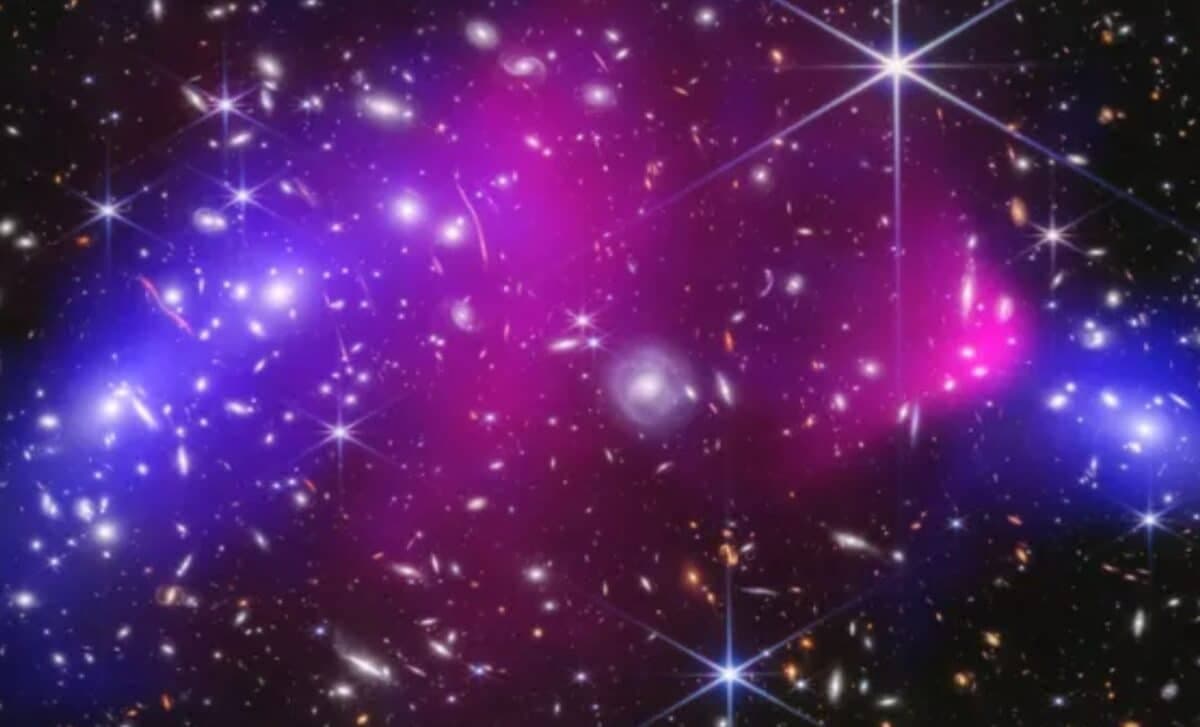
Astronomers have used imaging from the James Webb Space Telescope to reconstruct the largest, highest-resolution contiguous map of dark matter yet, revealing a detailed skeleton of the cosmic web and previously unseen faint structures. Published in Nature Astronomy on Jan. 26, the study used 255 hours of JWST observations from the COSMOS-Web survey to probe a contiguous 0.54-square-degree patch of sky in the constellation Sextans, an area roughly 2.5 times the apparent size of the full Moon.
The team identified nearly 800,000 galaxies in COSMOS-Web imaging and used shape and position measurements of roughly 250,000 background galaxies to perform a weak gravitational lensing reconstruction of the projected mass across the field. Weak lensing measures the subtle warping of galaxy shapes by foreground mass, allowing researchers to infer the distribution of invisible matter that dominates the universe’s mass budget. In the released figures the dark-matter reconstruction is shown in blue; the annotated JWST image is credited to NASA/STScI/J. DePasquale/A. Pagan.
The JWST-based map attains about twice the spatial resolution of previous dark-matter maps of the same region, including earlier Hubble reconstructions. That sharper view exposed filamentary bridges and dense nodes where galaxy clusters sit, along with clumps and low-mass galaxy groups that had been too faint or diffuse to detect reliably with earlier telescopes. The map also clarified how invisible dark matter overlaps and intertwines with the distribution of luminous galaxies, reinforcing the view that galaxies and gas form along an underlying dark-matter scaffold.
Diana Scognamiglio of NASA’s Jet Propulsion Laboratory, the paper’s lead author, described the result as “the largest dark matter map we’ve made with Webb, and it’s twice as sharp as any dark matter map made by other observatories.” Kartaltepe serves as principal investigator of the COSMOS-Web survey, and the project builds on decades of multiwavelength observations in the COSMOS field, including luminous-structure studies led by Bahram Mobasher and earlier Hubble-based mapping work from 2007 by Richard Massey with coauthor Jason Rhodes of JPL.
Researchers say the new map serves as a high-resolution case study rather than a comprehensive cosmological survey. JWST’s strength lies in depth and clarity over modest sky areas; it does not survey the broad swaths that will be needed to constrain cosmological parameters and test alternative gravity models at the population level. That broader work is expected to come from upcoming wide-field missions such as the European Space Agency’s Euclid and NASA’s Nancy Grace Roman Space Telescope, which will apply similar weak-lensing techniques across much larger fractions of the sky.
Public reaction to the release was immediate, with images and discussions circulating on social platforms and sparking renewed public fascination with cosmic structure. For researchers, the map offers a laboratory for studying how galaxies form and evolve within their dark-matter environments, and for testing models of structure formation at fine spatial scales. As imaging and analysis techniques continue to improve, scientists expect that higher-resolution case studies like this will combine with wide-area surveys to produce a far more complete picture of the cosmic web that shapes our universe.
This article was produced by Prism’s automated news system from verified source data, official records, and press releases, then run through automated quality and moderation checks before publishing. The system is built and supervised by the people who set the standards it runs under. Read our full AI policy.
Did this article answer your question?


