Whitmer thanks President Trump for “historic investments,” signaling bipartisan economic shift
Gov. Gretchen Whitmer publicly thanks President Trump for historic investments in Michigan, a rare bipartisan nod that could calm investor concerns and hasten project rollouts.
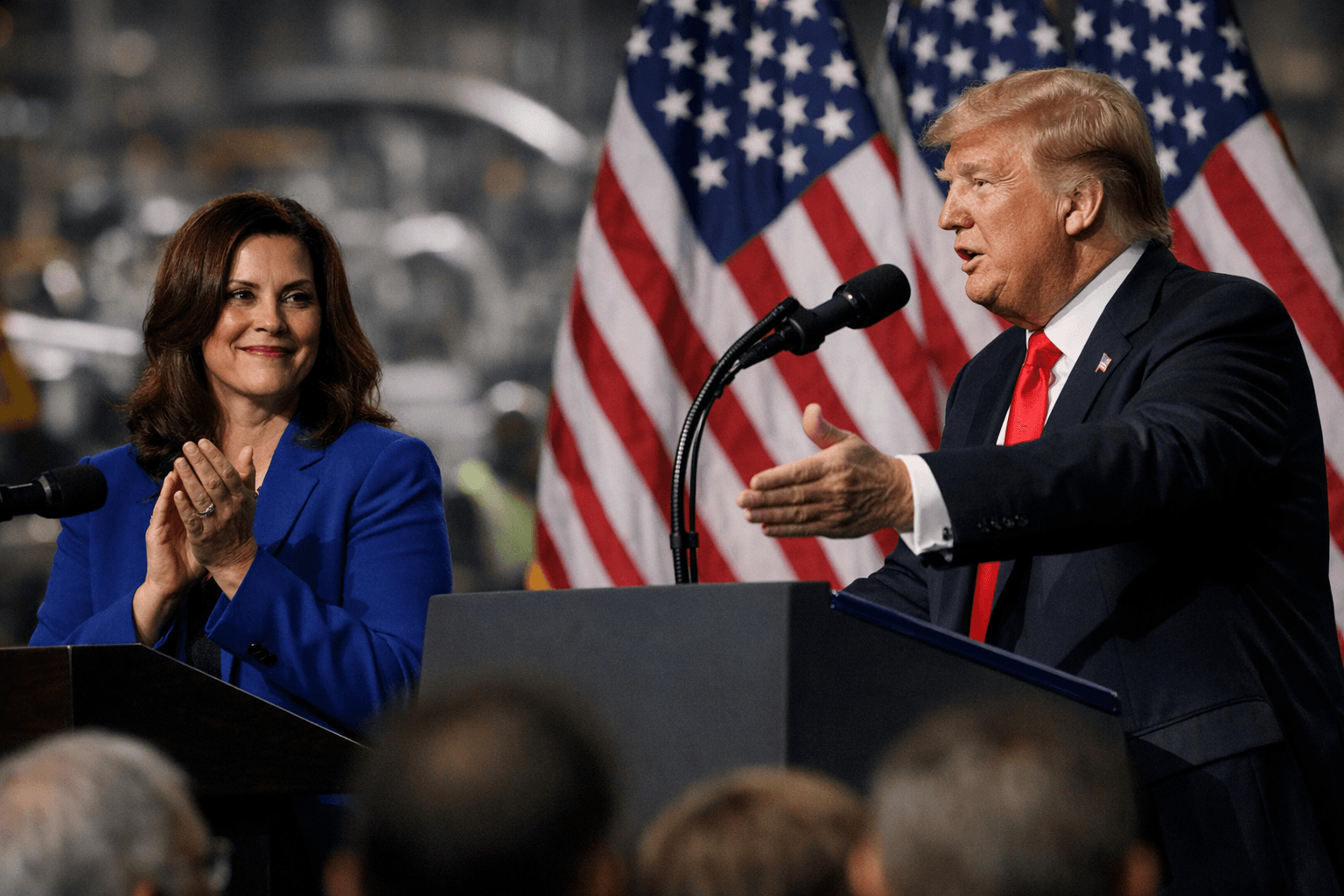
Gov. Gretchen Whitmer surprised a crowd of state and business leaders Thursday by publicly thanking President Trump for what she described as historic investments in Michigan, a bipartisan gesture that punctured the usual partisan script and immediately refocused attention on economic outcomes rather than politics.
The acknowledgement came during a speech in which Whitmer credited recent federal commitments with helping secure major projects and supply-chain work tied to Michigan’s manufacturing base. Her remarks, unexpected from a high-profile Democrat, underscore a practical alliance around jobs, factory investment and infrastructure that both parties increasingly see as central to regional competitiveness.
The short-term consequence is pragmatic: state and local officials now have a clearer political runway to move projects through permitting and workforce programs without the friction of overt partisan opposition. For investors and corporate executives watching site-selection decisions, the public rapprochement reduces political risk and lowers the odds of regulatory or reputational blowback tied to project approvals. That matters in Michigan, where automotive production, battery plants and advanced manufacturing remain anchors of employment and capital spending.
Michigan’s economy is uniquely sensitive to federal policy and private investment decisions. The state’s manufacturing and mobility clusters create dense supply chains that can generate ripple effects across employment and tax receipts. Even absent precise dollar figures from Whitmer’s remarks, the character of the investments she cited, in factories, ports and workforce development, aligns with a wave of capital the state has sought to attract for years. For workers and suppliers, smoother coordination between the governor’s office and the federal administration can translate into faster hiring timelines and steadier contract flows for small and medium-sized firms.
Policy implications extend beyond the immediate projects. Bipartisan cooperation on investment can influence how federal conditionality, for example, requirements tied to grants or tax incentives, is implemented at the state level. If governors and the White House present a united front, states can more quickly deploy matching funds, training dollars and infrastructure improvements that make large-scale projects viable. That in turn reinforces broader economic goals such as reshoring supply chains and accelerating the transition to electric vehicles, areas where Michigan has been positioning itself as a national hub.
Market implications are subtle but tangible. Reduced political heat around major deals can lower the perceived country- or state-level risk premium for capital-intensive projects. Lenders and equity investors often price in regulatory and political uncertainty; a public display of bipartisanship can nudge those calculations, shortening the timetable for financing and construction. For workers, the key near-term effect will be whether planned plants move from announcement to concrete work and hiring.
Longer term, Whitmer’s public thanks points to a trend in which economic policy and industrial strategy increasingly transcend partisan lines. As states compete globally for manufacturing and technology investment, the practical need to preserve jobs and tax bases may push more elected officials to privilege outcomes over ideology. For Michigan, a state that has weathered multiple industrial restructurings, that shift could translate into steadier investment flows and a clearer path for workforce transition, provided the bipartisan cooperation endures through the nitty-gritty of implementation and oversight.
This article was produced by Prism’s automated news system from verified source data, official records, and press releases, then run through automated quality and moderation checks before publishing. The system is built and supervised by the people who set the standards it runs under. Read our full AI policy.
Did this article answer your question?