Whole Dog Journal outlines evidence-based conditioning plan for hyperenergetic dogs
Whole Dog Journal lays out a practical, evidence-based conditioning plan focused on cardiovascular fitness, muscular strength, balance, and sport-specific readiness for hyperenergetic dogs.

Whole Dog Journal lays out a four-pillar conditioning plan for hyperenergetic dogs that blends cardiovascular conditioning, progressive strength training, balance work, and sport-specific readiness into a structured program owners can follow at home or with a trainer.
1. baseline assessment and goal setting
Whole Dog Journal starts every program with a baseline: medical clearance from your veterinarian, a notes-based movement screen, and clear, sport- or lifestyle-based goals. Record current exercise amounts (type, duration, intensity), any prior injuries, and the dog’s normal behavior—these facts allow you to choose appropriate starting loads and avoid compromising an already active dog. Setting concrete targets—such as “safely complete a 10-minute off-leash hike” or “reduce frenetic zoomies during evening hours”—frames progress and helps you select cardio, strength, and balance drills that map to real outcomes.
2. cardiovascular fitness: interval and low‑impact building blocks
Whole Dog Journal emphasizes cardiovascular fitness as the foundation for hyperenergetic dogs, recommending a mix of short high-effort intervals and longer low-impact sessions to build aerobic capacity without injury. Practical examples include structured interval walks—short bouts of brisk trotting or controlled canter interspersed with walking recoveries—and steady-state low-impact sessions like swims or underwater treadmill work for dogs with joint concerns. The Journal recommends tracking progression by increasing interval duration or decreasing recovery gently, and notes that cross-training (mixing swim and land work) reduces repetitive-stress risk while sustaining high energy expenditure.
3. muscular strength: progressive, functional exercises
Whole Dog Journal frames strength work around functional movements that transfer to everyday life and sport performance: sit-to-stand repetitions, controlled uphill walks, and resisted turns and decelerations. Strength sessions should prioritize quality—slow, controlled repetitions with proper form—over raw load; owners can start with bodyweight and add graded resistance (e.g., hill grade, weighted pack under guidance) as movement quality remains excellent. The Journal advises targeting both prime movers (hip and shoulder musculature) and the core/postural muscles to reduce injury risk during high-energy activity; practical starter sets include multiple short sets of sit-to-stand, controlled backing and step-ups to low platforms.
4. balance and proprioception: small tools, big payoffs
Whole Dog Journal highlights balance and proprioception work as essential for hyperenergetic dogs because improved body awareness cuts down on collisions, missteps, and strains. Use tools such as low cavaletti, wobble cushions, and uneven-surface mat work to challenge paw placement, single-leg weight bearing, and synchronized movement. Sessions should begin with very short, low-complexity drills—few repetitions with frequent breaks—and progress to dynamic tasks (walking across an unstable surface at trot, multi-obstacle footwork). The Journal notes gains in balance often translate quickly into smoother turns and fewer slips in play and sport.
5. sport‑specific readiness: translate fitness to performance
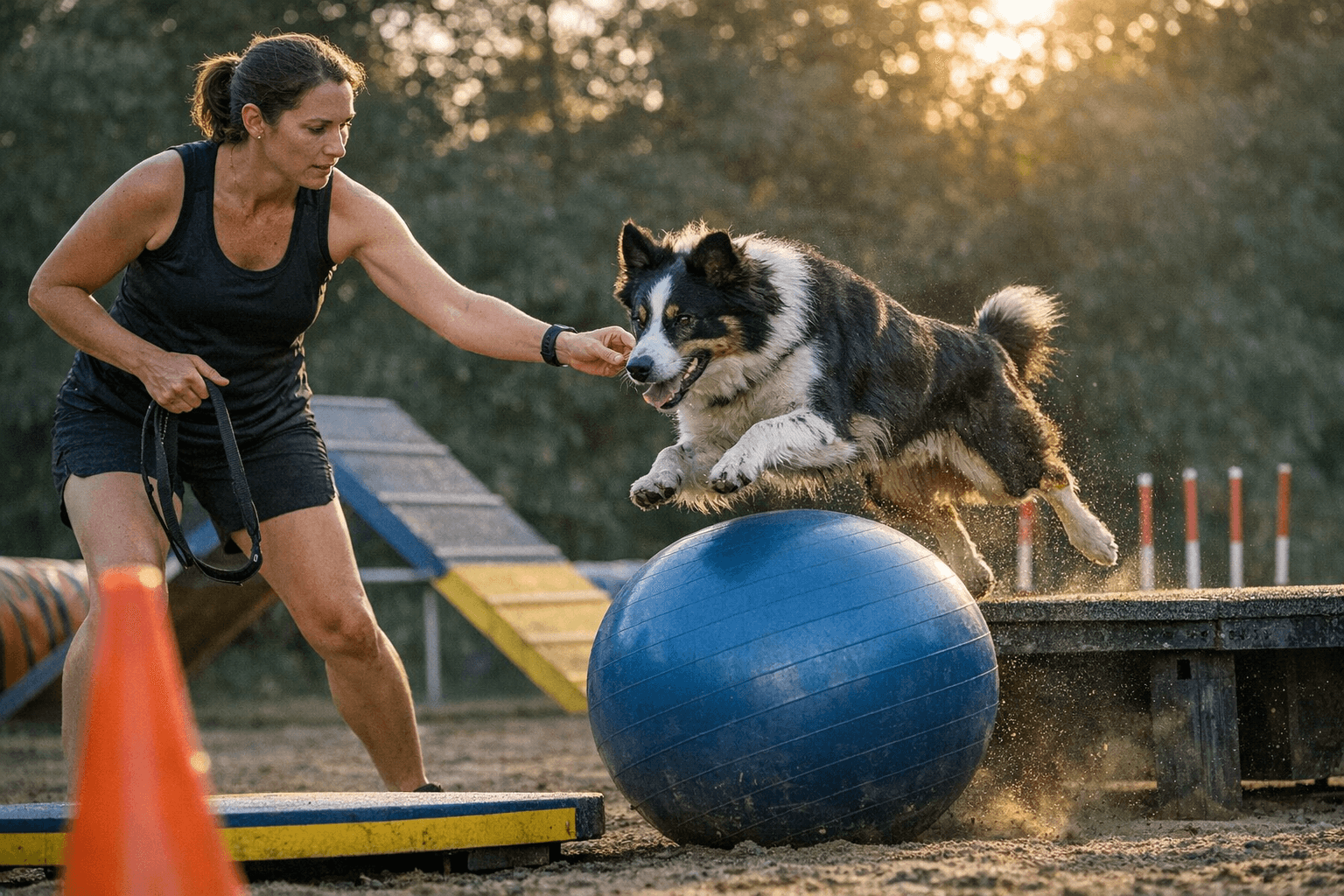
Whole Dog Journal insists that conditioning must be sport-aware—agility, flyball, herding, or long-distance hiking each demands different emphasis—so integrate targeted drills that mimic the demands of the activity. For agility-minded dogs, include short sequences with focus on acceleration, deceleration, and controlled contacts; for hiking dogs, gradually lengthen loaded uphill walks and introduce rocky terrain for proprioceptive challenge. The Journal recommends breaking sport skills into component abilities (speed, stamina, deceleration, repetitive impact tolerance) and sequencing conditioning so the dog has the underlying fitness before increasing sport-specific exposure.
6. program structure and progressive overload
Whole Dog Journal provides a template approach to periodizing conditioning: alternate focused microcycles (e.g., a week emphasizing strength, a week emphasizing cardio endurance) while keeping total workload steady to avoid spikes that invite injury. Progression should follow the principle of gradual increase—longer intervals, more sets, slightly higher loads or more complex balance tasks—only after the dog performs current work without signs of fatigue or altered movement. The Journal suggests mixing hard and easy days, inserting a recovery day after two hard sessions, and using a 3–4 week build followed by a lighter week to consolidate gains before escalating again.
7. warm‑up, cool‑down, and injury prevention practices
Whole Dog Journal pays attention to warm-ups and cool-downs as non-negotiable bookends: dynamic movement and light play to increase tissue temperature before intense work, and low-intensity walking and gentle range-of-motion checks after sessions. Routine checks for asymmetry, soreness, stiffness, or altered appetite are emphasized as early warning signs; if any persist, the Journal recommends pausing the program and consulting a veterinarian or canine rehabilitation professional. Simple on-hand tools—ice for acute swelling, topical cold packs after excessive impact, and joint-support strategies discussed with your vet—are part of sensible injury prevention.
8. monitoring progress: objective and subjective measures
Whole Dog Journal encourages a mix of objective metrics (session duration, distance trotted, number of repeats, jump counts) and subjective observations (willingness to work, recovery behaviors, gait quality). Keeping a short training log with these metrics lets you spot sudden workload increases or plateaus and adapt the plan. The Journal also recommends periodic re-assessment—repeating the baseline movement screen and goal review every 4–8 weeks—to ensure the program remains aligned with your dog’s needs and returns.
9. practical equipment, environment, and accessibility
Whole Dog Journal makes the case that effective conditioning doesn’t require fancy gear—cavaletti poles can be PVC, balance pads can be made from inexpensive cushions, and hill work uses municipal parks or safe sidewalks—while acknowledging certain investments, like access to an underwater treadmill or a certified trainer, speed results for dogs with high athletic ambitions. The Journal advises safety checks on all surfaces and gradual introduction of unfamiliar equipment, and it reminds owners that many conditioning elements can be woven into daily routines (stair-step sit-to-stands before a hike, a short balance circuit after a walk).
10. sample weekly blueprint and scaling ideas
Whole Dog Journal gives modular examples owners can scale: combine 2–3 shorter cardio intervals with 2 focused strength sessions and 2 balance or sport-skill sessions across a week, with at least one full rest day. Scale back intensity by shortening intervals or reducing load, and scale up by adding repetitions, complexity, or terrain challenge only when baseline form is excellent. The Journal’s modular model lets owners tailor volume and intensity for breed, age, and sport goals while maintaining consistent progression.
Conclusion Whole Dog Journal’s evidence-based plan converts the energy of hyperenergetic dogs into safer, more sustainable performance by blending measurable cardio, progressive strength, balance work, and targeted sport-readiness into a coherent program. Start with a careful baseline, progress deliberately, and use the Journal’s modular approach to keep your dog fit, focused, and ready for the demands of play, sport, or life on the trail.
Know something we missed? Have a correction or additional information?
Submit a Tip