Why the Declaration of Independence is harder to read today
The Declaration is fading because history kept putting it in public view. Its script, copies and conservation cases trace the nation’s struggle to preserve founding ideals.
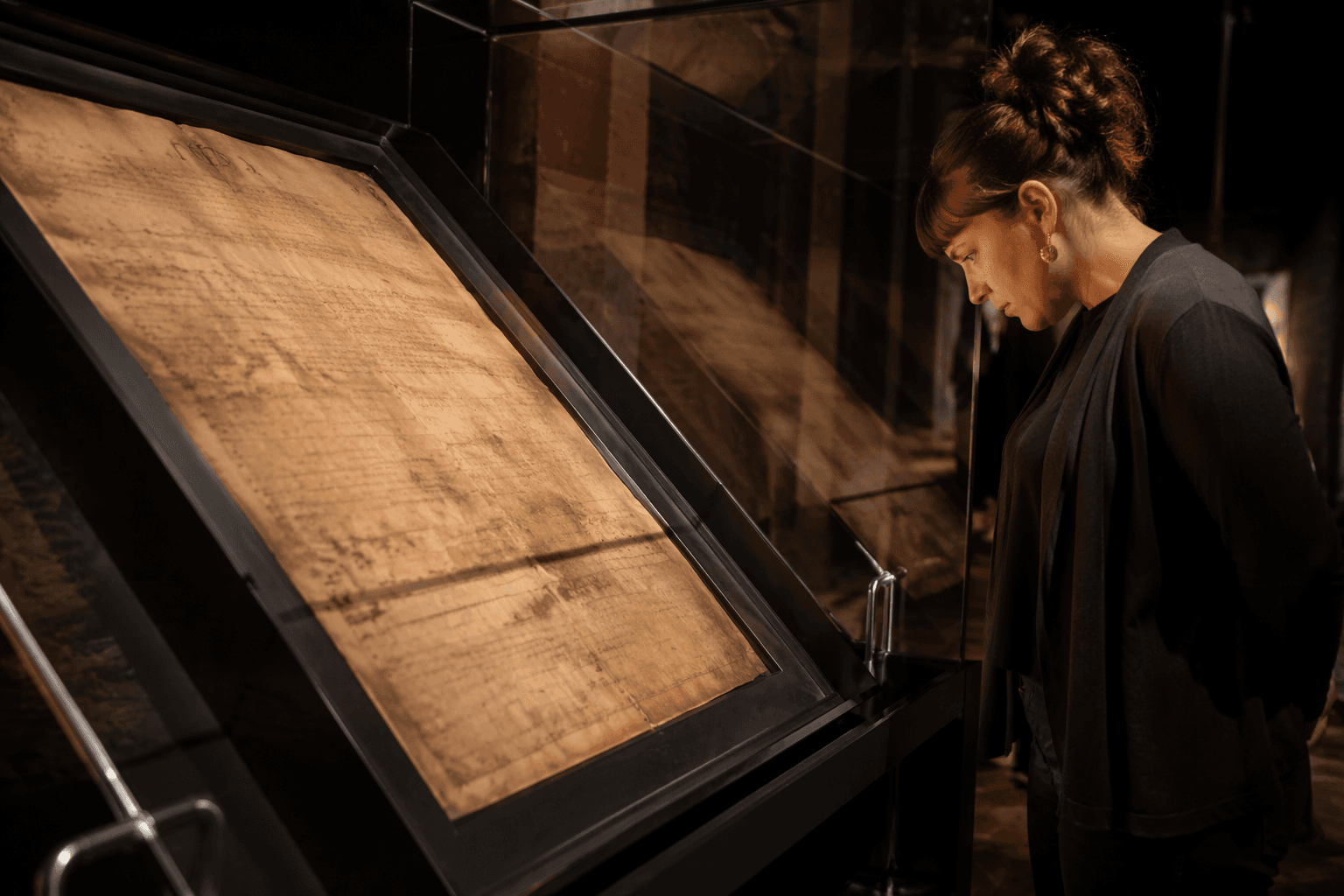
The Declaration of Independence looks harder to read because it has spent nearly two and a half centuries being both a political symbol and a fragile artifact. The parchment in the National Archives Rotunda is the engrossed copy adopted on July 4, 1776, signed beginning August 2, 1776, and written out in Timothy Matlack’s careful, large hand. What began as a document meant to be legible has become one that visitors now bend toward the glass to decipher, a physical reminder that the nation’s record of itself has aged along with the ideals it set down.
A document made for permanence, then tested by time
The Continental Congress ordered the Declaration engrossed on parchment on July 19, 1776, turning Thomas Jefferson’s words into an official manuscript fit for signing and display. Matlack’s script gave the document a clarity that was essential in an era before mass printing, but the parchment was never immune to time, handling, and environmental stress. The National Archives says its legibility is greatly diminished today compared with when it was penned in 1776, and the contrast with the Constitution and Bill of Rights in nearby display reinforces how uneven preservation can be across the founding documents.
That decline is visible to the public every day. More than a million visitors a year come to the National Archives Building in Washington, DC, to see the Declaration, Constitution, and Bill of Rights, and the Declaration draws a particular kind of attention because its famous text is now faint. People come not just to admire it, but to lean in and strain after names that once read cleanly across the page.
Why the text faded
The fading did not happen in a single moment. It reflects a long chain of exposure, from the document’s original production and signing to its public life as a ceremonial object. Parchment, ink, and display conditions all age differently, and the Declaration’s surface has borne the costs of being both preserved and seen.
By the early 19th century, officials were already worried enough about the original signed Declaration that John Quincy Adams, then Secretary of State, commissioned engraver William Stone in 1823 to make a copperplate facsimile. The Smithsonian Institution says Stone’s work was created because the signed parchment was believed to be fading. That decision captures the central paradox of the document’s history: to preserve the text, the government had to reproduce it, because the original itself could no longer carry the full burden of public reading.
The facsimile also shows that deterioration was not treated as an abstract conservation issue. It was a civic problem. If the nation wanted citizens to keep reading the Declaration, it had to make the words available in another form when the original no longer served that purpose well.
Preserving access without hiding the original
The National Archives has spent decades trying to balance visibility and protection. From 1952 until July 5, 2001, the Charters of Freedom were kept in helium-filled cases created by the Commerce Department’s National Bureau of Standards. Those cases helped slow deterioration, but conservation science kept advancing, and by 2001 the documents were removed from the Rotunda for installation in a new case.
During that removal, conservators inspected the reverse side of the Declaration and found two docket lines reading, “Original Declaration of Independence dated 4th. July 1776.” Even the back of the parchment, long hidden from public view, carried evidence of the document’s administrative life. It is a small detail, but it underscores how much of the nation’s founding record survives through survival itself: notes, labels, bindings, and preservation decisions made over generations.
Between 2001 and 2003, the National Archives and the National Institute of Standards and Technology installed new encasements designed to protect the founding documents in an oxygen-free environment. National Archives officials say the display cases are filled with argon to create an anoxic environment of less than 0.5 percent oxygen, reducing the conditions that accelerate deterioration. In 2023, officials said five of the encasements had maintained that oxygen-free environment since they were sealed 20 years earlier, evidence that conservation is now built into the documents’ public life rather than tacked on after damage is done.
What the fading means for the country
The Declaration’s worn surface carries more than aesthetic loss. It reveals how democratic memory depends on infrastructure, expertise, and repeated intervention. Sarah Stauderman, Mary Lynn Ritzenthaler, and Catherine Nicholson have all worked within a preservation culture that treats access and protection as inseparable, because a founding document locked away completely would fail the public just as surely as one left to deteriorate in the open.
That is why the National Archives keeps the Declaration on view in Washington, DC, and why admission is free. The document belongs to the public, but the public can only continue to encounter it if the nation keeps making careful choices about light, air, housing, and display. Each case, each transfer, and each conservation standard reflects a judgment about what it means to keep faith with the past without allowing the past to vanish.
The Declaration’s fading text is not simply damage. It is the record of the country trying, in imperfect and increasingly technical ways, to preserve the words that announced its birth.
This article was produced by Prism’s automated news system from verified source data, official records, and press releases, then run through automated quality and moderation checks before publishing. The system is built and supervised by the people who set the standards it runs under. Read our full AI policy.
Did this article answer your question?