Wisconsin Supreme Court Election Tests Liberal Majority as Musk Exits Race
Wisconsin voters chose between two Court of Appeals judges Tuesday, with a liberal win poised to stretch the court's progressive edge to 5-2 and lock conservatives out until at least 2030.
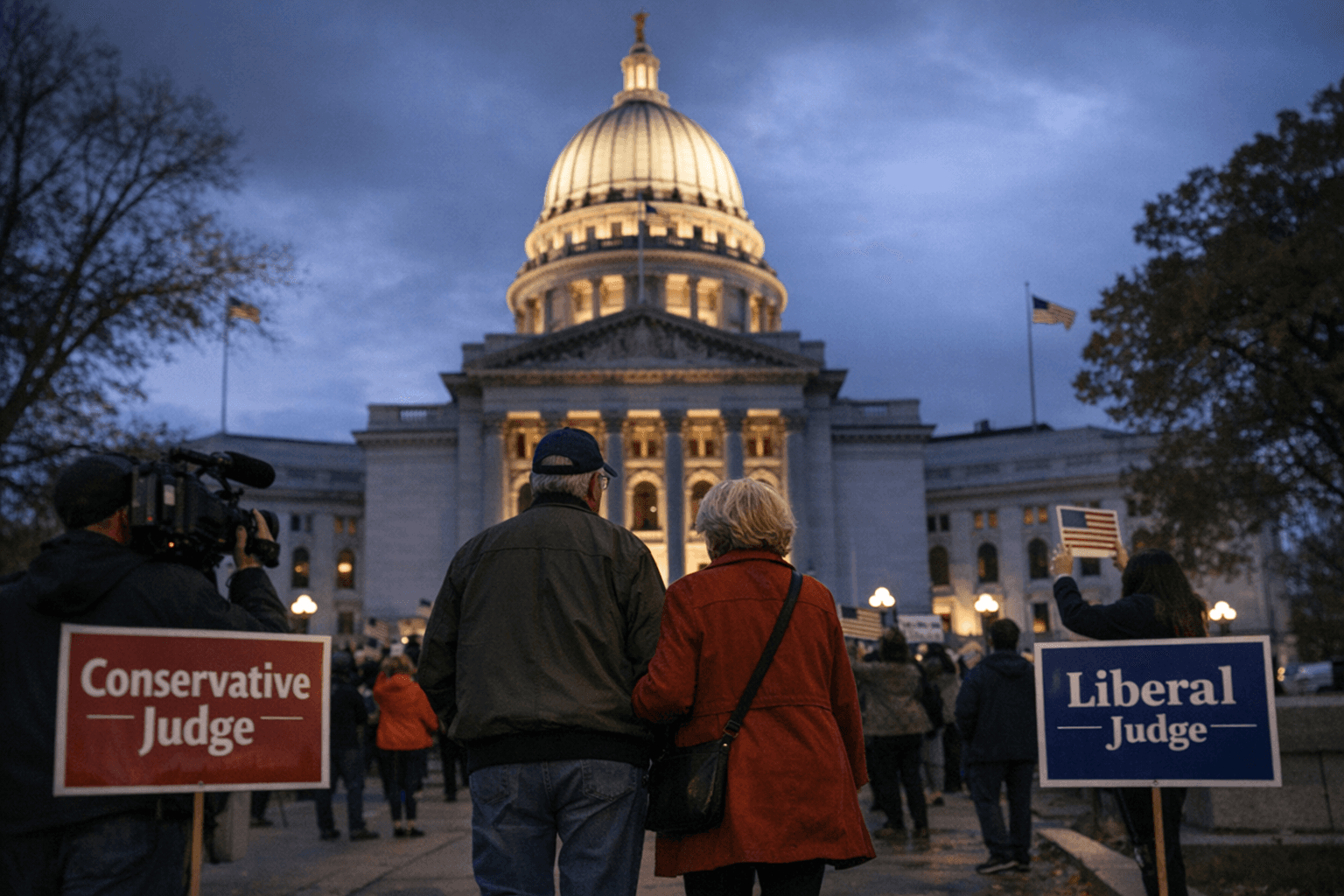
Wisconsin held its Supreme Court election Tuesday with substantially less chaos than the year before. Gone was the cheesehead hat, the nine-figure spending war, and Elon Musk. In their place: two Court of Appeals judges, a court whose ideological stakes were already settled, and a race that tested whether Democratic organizing could hold without a megadonor-fueled spectacle driving turnout.
Conservative judge Maria Lazar and liberal judge Chris Taylor faced off to replace retiring Justice Rebecca Bradley, a conservative who has served on the court since October 2015. The race could not flip the court's 4-3 liberal majority, but a Taylor victory would push that edge to 5-2, potentially locking conservatives out until at least 2030.
As of late in the campaign cycle, spending had totaled just over $638,000, a steep drop from the $25 million poured into Susan Crawford's race at the same point last year. That 2025 race ultimately broke records, becoming the most expensive judicial contest in U.S. history, with Musk pouring millions into supporting Crawford's opponent, Republican-backed Brad Schimel. Crawford defeated Schimel, keeping the court's 4-3 liberal majority intact.
Taylor spent about nine times more than Lazar on television ads, based on a tally by the Brennan Center for Justice. The spending asymmetry reflected broader Democratic infrastructure advantages: Taylor served as a Dane County Circuit Court judge from 2020 to 2023, and as a Wisconsin Assembly representative from 2011 to 2020, previously working as Policy and Political Director for Planned Parenthood of Wisconsin. Lazar, a member of the Federalist Society, aligns with conservative legal networks that have spent decades building influence in both federal and state courts.
The policy consequences of this seat are specific and imminent. The winner may take part in further rulings on Act 10, which effectively ended collective bargaining for most Wisconsin public employees, as well as cases involving congressional redistricting and voting rules, including a 2022 case in which the court banned ballot drop boxes. Abortion access is the most prominent fault line: Lazar called the U.S. Supreme Court's Dobbs ruling overturning Roe v. Wade "very wise" and "a good move forward," adding that Wisconsinites might support a state law banning abortion once a fetal heartbeat is detected, at roughly six weeks. Taylor's record runs in the opposite direction; during her time in the Assembly, she introduced a bill specifying that every woman has the fundamental right to choose a safe and legal abortion, except after viability unless her life or health is endangered.
The liberal-controlled court has already struck down a state law banning abortion, and liberals have now won the last three Wisconsin Supreme Court contests, securing their narrow majority most recently through Crawford's record-breaking 2025 win, which drew more than 2 million voters. Democrats also looked to build midterm momentum with an eye toward keeping the governor's office and potentially flipping the GOP-controlled state legislature.
Without Musk's millions and Trump's megaphone amplifying the opposition, the question Tuesday was whether liberal enthusiasm in Wisconsin could sustain itself on institutional organizing alone. The answer carries implications well beyond Madison.
Sources:
Know something we missed? Have a correction or additional information?
Submit a Tip