Workers wary of AI, welcome automation only with human oversight
Workers want AI to clear away repetitive work, not decide for them. Surveys show worry, not hype, still defines the public mood.
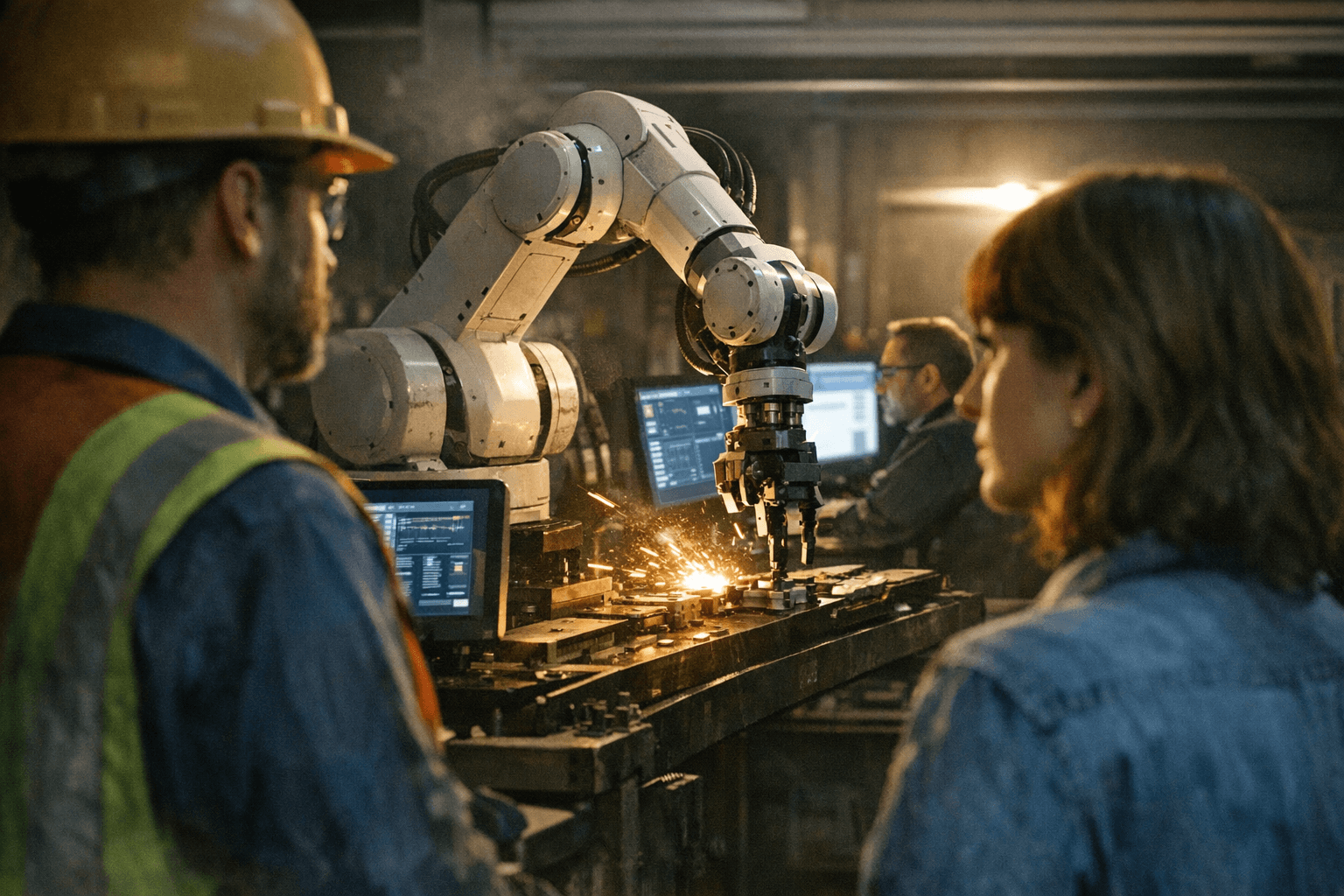
The real demand: AI as assistance, not replacement
The strongest signal from workers is not rejection of automation, but a demand for boundaries. People are open to software that strips away repetitive tasks, yet they still want human judgment in the loop, and that gap is where much of the current AI pitch falls short. The public launch of ChatGPT on November 30, 2022 pushed AI from a niche product conversation into the center of workplace debate, but the appetite that followed has been far more cautious than many tech companies expected.
Worry remains the dominant workplace emotion
Pew Research Center’s survey of 5,273 employed adults, fielded from October 7 to 13, 2024, shows a labor force that is uneasy first and enthusiastic second. Fifty-two percent said they feel worried about future AI use in the workplace, while 36% said hopeful, 33% overwhelmed, and 29% excited. That mix matters because it suggests workers are not experiencing AI as a clean productivity upgrade; they are experiencing it as another force that could change their jobs before they can shape the terms.
The long-run expectations are even more sobering. Only 6% of workers said workplace AI would lead to more job opportunities for them. By contrast, 32% expected fewer opportunities and 31% said it would not make much difference. Kim Parker’s work at Pew captures a labor market mood in which AI is not yet viewed as a broad path to upward mobility, but rather as a tool whose gains may be captured elsewhere.
What workers actually want automated
A Stanford study led by the Stanford Institute for Human-Centered AI and the Stanford Digital Economy Lab helps explain why the public mood is so selective. Researchers surveyed 1,500 workers across 104 occupations and interviewed 52 AI experts, building a database that spans 844 occupational tasks. The headline is not that workers want less AI, but that they want different AI than the industry often sells.
Workers were most welcoming when AI was aimed at repetitive tasks, freeing time for higher-value work, and improving work quality. That is a very different proposition from a fully autonomous system that substitutes for judgment. Diyi Yang and her colleagues found that 45% of workers doubted AI’s accuracy and reliability, 23% feared job loss, and 16% worried about a lack of human oversight. In other words, the resistance is not abstract technophobia. It is a practical concern that machines should not be asked to do what people still value most: catch nuance, own responsibility, and decide when a result is good enough.
That distinction is crucial for understanding everyday software. Most workers are not asking for a world with no automation. They are asking for automation that targets the parts of the day they resent, especially tedious, repetitive work, while preserving human control over decisions that affect customers, paychecks, safety, or reputation.
The public fear extends beyond the office
Outside the workplace, the concern is even broader. A Reuters/Ipsos poll in August 2025 found that 71% of Americans were concerned AI could put too many people out of work permanently. That is a labor-market fear, but it is not the only one. The same poll found 77% worried AI could be used to stir up political chaos, and 61% were concerned about the electricity needed to power the technology.
Those numbers show that the public is not merely weighing convenience against convenience. People are also thinking about social stability and physical infrastructure. If AI systems require more power, more data-center buildout, and more trust in opaque outputs, then adoption becomes a question of who pays the cost and who gets the benefit. That is especially important for companies pitching AI as an invisible layer inside every product, because users are increasingly judging the technology not just by speed, but by its side effects.
Why the market is running into a trust problem
This is the mismatch at the center of the AI boom: companies often market the technology as a way to replace busywork and optimize systems, while workers appear to want augmentation that leaves accountability with humans. That gap is not a small messaging issue. It shapes product design, adoption rates, regulation, and the willingness of organizations to let AI move from a suggestion engine to a decision engine.
The numbers point to a market that rewards narrow usefulness over sweeping claims. Tools that save time on routine tasks, reduce repetition, and improve quality are likely to gain traction because they match what workers already endorse. Systems that promise too much autonomy, by contrast, will run into skepticism about accuracy, fears of job loss, and anxiety over who remains responsible when something goes wrong.
What this means for the next phase of AI
The next phase of AI adoption is likely to be defined less by “Can the model do it?” and more by “Should the model do it alone?” That question goes to the heart of software design, management strategy, and labor relations. If companies build products around human review, editable outputs, and clear approval steps, they are closer to the way workers actually want the technology to fit into the day.
That makes the economic lesson of the current AI cycle fairly clear. The public is not rejecting automation in principle. It is rejecting the idea that automation should erase human judgment, own the consequences, or claim the entire value of the work. In the labor market and beyond it, the winning products will be the ones that make people faster without making them feel replaced.
This article was produced by Prism’s automated news system from verified source data, official records, and press releases, then run through automated quality and moderation checks before publishing. The system is built and supervised by the people who set the standards it runs under. Read our full AI policy.
Did this article answer your question?