Y Combinator Winter 2026 Demo Day Highlights 16 Standouts From 190 Startups
Out of nearly 190 startups pitching at Y Combinator's Winter 2026 Demo Day, TechCrunch narrowed the field to 16, and the picks range from a nonprofit benchmarking AGI progress to an AI tool hunting uranium deposits.

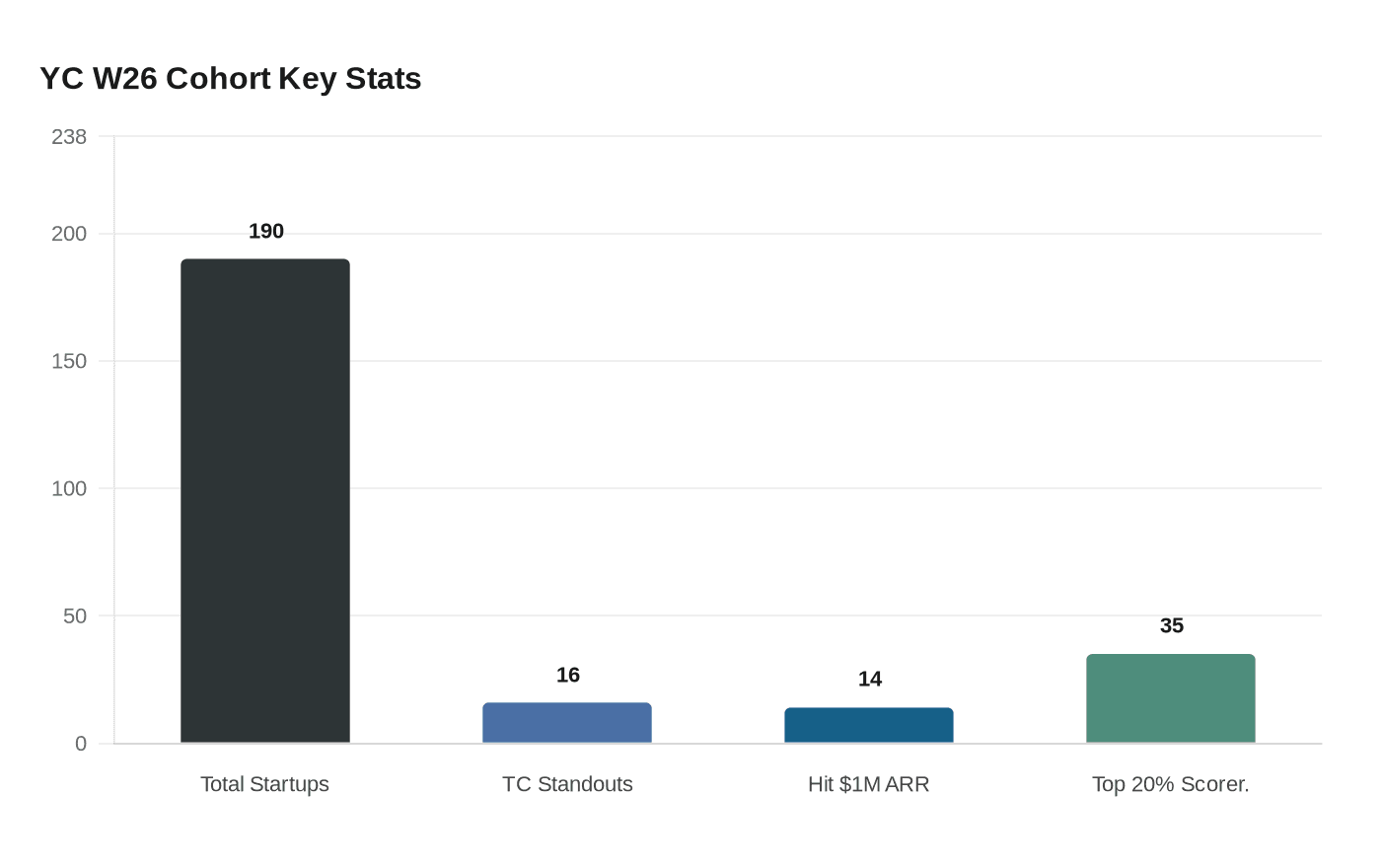
Sixteen companies from a cohort that nearly touches 190. That ratio, roughly one spotlight for every dozen pitches, captures just how crowded Y Combinator's Winter 2026 Demo Day became.
AI was once again the dominant theme for the latest batch of YC Demo Day companies, with nearly 190 startups participating in the Winter '26 cohort and presenting on Tuesday, March 24. Rather than a livestream or an in-person session, YC posted pitch videos one by one, roughly 20 minutes after each founder presented, requiring journalists and investors to read about all 190 companies and selectively watch those that caught their attention before narrowing down a final list.
Companies in the cohort are working on products across industries including law, transportation, and healthcare, but the through-line connecting most of TechCrunch's 16 standouts is unmistakable: AI as infrastructure, not ornament. Rebel Fund, which has attended every YC Demo Day since 2013 and built a machine learning algorithm to score batches, noted before a single company presented that 35% of W26 startups score in the top 20% of all YC companies ever evaluated, a figure no previous batch has come close to matching.
Fourteen companies out of almost 200 in YC W26 hit $1 million ARR by Demo Day, according to YC CEO Garry Tan, the highest ever recorded for any cohort.
Here are the 16 standouts TechCrunch selected from the Winter 2026 cohort:
1. ARC Prize Foundation - Creates benchmarks to help measure progress toward AGI.
A nonprofit in YC is unusual, but when OpenAI, Anthropic, and Google are already using some form of the organization's benchmarks, its inclusion makes sense. The foundation aims to inspire more open source AGI research by hosting competitions and awarding research grants. It positions itself as a matter of historical record for tracking how close the world is to AI machines with general intelligence, at a moment when Nvidia CEO Jensen Huang has publicly argued that AGI has already arrived.
2. Asimov - Collects human movement data to train humanoid robots.
People from around the world submit videos of themselves performing movements and tasks so the company can turn them into datasets that help train robots. Asimov is scaling what it calls the most diverse dataset of human motion data, deploying hardware across a network of more than 5,000 contributors in households, restaurants, hotels, and factories to supply frontier robotics labs with thousands of hours of organic human data.
3. Avoice - Uses AI to automate tedious tasks for architects.
Targeting a market that the founders themselves describe as underserved, this tool uses AI to help automate tasks that architects may find tedious, including reviewing specifications, drawings, contracts, and proposals. The architectural sector has been largely untouched by the current wave of AI tooling, making it a clear greenfield opportunity for a vertical-specific product.

4. Button - A tiny wearable computer built for AI, co-founded by two former Apple employees.
As the world awaits OpenAI's wearable product following its acquisition of Johnny Ive's company, Button enters the race as a small AI-native device that connects to apps like email, Slack, and Salesforce and operates them via voice command. The next must-have hardware is likely to be some form of AI wearable, making this a space to watch closely.
5. MouseCat - Uses AI to investigate fraud.
The company pulls data from large cloud storage platforms like Databricks or Snowflake, analyzes consumer data and activity for anything suspicious, and provides recommendations on how to take action. AI-native tools like this are important for keeping up with the bad AI that is also capable of unleashing harm, a dynamic that makes purpose-built fraud detection increasingly urgent for enterprise risk teams.
6. Opalite Health - Uses AI to help healthcare providers communicate with non-English speakers.
There is much left up to interpretation when two people cannot understand each other, and in the medical world, that miscommunication can be life or death. This AI medical translator helps break the language barrier, enabling healthcare providers to understand patients who speak a different language. The product addresses one of the most persistent equity gaps in American healthcare, where limited English proficiency patients routinely receive worse care than their English-speaking counterparts.
7. Sonarly - Helps software fix its own production issues.
It connects to existing monitoring systems, promises to reduce alert noise that distracts engineers from the alerts that actually matter, and automatically identifies root causes of problems before finding ways to either fix them or suggest further actions. While AI code review startups are multiplying and model makers are offering the feature themselves, independent players should find room once code hits production systems, which represents yet another aspect of the engineering workflow that founders are actively automating.
8. Terranox AI - Uses AI to find uranium deposits in North America.
Uranium will be needed to power the next generation of nuclear energy, the founders noted during their pitch. Terranox applies machine learning to identify promising uranium deposits more efficiently than traditional geological methods, placing it at the intersection of two of the most heavily discussed topics in energy policy: AI compute demand and nuclear power's resurgence.
9. General Legal - An AI-native law firm built for growth-stage companies.
General Legal combines legal expertise with AI to deliver fast, scalable legal services to startups and scale-ups, targeting a sector that TechCrunch's broader industry coverage flagged as one of the cohort's most active verticals.
10. Condor Energy - An energy operating system targeting reliable and sustainable electricity supply.
Condor Energy is building what it describes as an energy operating system that optimizes energy generation and distribution for better outcomes, arriving at a moment when AI data center power demand is straining grids across the country.
11. RoboDock - Builds charging and maintenance infrastructure for autonomous vehicle fleets.
RoboDock builds the charging and maintenance infrastructure that self-driving vehicles need to operate autonomous depots, filling a logistics gap that becomes more acute as autonomous fleets scale beyond pilot programs.
12. Hex Security - Agentic offensive security platform.
Hex Security uses autonomous agents to continuously probe and test an organization's defenses, automating the kind of red-teaming that most companies can only afford to commission periodically.
13. Canary - An AI QA engineer that reads and understands code to write and maintain tests.
Canary reads and comprehends your codebase to write and maintain tests that actually matter, positioning itself in the growing category of AI tools that move beyond code generation into code quality assurance.
14. Visibl - AI agents for chip design.
Visibl is applying artificial intelligence to the notoriously complex and resource-intensive process of semiconductor design, a bottleneck that constrains the pace of hardware development across consumer electronics, defense, and AI accelerator markets.
15. Zymbly - Automates administrative work for aircraft technicians.
Zymbly eliminates paperwork overhead in aviation maintenance, letting technicians focus on the work that matters, addressing a compliance and documentation burden that has long consumed a disproportionate share of skilled labor time in the aviation industry.
16. Cardboard - An agentic video editor rethinking how video production works.
Cardboard earned the highest-upvoted Hacker News launch in the entire YC W26 cohort, generating significant buzz in the developer community before Demo Day even concluded, a signal that community-driven product discovery is still running parallel to the formal pitch process.
The W26 cohort's composition reflects a broader industry shift. Only about 5% of this batch is consumer-facing, with the cohort running 64% B2B and heavily weighted toward infrastructure and hard technical problems. Y Combinator's 2026 batches are roughly 60% AI companies, up from 40% in 2024, a trajectory that shows no sign of reversing. What separates this cycle from earlier AI-heavy batches is specificity: the standout companies are not building general-purpose chatbots but tools aimed at narrow, high-stakes workflows where being wrong carries real cost, whether that is a misdiagnosed patient, an undetected fraud transaction, or a misfiled aircraft maintenance record.
This article was produced by Prism’s automated news system from verified source data, official records, and press releases, then run through automated quality and moderation checks before publishing. The system is built and supervised by the people who set the standards it runs under. Read our full AI policy.
Know something we missed? Have a correction or additional information?
Submit a Tip