ZeroClaw Rust rewrite delivers significant speed and memory improvements versus OpenClaw
ZeroClaw delivers 14x faster skill execution and roughly 90% lower memory use versus OpenClaw, and is available as the zeroclaw crate via cargo add zeroclaw.

Elena Marchetti at Awesome Agents published a hands-on benchmark review on February 27, 2026, concluding ZeroClaw "rewrites OpenClaw's core in Rust, delivering 14x faster skill execution, 90% lower memory usage, and memory safety guarantees." Marchetti ran side-by-side tests after "a couple of weeks" of use and reported consistent results across three runs on identical 4-core AMD EPYC hardware with 8 GB RAM on Ubuntu 24.04.
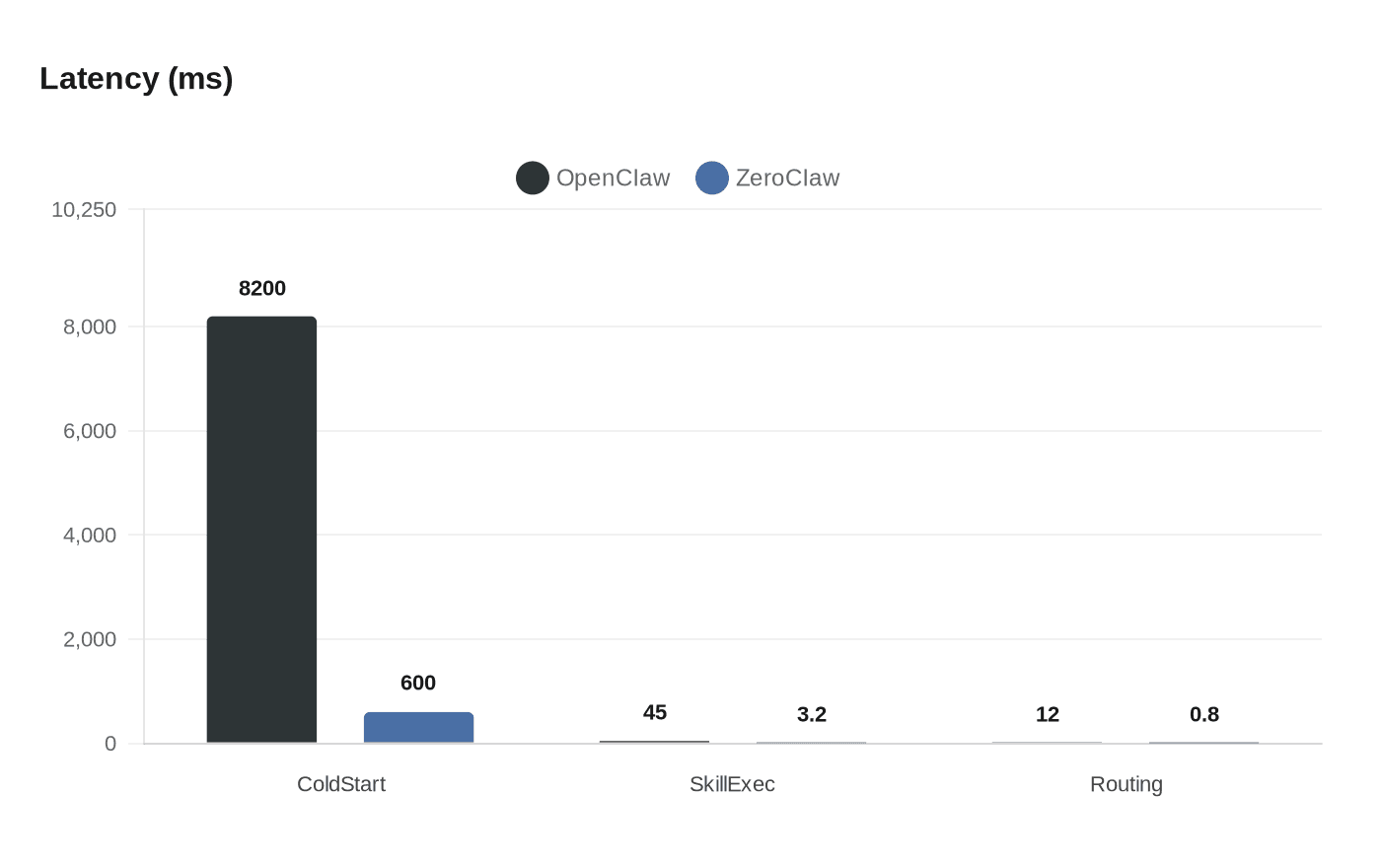
The benchmark table in the review shows stark gains: cold start dropped from 8.2 seconds in OpenClaw to 0.6 seconds in ZeroClaw, idle memory fell from 487 MB to 38 MB, and peak memory for 10 concurrent skills fell from 1.2 GB to 142 MB. Skill execution overhead moved from 45 ms to 3.2 ms, message routing latency from 12 ms to 0.8 ms, and sustained throughput rose from 22 skills/sec to 310 skills/sec. Awesome Agents also noted OpenClaw’s Node.js gateway consumes roughly 400-600 MB at idle, while a separate ZeroClaw local note cites a Node.js overhead of approximately 390 MB; both figures appear in the reporting.
ZeroClaw is a ground-up Rust rewrite led by former Mozilla engineer Kai Tanaka with a team of twelve contributors and launched in early February 2026. The project is dual-licensed under MIT and Apache 2.0 and published as a Rust crate named zeroclaw; users can add it with cargo add zeroclaw. The architecture is modular and trait-based, with every subsystem - memory provider, communication channel, and tool execution environment - exposed as simple traits to enable extensibility. ZeroClaw and PicoClaw ship as static binaries; OpenClaw relies on a Node.js runtime.
Marchetti summarized ZeroClaw’s positioning bluntly: "The knock on OpenClaw has always been performance." The review frames ZeroClaw as "a modern, Rust-implemented successor to OpenClaw, focusing on efficiency and safety for AI orchestration tasks." Sparkco Ai supplied a small pseudo-code example print(agent.id) and estimated integration effort for Rust users at 1–2 hours to bind the crate, noting basic setup can be done in under 10 lines.
Readers who want to reproduce quick checks can follow the project README and local notes: git clone, cd zeroclaw, cargo build release, cargo install path . force, and measure with /usr/bin/time -l target/release/zeroclaw help or /usr/bin/time -l target/release/zeroclaw status. Onboarding and runtime commands include zeroclaw onboard api-key sk-... provider openrouter or zeroclaw onboard interactive, zeroclaw agent, zeroclaw gateway (default 127.0.0.1:8080, or use port 0 for a random port), and zeroclaw daemon. Migration tooling is included: zeroclaw migrate openclaw dry-run followed by zeroclaw migrate openclaw for an actual migration.
The project publishes bi-monthly releases with stable tags such as v1.2.0 and reports 95% test coverage plus extended fuzzing for betas, but it has no formal LTS strategy yet. Reviewers caution that Rust’s memory-safety advantages do not obviate scrutiny: examine unsafe code and FFI, integrate ZeroClaw into vulnerability management and automated CVE scanning, and use the project’s fuzzing and test coverage as part of risk assessment.
Open questions remain for full evaluation: the review does not specify exact OpenClaw and ZeroClaw git tags used, precise workload definitions for skill and routing metrics, or whether model call latency was included versus isolated runtime overhead. Elena Marchetti’s benchmarks and the ZeroClaw local reproduction notes give concrete commands and numbers that make independent validation straightforward, and the reported 14x performance and ~90% memory reductions position ZeroClaw as a compelling, efficiency-focused alternative to OpenClaw pending deeper production vetting.
Know something we missed? Have a correction or additional information?
Submit a Tip