AHL lays out Calder Cup playoff seed scenarios, qualification rules
AHL’s Playoff Primer lays out the 23-team Calder Cup field, who gets byes, series lengths and the exact clinching conditions teams like Toronto, Rochester, Stockton and Chicago are chasing.
1. Playoff field and the document to know
The AHL published a Calder Cup Play-off Primer (file: PlayoffPrimer_22Apr30; last update: April 30, 8:15 am ET) that lays out qualification rules, seeding scenarios, tie-break rules and a playoff tree. The headline number: 23 teams qualify for the Calder Cup Playoffs under the format the league has used since 2022, and the primer is the daily reference managers, scouts and bettors should be checking for scenario tables and schedule updates.
2. How many teams, by division
The league allocates those 23 spots unevenly across divisions: Atlantic six, North five, Central five and Pacific seven, a breakdown that explicitly sums to 23. That structure means each division’s cutoff looks different on the scoreboard: in the Atlantic six teams qualify out of eight; in the Pacific seven out of ten; North and Central send five of seven teams each.
3. Who gets byes (and how many)
Nine teams earn byes into the Division Semifinals (the best-of-five stage): two highest seeds in the Atlantic, three highest seeds in the North, three highest seeds in the Central and the first-place team in the Pacific. Put another way: two + three + three + one = nine byes; the remaining 14 qualifiers will play in first-round best-of-three series to reduce the field to the nine bye teams plus five winners.
4. Series lengths, reseeding and home ice
The playoff ladder is staged: First round, best-of-three; Division semifinals, best-of-five; Division finals, best-of-five; Conference finals, best-of-seven; Calder Cup Finals, best-of-seven. Home-ice advantage in all series is awarded to the team with the higher points percentage, and first-round winners are re-seeded within their division for the Division Semifinals, so finishing higher in the regular season meaningfully changes matchups and travel.
5. North Division: a worked example and a Belleville nail-biter
The North Division layout is a clean example of how byes reshape matchups: the top three seeds receive byes into the best-of-five North Division Semifinals; the fourth- and fifth-place teams play a best-of-three first-round series, with the winner advancing to face the number-one seed (Utica Comets) in round two. Belleville sits fourth in the division with a 0.577 point percentage and, with one game remaining, can still move into third, it trails Laval by .003 PT% while the Rocket still have three games left. Those tiny PT% margins will decide which Belleville players get an extra week of rest and which prospects get an extra audition in a first-round series.
- "Toronto clinches a playoff berth on Saturday with: (a) a point at Belleville"
- "Rochester clinches a playoff berth on Saturday with: (a) a Toronto regulation loss at Belleville"
- "Stockton clinches the Macgregor Kilpatrick Trophy on Saturday with: (a) a win at Bakersfield, OR (b) a Chicago regulation loss at Rockford, OR (c) an OTL/SOL at Bakersfield AND a Chicago OTL/SOL at Rockford"
- "Chicago clinches the Macgregor Kilpatrick Trophy on Saturday with: (a) a win at Rockford AND a Stockton loss (reg/OT/SO) at Bakersfield, OR (b) an OTL/SOL at Rockford AND a Stockton regulation loss at Bakersfield"
6. Clinching scenarios you can act on (verbatim AHL table lines)
The Playoff Primer publishes literal clinching lines teams can use to pencil in playoff spots or trophies. Those lines excerpted in the primer include:
Those are literal conditions from the primer, read them exactly as written and use the precise game outcomes noted (regulation wins, OTL/SOL, etc.) when tracking clinches.
7. What the first round looks like numerically
The AHL notes the first round will feature 14 of the 23 teams, those 14 play best-of-three series to trim the field. Winners advance to face the nine bye teams in the Division Semifinals; with reseeding applied, a team’s path can change dramatically depending both on its own result and outcomes elsewhere in the division. That interplay, small shifts in PT% and one-goal games, is how a fourth-place team can end up facing the division’s top seed or slipping into a different matchup entirely.
- Wilkes-Barre/Scranton 1 at Syracuse 4
- Springfield 3 at Providence 0
- Utica 1 at Rochester 8
- Rockford 2 at Milwaukee 3
- San Diego 2 at Tucson 3 (SO)
- Toronto at Belleville, 3:00 PM EDT
- Abbotsford at Manitoba, 2:00 PM CDT
- Grand Rapids at Cleveland, 7:00 PM EDT
- Chicago at Rockford, 6:00 PM CDT
- Laval at Syracuse, 7:00 PM EDT
- Wilkes-Barre/Scranton at Lehigh Valley, 7:05 PM EDT
- Utica at Providence, 7:05 PM EDT
- Stockton at Bakersfield, 6:00 PM PDT
- Ontario at Henderson, 7:00 PM PDT
8. Weekend schedule snapshot (as listed in the primer)
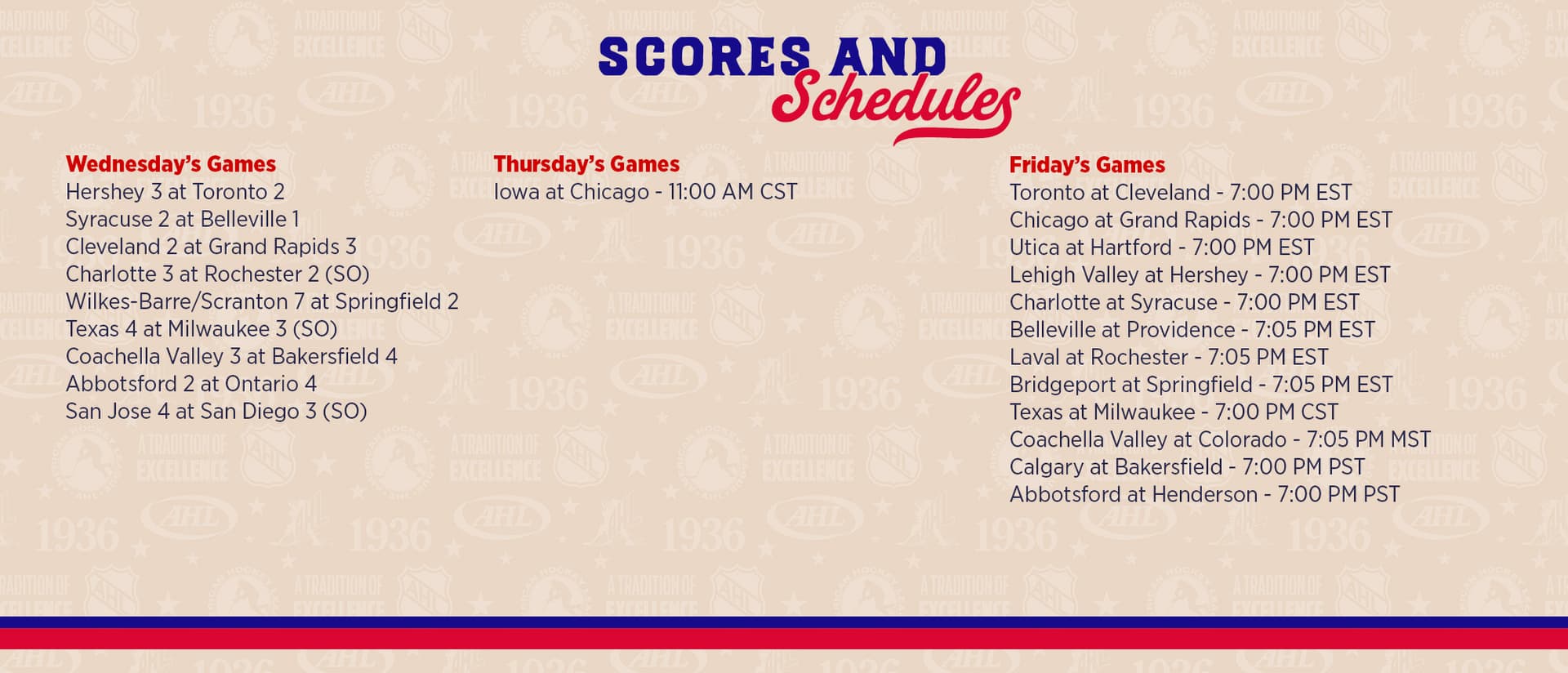
The Playoff Primer also publishes daily game lists and results; the excerpted weekend slate shows both Friday results and Saturday matchups/times. Friday’s results in the primer read:
Saturday’s matchups and times in the primer include:
Use the primer’s daily updates (PlayoffPrimer_22Apr30) to convert those matchups into immediate clinch-watch calendars.
9. Tickets, broadcast and Calder Cup context
Teams are moving on ticket timelines: Belleville announced playoff-home tickets go on sale starting Friday, April 29, and urged fans to follow team social channels for dates and opponents once the bracket locks. For viewers, the playoffs stream on FloHockey and the FloSports app, which the platform promotes as carrying live games, replays and highlights. And for context: the Calder Cup dates to 1938 (first awarded to the Providence Reds), and Hershey has won the last two Cups, defeating Coachella Valley in seven games in 2023 and six games in 2024, making a three-peat an explicitly noted storyline entering the postseason.
10. Conflicts in the copy and how to read the primer
The sources use slightly different shorthand, for example, an older AHL phrasing says “all but the bottom two teams in each of the AHL’s four divisions will qualify,” which mathematically doesn’t reconcile with the explicit Atlantic/North/Central/Pacific counts that total 23 teams. When language conflicts, use the division-by-division counts (Atlantic six, North five, Central five, Pacific seven) because they are explicit and sum correctly to 23; treat the “bottom two” line as shorthand or template language. Also note the primer’s clinch table in our excerpt is partial, the primer contains more rows and tie-break procedures that teams rely on, so download the full PlayoffPrimer_22Apr30 PDF for the complete permutations.
Conclusion The AHL’s primer is the operations manual for the final sprint: precise PT% margins, regulation vs. overtime outcomes and a handful of byes will decide first-round opponents and who gets extra rest. If you follow one document this postseason, it’s the PlayoffPrimer_22Apr30, read the clinching lines verbatim, track PT% to three decimal places, and remember reseeding can flip a team’s path overnight. The math is simple; the drama is not.
This article was produced by Prism’s automated news system from verified source data, official records, and press releases, then run through automated quality and moderation checks before publishing. The system is built and supervised by the people who set the standards it runs under. Read our full AI policy.
Did this article answer your question?