Axel Sandin-Pellikka sharpening his game in Griffins playoff run
Grand Rapids is turning its playoff run into a crash course for Axel Sandin-Pellikka, and Detroit’s top blue-line prospect is already showing why it matters.

Grand Rapids is doing more than chasing a Calder Cup
The Griffins are showing Detroit exactly what a playoff development pipeline looks like when it works. Axel Sandin-Pellikka sits at the center of it, and the biggest lesson is not the points he has added, but the pressure he is absorbing in games that actually decide something.

That is the difference between a prospect getting reps and a prospect getting hardened. In Grand Rapids, every shift has playoff consequences, every read gets punished faster, and every mistake is magnified by veteran opponents who know how to squeeze a young defenseman. For Detroit, that is the point.
Why this playoff run matters so much
Grand Rapids did not back into the postseason. The Griffins were the first team to clinch a berth in the 2026 Calder Cup Playoffs, doing it on February 27 with 20 games and 51 days still left in the regular season. That kind of early lock-in tells you the roster was built on more than hot shooting or a lucky stretch.
It started with a staggering opening run. Grand Rapids opened the 2025-26 season 29-1-1-1 and later built a 21-point lead in the Central Division. The Griffins also matched an AHL road points streak record at 14-0-1-1, then set a new standard at 15-0-1-1, stretching the run to 17 games away from home without a regulation loss. That balance and depth is exactly why the playoff environment has real developmental value: it is not a team hanging on, it is a team that has learned how to win in multiple ways.
Sandin-Pellikka’s offensive game is already part of the package
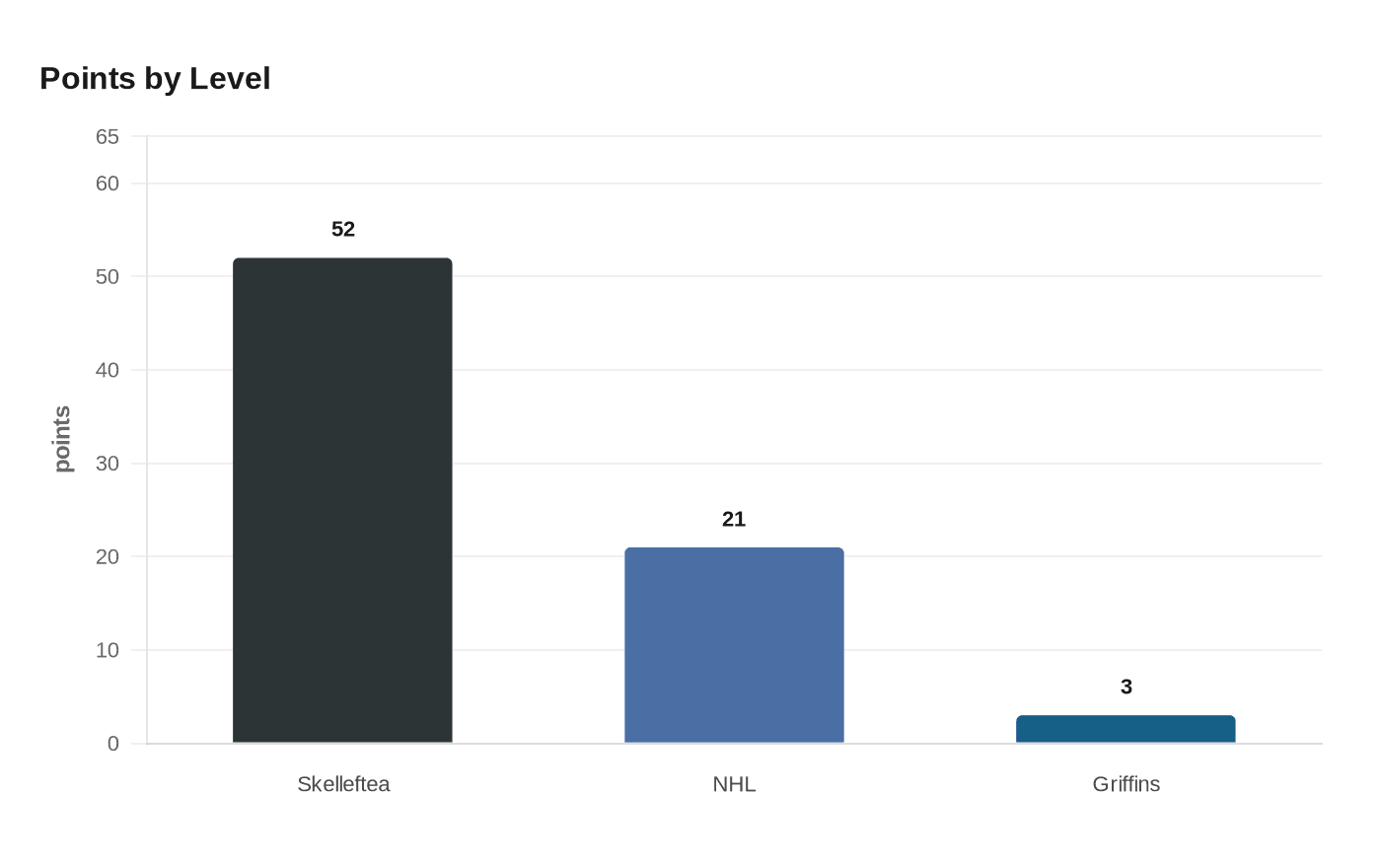
The easy label on Axel Sandin-Pellikka is offensive defenseman, but that undersells how much he is already bringing to the table. Detroit selected him 17th overall in the 2023 NHL Draft, and his resume before North America was already loud: 52 points in 107 games with Skellefteå AIK from 2022-25, plus a 2024 SHL championship.
He has also shown that his production travels. NHL.com lists him at 6-foot-0 and 186 pounds, with a 2025-26 NHL regular-season line of 68 games, seven goals and 14 assists for 21 points. Among NHL rookie defensemen, those seven goals ranked third behind only Matthew Schaefer and Alexander Nikishin. That matters because it tells you his offense is not a side note. It is a legitimate weapon, and it gives Detroit a real baseline if the defensive side catches up.
He also kept that touch alive in Grand Rapids. In six regular-season games with the Griffins, he added three points, and he scored in the series-clinching win over Manitoba. That is the kind of detail that changes the conversation from “promising prospect” to “playoff contributor.”
The real development is happening away from the puck
The most important part of Sandin-Pellikka’s run is not the shot or the stat line. It is what he is learning when the puck is not on his stick. Sandin-Pellikka has said he has learned a lot, gotten stronger and shifted his mental game toward the faster, more physical style of American hockey. That is the kind of adjustment that often decides whether a talented defenseman becomes an NHL fixture or just a useful call-up.
Dan Watson’s evaluation sharpens the picture. Watson said Sandin-Pellikka has already cleaned up a number of puck-management issues and now needs to keep sharpening his defensive reads, penalty killing, gap control and overall consistency. Those are not cosmetic fixes. They are the exact areas that determine whether a defenseman can survive NHL matchups against top lines, defend late leads and stay on the ice when the game tightens.
That is why the Calder Cup run is such a strong classroom. High-leverage games against Central Division opponents force quick decisions, immediate adjustments and repeat exposure to pressure. A prospect can survive a few good shifts in the regular season. He has to earn trust in the playoffs.
The Manitoba series showed the point of the whole exercise
Grand Rapids pushed through the opening round by beating the Manitoba Moose 3-1 and finishing the series with a 5-2 win in Game 4 on May 8 at Van Andel Arena. Sandin-Pellikka scored in that clincher, and that single goal matters because it shows the balance Detroit wants: he is not just defending under stress, he is still driving offense when the game is on the line.
That series was also a reminder of why the Griffins’ roster is such a useful proving ground. The lineup includes other notable Red Wings prospects such as Michael Brandsegg-Nygård, Nate Danielson, William Wallinder and Antti Tuomisto. That mix creates a competitive environment where the internal standard is high every night, and where a young defenseman cannot hide from responsibility.
Chicago pushed the next test higher
The challenge only got sharper in the Central Division finals. Chicago beat Grand Rapids 2-1 in Game 1 on May 14 at Van Andel Arena, with Josiah Slavin scoring the third-period winner. Game 2 was set for May 16, and the series carried a different kind of weight: this was the stage where the Griffins’ regular-season dominance had to translate again under tighter margins.
That is exactly the kind of setting Detroit wants for Sandin-Pellikka. Close games expose whether a defenseman can manage the puck cleanly under pressure, handle special-teams assignments and stay composed when every breakout can swing the series. The playoffs do not just reward talent. They reveal what a player can handle before he reaches the NHL.
What this means for Detroit’s timeline
Sandin-Pellikka already has the kind of offensive base that gets attention. The bigger story is that Grand Rapids is accelerating the rest of his game at the right level of stakes. He is learning faster hockey, absorbing physicality, and getting repeated chances to defend lead changes, kill penalties and make smarter reads in the moments that matter most.
That is the proof of concept for Detroit’s model. Grand Rapids is not just a winning AHL team. It is a development engine with real consequence, and Axel Sandin-Pellikka is living the most important part of that experiment right now.
Know something we missed? Have a correction or additional information?
Submit a Tip