College arrivals boost AHL playoff pushes as Phantoms get instant production
College exits are reshaping AHL playoff races in real time, and Lehigh Valley is already getting goals from its newest arrivals.
College arrivals are no longer ceremonial
This is not a developmental courtesy. In the AHL’s final stretch, the annual post-college talent rush is a roster weapon, and teams that move first can change a playoff race overnight. With the 2025-26 regular season ending April 19, every NCAA signing now carries two timelines at once: the immediate push for Calder Cup positioning and the longer view of who might jump the NHL depth chart next.
Patrick Williams captured the real story in this wave of signings, and it has nothing to do with paperwork. It is about clubs identifying players who can step into meaningful minutes right now, not next fall. The proof is already on the ice, where new arrivals are affecting line combinations, special teams, and even shootout decisions before the postseason bracket is set.
Lehigh Valley got instant production, not just fresh bodies
No team has illustrated the value of this rush better than the Lehigh Valley Phantoms. In their April 12 home finale, a 4-3 shootout win over Cleveland, the newcomers were not passengers. Noah Powell scored his first career pro goal in the third period, gave the Phantoms a lift when they needed one, and finished as one of the night’s most important players. Cole Knuble and Jack Berglund then converted in the shootout, turning an ordinary late-season game into a snapshot of how quickly college talent can alter an AHL lineup.
The Phantoms called it an “infusion of young talent,” and that phrasing fits because this was more than a feel-good debut sequence. Powell and Knuble arrived with real organizational intention. Powell signed a three-year entry-level contract with the Flyers on March 11, 2026, beginning in 2026-27, and was assigned to Lehigh Valley for the rest of this season. Knuble followed with a two-year entry-level contract on March 17, also beginning in 2026-27, and he too was sent to the Phantoms for the remainder of 2025-26.
That matters because Lehigh Valley is not waiting until training camp to find out what it has. It is testing whether these players can handle pro pace, pro details, and pro pressure in games that still matter. The Philly organization has essentially turned the final week into a live audition, and the first answer was a good one.
Why this late-season window changes playoff depth charts
The AHL does not treat April like a housekeeping month. It is the bridge between college endings and postseason reality, and clubs use it to solve problems that have been nagging them for months. Injuries pile up. Roles get stretched. Top prospects run out of runway in junior or college. Suddenly, a player who was skating in East Lansing, Tempe, or Ann Arbor is asked to fill a scoring line, a power-play unit, or a goaltending backup chart in a matter of days.
That is why these arrivals matter more than routine signings. A college free agent who can handle the puck cleanly, win a wall battle, or survive against older pro defenders is not just helping the AHL club. He is changing the NHL parent club’s summer planning too. If he can hold water in April, the organization gets a real read on whether he belongs in the fall mix.
Trey Augustine’s debut showed how fast a prospect can move
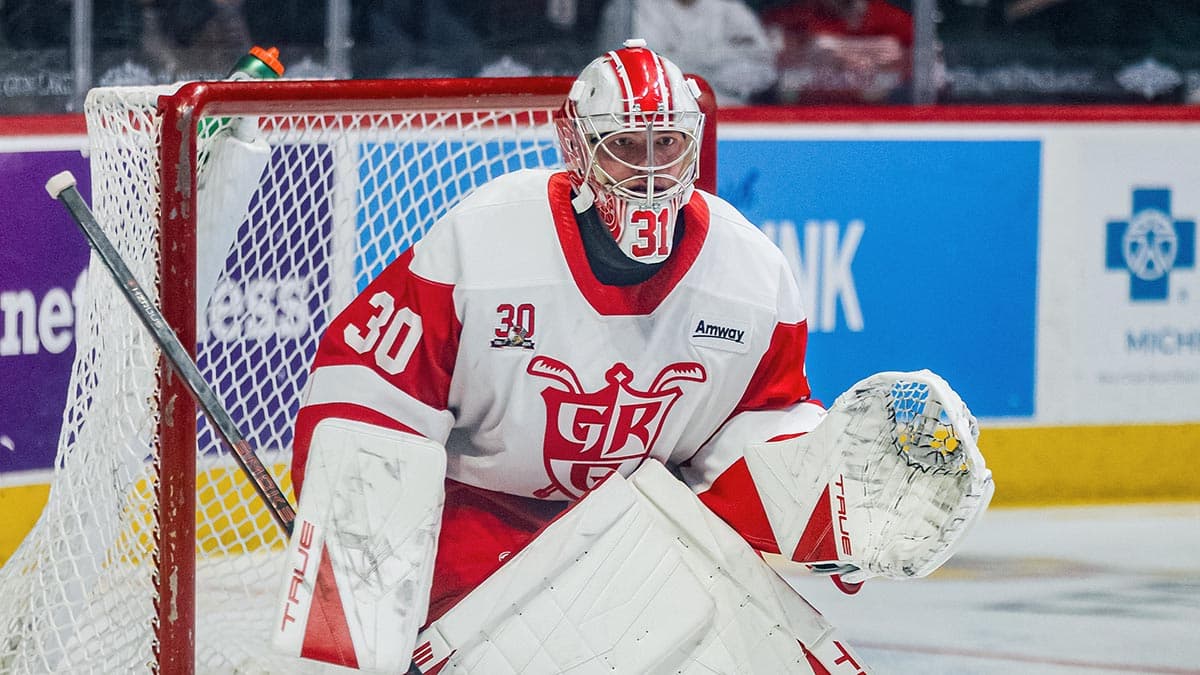
Grand Rapids provided the clearest example of how quickly a standout college season can turn into an AHL audition. Michigan State goaltender Trey Augustine made his professional debut on April 10 and stopped 26 shots in a 4-1 loss to Chicago at Van Andel Arena. That same night, shortly after puck drop, he was announced as the winner of the Mike Richter Award, given to college hockey’s top goaltender.

The resume was already loud before he put on an AHL sweater. Augustine finished the season with a 24-9-1 record, a 2.11 goals-against average, and a .929 save percentage. Those numbers tell you why the Griffins wanted him in the pipeline immediately, and why the debut mattered even in a loss. For a goaltender, the first pro game is often less about the result than the translation: can the reads, rebound control, and tracking survive against faster shot volume and heavier net-front traffic? Grand Rapids now has the first data point.
There is also a local layer here. Augustine, a South Lyon, Michigan native, went from Michigan State star to pro starter in one evening. That kind of transition can shift a depth chart faster than a summer camp battle, especially for an organization trying to evaluate goaltending in real time.
T.J. Hughes brings production and a pro contract at the same time
Colorado added another high-end college scorer with immediate value. T.J. Hughes, a Hobey Baker finalist, finished second nationally in scoring with 57 points in 40 games for Michigan before signing a one-year entry-level contract with the Avalanche on April 11, beginning in 2026-27. He will join the Colorado Eagles on an AHL professional tryout for the rest of this season.
The contract details underline how seriously Colorado views the player. The University of Michigan said Hughes’ ELC includes an $850,000 NHL salary, a $102,500 signing bonus, and a $72,500 games-played bonus. Those are not the numbers of a placeholder. They are the numbers of a player the organization expects to track closely, and maybe sooner rather than later.
Hughes is one of the most sought-after college free agents this spring because his scoring profile already looks pro-ready. An AHL tryout gives the Eagles an immediate look at how that production translates against older defenders and tighter checking. It also gives Colorado a clean read on whether his game can climb a rung quickly, which is exactly why these spring arrivals are so valuable.
Grand Rapids added another Draper to the pipeline
Grand Rapids also showed that this late-season roster churn is not limited to one or two marquee names. Kienan Draper signed an amateur tryout for the rest of 2025-26 and a two-year AHL contract beginning in 2026-27. He is the son of Red Wings assistant general manager Kris Draper, which makes the addition notable, but the more important point is simpler: he is now in the same pro ecosystem as the rest of these college arrivals.
That is the hidden mechanism here. AHL teams are not just collecting bodies for a week. They are building playoff depth charts, testing future contracts, and giving NHL clubs a fast answer on how a player handles the jump from campus hockey to professional demands.
The final week of the regular season is therefore not a waiting period at all. It is a live roster market, and the teams that understand it best are getting more than fresh legs. They are getting goals, saves, and evaluation clarity exactly when the standings and the Calder Cup bracket are about to lock in.
This article was produced by Prism’s automated news system from verified source data, official records, and press releases, then run through automated quality and moderation checks before publishing. The system is built and supervised by the people who set the standards it runs under. Read our full AI policy.
Know something we missed? Have a correction or additional information?
Submit a Tip