Asian pickleball shakes up old order in Kuala Lumpur, Macao tests
Teenagers and qualifiers are overturning the old hierarchy in Asia, and Kuala Lumpur plus Macao show a deeper pipeline that is rewriting the path to the top.

A 15-year-old American, a Vietnamese qualifier, and a pair of veterans who were supposed to steady the ladder all collided in Asia, and the results kept breaking the old script. What used to be a predictable swing for established North American names has turned into a stretch where seeding means less and patience, transition play and belief matter more. For amateur players, the message is clear: the global game is getting harder to forecast because more countries and younger players are learning how to win.
The old order is losing its grip
The simplest version of Asian pro pickleball used to be easy to read. Established North American players would arrive, sit at the top of the draw and take home most of the gold while local players collected experience and moved on. That structure started to crack in May as PPA Tour Asia staged back-to-back 500-point events in Kuala Lumpur and Macao, turning the region into a genuine points chase rather than a ceremonial stop.
Kuala Lumpur ran May 12-16, 2026, and Macao followed May 28-31, 2026. The Kuala Lumpur Open produced five different pro champions, a useful sign that the depth of the field was spreading beyond a few familiar names. The circuit’s early Asia schedule also included the MB Hanoi Cup from Mar. 31-Apr. 4, 2026, and the calendar only keeps widening from there.
Kuala Lumpur turned qualifiers into threats
The clearest proof came in men’s singles in Kuala Lumpur, where Nguyen Hung Anh first had to survive three qualifying matches on the opening day before he even reached the main draw. Then he met 15-year-old Tama Shimabukuro, a player who had already become a headline name, and the match flipped the bracket logic on its head.
Hung Anh trailed 0-7 before ripping off an 11-point run to steal the opening game 11-7. He then dropped the second 5-11 and closed the decider 11-9, a scoreline that tells the whole story: this was not just a lucky swing, but a disciplined adjustment under pressure. He slowed the pace, stretched rallies wider and refused to get dragged into a straight power contest.
That same pattern showed up in qualifying doubles, where Ho Vu Hoan and Hung Anh upset Zane Navratil and Mitchell Hargreaves 11-7, 14-12 in straight games. In one day, three of the top four seeds were eliminated, which is the kind of bracket shake-up that usually signals more than a one-off hot streak. It suggests Asian teams are getting more patient in transition and more confident against names that once looked untouchable.
Macao confirmed the youth movement
Macao carried the same message, only louder. Official PPA Tour Asia results list Tama Shimabukuro as the men’s singles gold medalist and Armaan Bhatia with Shimabukuro as the men’s doubles gold medalists, and the finals underscored why those results matter. Shimabukuro, who is 15, beat No. 1 seed Hong Kit Wong 11-9, 11-9 in the singles final, then returned with Bhatia to beat Mitchell Hargreaves and Kenta Miyoshi 12-10, 11-5 in doubles.
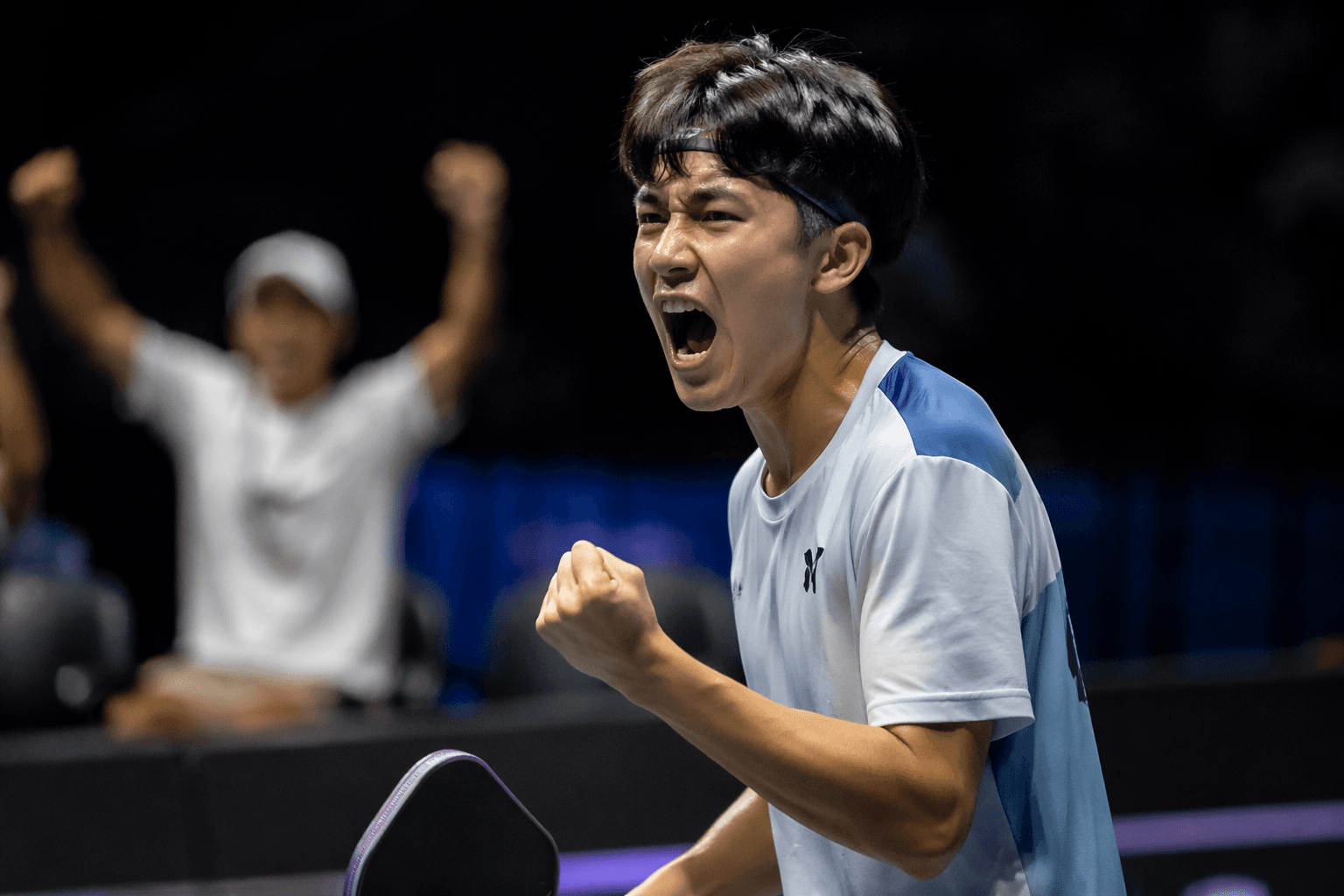
That kind of double-duty success says something important about the level of the field. Shimabukuro is not just surviving on junior energy or novelty; he is winning against top seeds and then pairing with a veteran partner to close out another title run. In a circuit that is now handing out 500 points in multiple stops, that kind of versatility changes the pecking order fast.
The broader takeaway is that Asia is no longer functioning like an exhibition stop for the U.S. elite. The gap between the international elite and the chasing pack has narrowed, and in some matches it has disappeared entirely. Teenagers are not waiting their turn, and qualifiers are not treating the draw as a learning exercise.
Why this matters for the amateur game
For the amateur side of pickleball, the implications run deeper than one upset run or one teenage gold medal. When the pro ladder becomes less predictable, the sport’s pathway changes with it. Coaching priorities shift toward more complete transition games, more patience under pressure and more tactical variety, because brute force alone is no longer enough to separate players once the talent level rises.
It also changes what young players in new regions can imagine for themselves. If a qualifier can beat a third seed after surviving the opening round gauntlet, and a 15-year-old can beat a No. 1 seed in a 500-point event, then the map of who belongs at the top gets redrawn. That matters in Asia, but it matters just as much for amateur players everywhere who are watching the sport expand into new markets and new age groups.
Beijing is the next test of how wide the field has become
The calendar is already pushing that story forward. The Beijing Open is scheduled for June 17-21, 2026 at the National Tennis Centre in Beijing, and official promotional material says players from more than 30 countries and regions are expected. That is not the shape of a regional showcase. It looks more like a full global proving ground.
Beijing’s player list also points to the depth of the women’s field, with Chao Yi Wang highlighted as Asia’s top female player and ranked No. 7 in the world in women’s singles. Put that next to Kuala Lumpur’s five different champions, Macao’s teenage gold medalist and the steady flow of new stops across the continent, and the conclusion is hard to miss. Asian pickleball is not just producing upsets; it is building the kind of pipeline that can hold them together.
This article was produced by Prism’s automated news system from verified source data, official records, and press releases, then run through automated quality and moderation checks before publishing. The system is built and supervised by the people who set the standards it runs under. Read our full AI policy.
Know something we missed? Have a correction or additional information?
Submit a Tip