Brazil’s EdCoach program uses pickleball to grow youth inclusion
Théo’s adapted setup shows how EdCoach is widening Brazil’s pickleball pipeline by making the sport easier to enter, stick with and share.
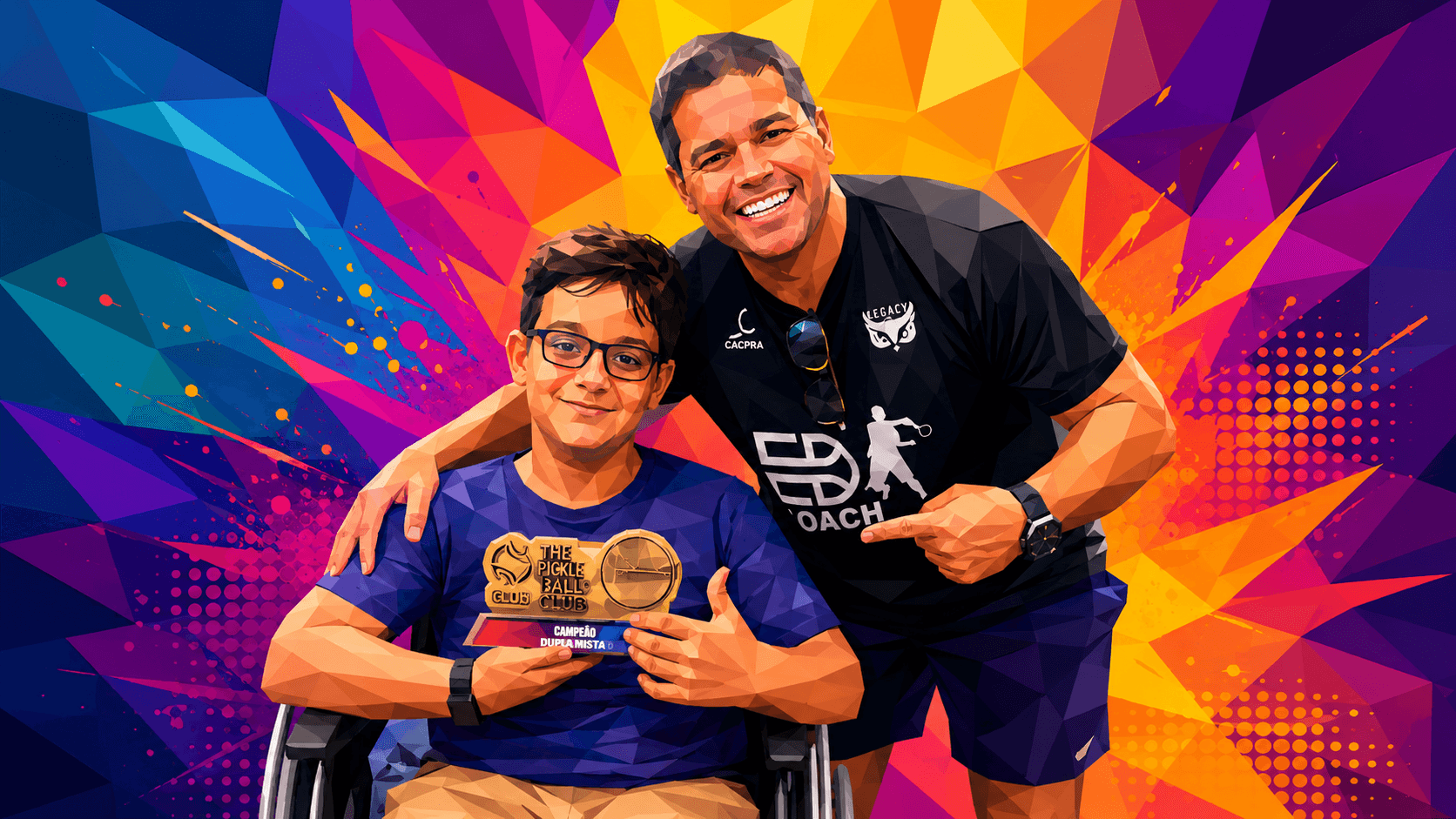
EdCoach’s adapted entry point
Seven-year-old Théo is the kind of player Brazil’s pickleball future depends on. With a lighter racket and larger, slower balls, he is able to step into a game that might otherwise have looked too fast, too technical or simply too hard to join.
That is the value of EdCoach: it changes the starting line. Instead of treating pickleball as something children must grow into, the program reshapes the sport around the child, using equipment and coaching that make the first swings feel possible. In a country where court time, access and confidence can all be barriers, that matters as much as any tournament result.
EdCoach was created by Ednardo Oliveira, who brings training from the Brazilian Paralympic Committee, the Brazilian Tennis Confederation and the International Tennis Federation. That background shows up in the method itself. This is not a novelty clinic or a one-off outreach idea. It is a structured adaptive approach built to use racket sports as a tool for human development.
The point goes beyond mechanics. Théo’s experience is framed as a place where confidence, friendship and development can grow, especially for children who might never see themselves as racket-sport players in the first place. For amateur pickleball, that is the story that matters most: access is not just participation, it is retention.
Why pickleball fits the inclusion model
Pickleball’s court size and tempo give programs like EdCoach a natural advantage. The smaller playing area reduces the physical intimidation that can come with tennis or other racket sports, while the lighter equipment and manageable pace give beginners more time to react and more chances to succeed.
That is why the sport fits more than one audience at once. Children can learn it without needing elite coordination on day one, older adults can approach it without the same physical strain as faster court games, and people with disabilities can engage through adapted equipment and coaching that respect different movement patterns and abilities. The game’s flexibility is the feature, not a compromise.
The broader lesson is that inclusion is not a side effect of pickleball. It is one of the sport’s strongest growth engines. When players are introduced through patient coaching and adjusted gear, the court becomes a place for social interaction, self-belief and a sense of possibility, not just exercise.
That is where EdCoach stands out from a standard growth story. Instead of asking how many new countries are adopting the sport, it asks who gets to play at all. For youth development, that is a bigger question, and a more durable one.
Brazil’s pickleball ecosystem is widening
EdCoach sits inside a Brazilian scene that is no longer experimental. Pickleball has spread across all five of the country’s macro-regions: South, Southeast, Midwest, Northeast and North. That matters because the sport’s future will not be defined by one city or one club. It is being built through a network of courts, local organizers and community-level momentum.
The pace of that growth is visible in the competitive calendar. São Paulo hosted the Copa Latam and the Latam Open Pickleball in September 2024, and the two events produced 368 matches. By 2025, Brazil had also introduced the Liga Supremo, giving the sport a professional structure that signals seriousness beyond casual pickup play.
The national governing body, the Confederação Brasileira de Pickleball, has said it is committed to expanding pickleball as a professional sport nationwide. That commitment matters because a healthy amateur base often grows in the shadow of organized competition. When a country builds leagues, rankings and formal pathways, it also creates new reasons for children and families to try the sport in the first place.
EdCoach fits that ecosystem perfectly. It does not compete with the professional side of the game; it feeds it. A child who learns on a lighter racket and slower ball today may become a regular club player tomorrow, but the real win is broader than that: the sport gains a larger, more diverse entry point.
The lesson for youth programs elsewhere
Brazil’s example offers a practical blueprint for any youth sports program trying to widen participation. The first move is simple: lower the barriers that make a sport feel closed off. In pickleball, that can mean lighter rackets, slower balls, smaller courts and coaching that rewards comfort and confidence before speed.
The second move is cultural. Oliveira has described the sport as showing “inclusion verdadeira,” and that idea is central to the EdCoach approach. When children, older adults and players with different physical conditions can share the same court, the sport becomes a social connector instead of a filtered pathway reserved for the most naturally athletic.
The final lesson is that inclusion and ambition are not opposites. Brazil’s pickleball growth is being powered by both at once: adaptive programs like EdCoach on one side, and national competition, professional league development and multi-region expansion on the other. That combination is what gives the sport staying power.
For amateur pickleball, this is the clearest kind of progress. It is not only about building a bigger scene. It is about building a wider one, where more children can start, more families can stay involved and more players can see themselves on the court from the very first swing.
This article was produced by Prism’s automated news system from verified source data, official records, and press releases, then run through automated quality and moderation checks before publishing. The system is built and supervised by the people who set the standards it runs under. Read our full AI policy.
Know something we missed? Have a correction or additional information?
Submit a Tip