Pickleball court growth slows as expansion boom cools
Court growth has slowed to 4% across the biggest U.S. cities, a sign that players waiting for new courts may face tighter choices and tougher siting battles.
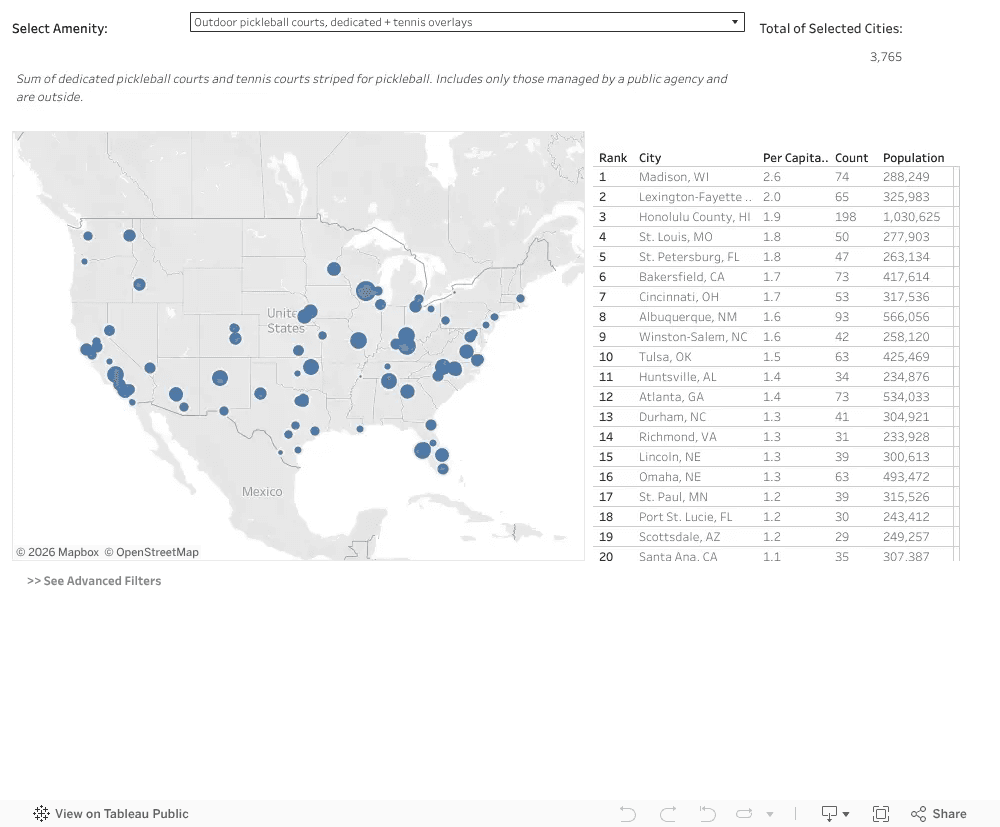
The pickleball boom is still real, but the easy part of it may be over. Across the 100 most populous U.S. cities, the number of pickleball courts rose just 4% from 2025 to 2026, a sharp slowdown from 13% growth in 2025 and 14% in 2024. For amateur players, that shift matters now: more communities are likely to fight over access, noise and land use instead of simply adding new courts wherever demand appears.
Trust for Public Land’s 2026 City Park Facts helps explain why the next phase looks more selective. The dataset covers the 100 most populous U.S. cities, which account for about 20% of the U.S. population, and those cities recorded a record $12.9 billion invested in park and recreation systems in 2026. That is still a lot of money flowing into public space, but the pickleball buildout is no longer moving at the breakneck pace that defined the last few years.
The earlier surge was enormous. CNBC reported in 2024 that outdoor public park pickleball courts in major cities had grown 650% over seven years, climbing from fewer than half of the largest U.S. cities offering formalized courts in 2017 to more than 3,000 courts across the 100 biggest cities. That expansion created obvious benefits for players who wanted more court time, but it also pushed cities into a more complicated conversation about where the game belongs and how much disruption it creates.

Noise has become the sharpest pressure point. A 2025 acoustics paper said parks departments often convert one tennis court into four pickleball courts to meet demand, and estimated about 900 popping noises per hour per court. Planning Magazine said a single pickleball strike can be about 20 decibels louder than tennis, and that turning one tennis court into four pickleball courts can create 3,600 sharp, high-frequency impulses every hour. The result has been petitions, tense council meetings, lawsuits and court closures.
That tension is already shaping how operators think about expansion. The American Planning Association has pushed setbacks, conditional-use permits and noise-mitigation tools such as barrier panels as ways to reduce conflict before construction starts. At the same time, Madison, Wisconsin, has emerged as the per-capita leader among the 100 largest U.S. cities, with 74 recognized courts and 2.6 courts per 10,000 people, a sign that some places are still building with purpose even as the broader pace cools.

Private operators are noticing the same limits. City Pickle founder Erica Desai has warned that oversaturation could eventually hit suburban markets, and said the company is being intentional about geography. City Pickle, founded in 2022 by Desai and longtime friend and tennis player Mary Cannon, operated 14 courts at Central Park’s Wollman Rink and reported 74,000 people booking court time through its app in 2024 coverage. The lesson is clear: pickleball is not fading, but the era of automatic court expansion is giving way to a tighter fight over access, maintenance and the next good site.
This article was produced by Prism’s automated news system from verified source data, official records, and press releases, then run through automated quality and moderation checks before publishing. The system is built and supervised by the people who set the standards it runs under. Read our full AI policy.
Did this article answer your question?


