Arm wrestling decoded: hook, toproll and press define the sport
The hand fight decides arm wrestling before the pin. Hook, toproll and press each show up in the wrist, fingers and pronation first.
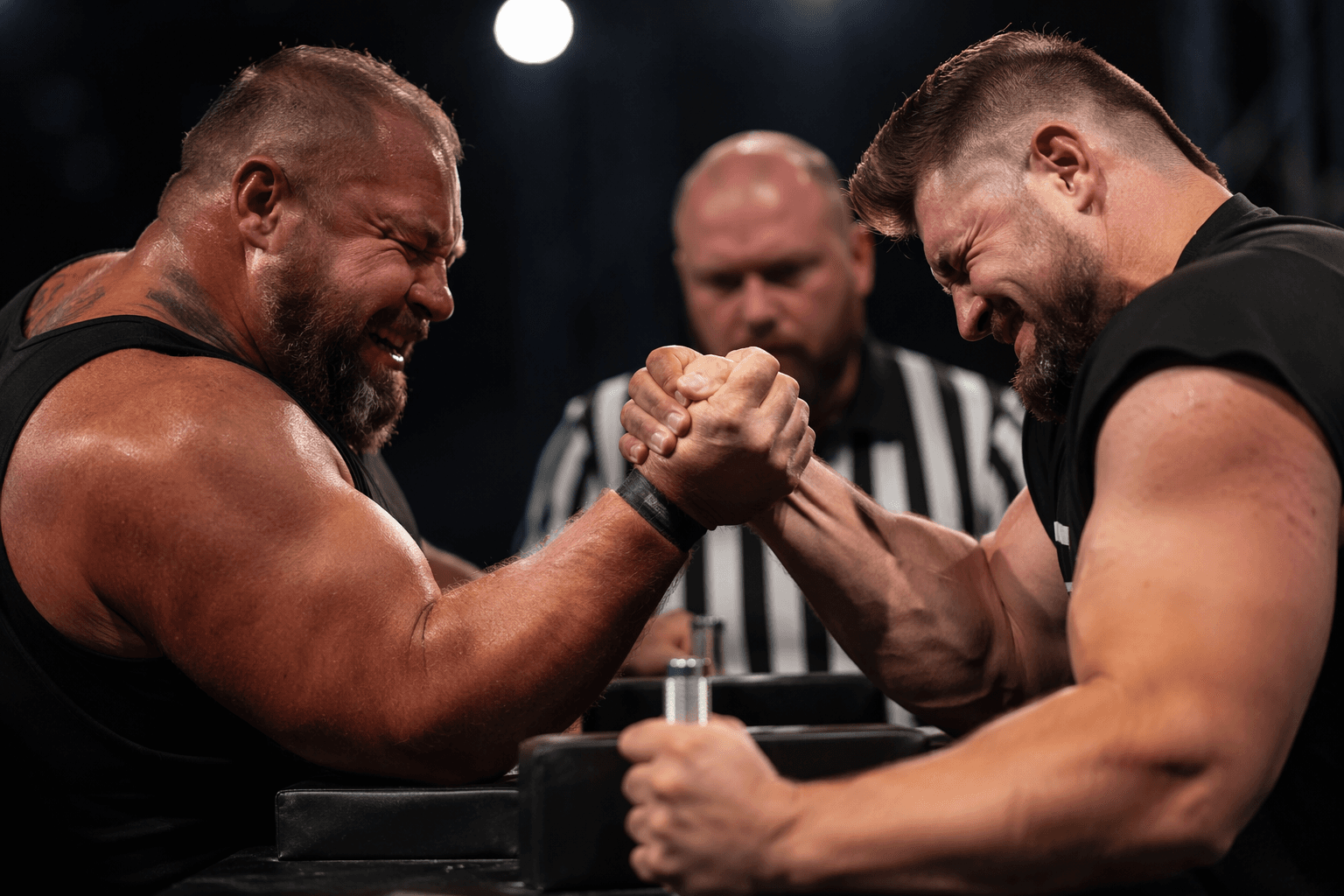
Hook, toproll and press are the sport’s three lanes. Watch the wrist, the fingers and the angle of the forearm, and you can usually read which lane a puller is trying to force long before the pin pad comes into play.
The three styles that decide the table
The hook is the inside battle. It shortens the fight, pulls the action into a tighter lane, and puts the weight on wrist cup, elbow flexion and shoulder engagement instead of long-range hand control. When a hook is working, the hand usually looks compressed and closed, with the puller trying to keep the opponent from extending the fingers or opening the wrist.
The toproll is the opposite strategy. It attacks the fingers and wrist, tries to force the hand open, and uses pronation to turn the other puller’s hand into a weaker structure. If the hook is about locking into the inside lane, the toproll is about winning height and leverage at the start, then peeling away the opponent’s grip until their power line disappears.
The press is the finish. Once the hand has been compromised, the athlete turns the pull into a body-driven drive toward the pad, using the chest, shoulder and torso to complete the pin.
What the setup reveals before the pull starts
The setup usually advertises the plan. A hook often shows a deeper cup and a shorter, more compact line to the body, while a toproll usually presents a higher hand and active fingers that look ready to climb over the opponent’s grip. The press usually does not appear as the first move at all; it comes after the hand is already damaged, when the puller can afford to drive forward with the body.
TAWF’s glossary includes terms like pronation, strap, pin pad and supermatch, but they are not jargon for insiders only; they are the language of the hand fight itself. A strap changes the grip dynamic once hands open or the referee tightens control, the pin pad is the finish line beneath the elbow, and supermatch describes a matchup format that puts the technical battle under a brighter spotlight.
A useful way to read the table is to watch three things at once:
- Wrist position, because a cupped wrist usually points toward the hook while an opening wrist can signal a toproll threat.
- Finger control, because the toproll tries to climb through the fingers and take the opponent’s hand apart.
- Shoulder and torso pressure, because the press depends on moving the force from the arm into the body once the hand battle is won.
Why pronation changes the whole fight
The styles make sense because the body does not respond the same way in every forearm position. A peer-reviewed neuroscience study found that the biceps brachii is shortest in supination and longest in pronation, and that forearm position can change neuromuscular behavior. Another peer-reviewed study found that forearm posture and elbow angle independently influence spinal excitability in the biceps brachii, with posture-specific changes in motor evoked potentials and cervicomedullary responses.
In the toproll, pronation is a central weapon. It is not only about making the hand look bad, it changes the geometry of the arm and the force line available to the puller. When pronation wins, the opponent’s wrist, fingers and elbow position all start to work against one another, and the match shifts from strength to structure.
From Petaluma to a codified sport
The modern version of the sport traces back to Petaluma, California, where Bill Soberanes promoted wristwrestling in the early 1950s and helped co-found the formal World’s Wristwrestling Championship in 1962. The first organized event was at Gilardi’s Saloon in 1952, which gives the sport a specific birthplace rather than a vague barroom origin story. By the 1962 championship, about 1,000 people paid $1 to watch.
The Petaluma event kept growing. In 1964, organizers added a lightweight division and an open women’s division.
Rules, referees and the real structure of the sport
In sanctioned competition, referees control the grip and the start, and straps, fouls, safety rules and table specifications all belong to the contest. The World Armwrestling Federation was founded in 1977, now has more than 80 member countries, and had gained GAISF membership by 2018.
A hook depends on a clean grip set, a toproll depends on an officiated start, and a press becomes a legal finishing move only if the earlier work has left the hand compromised without crossing into a foul. The referee’s role is part of the strategy because the start, the strap and the reset decide which style gets to breathe.
The injury data behind the caution
Arm wrestling carries real risk. A 2022 systematic review identified 153 arm-wrestling humeral shaft fracture patients across 57 studies, and 82 percent of those patients were male, mostly between 15 and 34 years old. The right arm was injured in 65 percent of the cases, which makes the dominant-side load and the table-side torque hard to ignore.
A 2023 retrospective study followed 27 arm-wrestling humeral shaft fracture patients from January 2013 to January 2021 and collected data on wrist position, warm-up, alcohol consumption and opponent characteristics.
How to read the bout in real time
Once you know the styles, the match becomes easier to decode. A high hand and active fingers point toward a toproll attempt, a compact wrist and inside pressure suggest a hook, and a late shift of the shoulder and torso toward the pad usually signals a press. The contest is rarely won by one clean explosion; it is more often decided by which style gets its preferred hand position first and whether the opponent can keep that structure intact.
This article was produced by Prism’s automated news system from verified source data, official records, and press releases, then run through automated quality and moderation checks before publishing. The system is built and supervised by the people who set the standards it runs under. Read our full AI policy.
Did this article answer your question?