Gary Goodridge's 1,000-man arm-wrestling feat still amazes fans
Gary Goodridge turned arm wrestling into a launchpad, winning 14 Canadian titles, 11 world titles, and a 1,000-man Japan marathon before moving into boxing and MMA.
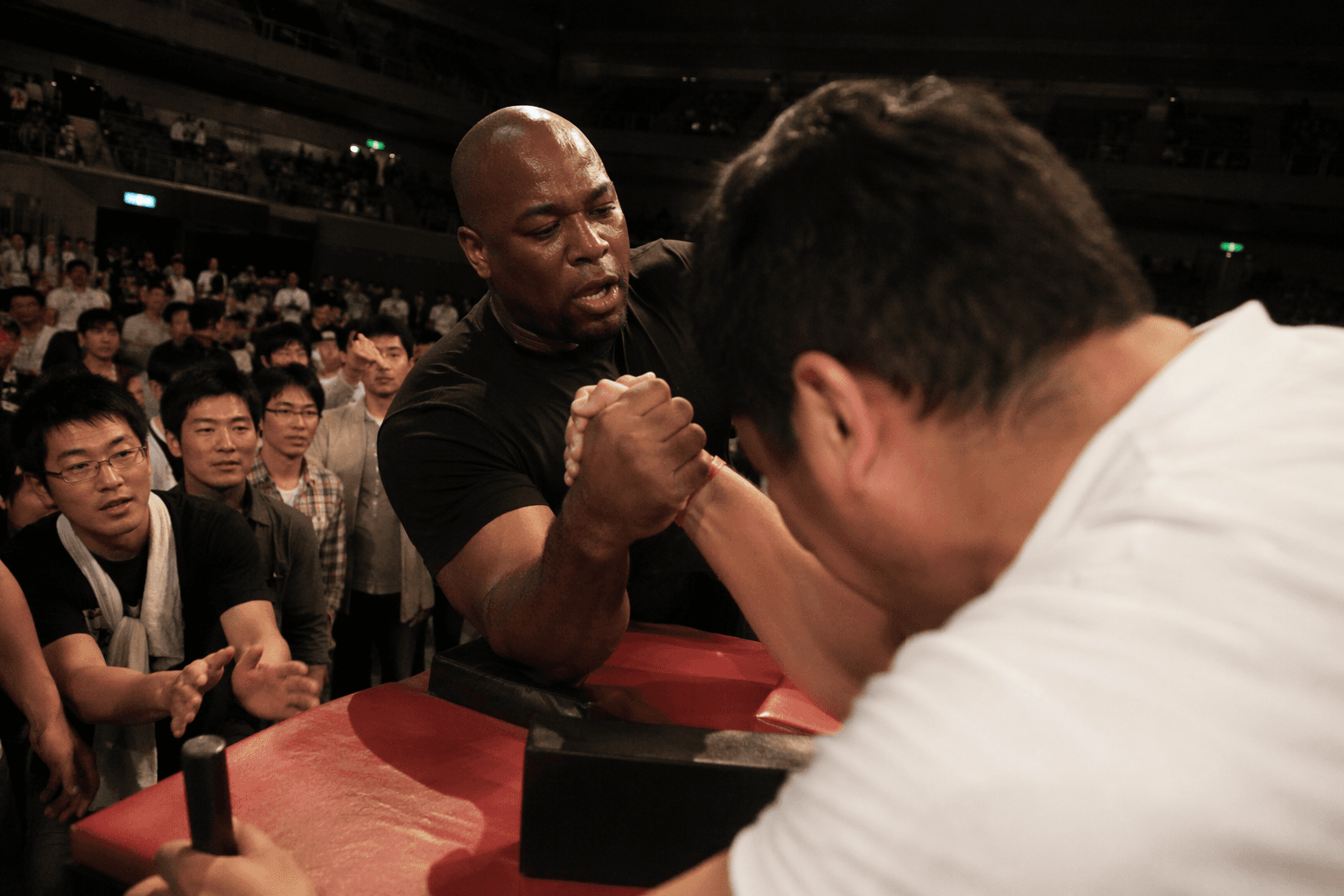
Gary Goodridge is best understood as an arm wrestler first, because everything that came later was built on what he did at the table. Born in Trinidad and Tobago in 1966 and raised in Barrie after moving there in 1973, he started weightlifting and local armwrestling at 14, then won the Canadian Arm-Wrestling Championship at 18. By the time his table career was done, he had stacked up 14 Canadian titles and 11 world titles, a record that gives his story real weight before the crossover chapters even begin.
The making of a table champion
Goodridge’s early rise shows how quickly arm wrestling can turn raw strength into competitive identity. Starting at 14 meant he had time to build more than muscle; he developed the hand control, pressure tolerance, and confidence that separate a strong lifter from a serious table threat. Winning the Canadian title at 18 also matters because it places him among athletes who were not just gifted, but already operational in the sport before most careers have fully formed.
Those 14 Canadian titles and 11 world titles are the spine of his legacy. They tell you that his success was not a one-off exhibition or a novelty run, but sustained dominance across years and formats. In a sport that often fights for attention outside its own circles, that sort of record gives arm wrestling a champion whose resume can stand beside any combat-sport résumé.
The 1,000-man day in Japan
The most famous number attached to Goodridge came in 1994, when he armwrestled 1,000 men in Japan and beat all of them in 1 hour and 15 minutes. It is one of those feats that sounds exaggerated until the date, place, and time lock it into the record. The scale is what makes it endure: not one match, not one bracket, but a relentless stream of opponents that turned endurance into spectacle.
That performance matters because it showed arm wrestling on a stage bigger than a normal tournament table. A feat like that is part stamina test, part carnival act, part public proof of what a top-level arm wrestler can absorb in a compressed stretch of time. It also helped frame the sport as something global, something with enough cultural pull to attract a mass participation stunt in Japan rather than a small local crowd.
How the table carried into boxing
Goodridge’s move into boxing was not a detour from arm wrestling; it was an extension of it. In 1993 he became the Canadian National Amateur Heavyweight Boxing Champion, and in 1994 he joined the Canadian Olympic boxing team. Those milestones show that the power base he built at the table translated well enough to matter in a ring, where strength alone is never enough but strength with timing and composure can be decisive.
Arm wrestling gives an athlete a few traits that travel cleanly into boxing: the ability to explode under pressure, the comfort of direct contact, and the habit of winning physical exchanges without hesitation. What it does not hand over automatically is footwork, distance management, or the rhythm needed to operate over multiple rounds. Goodridge’s success in boxing shows the upside of crossover strength, but the transition also underscores the limits, because a table specialist still has to learn a new geometry once the target is no longer a locked hand but a moving opponent.
MMA exposed the full crossover
By 1996, Goodridge had entered mixed martial arts, where his combat-sports arc broadened again. He became the UFC 8 runner-up, an IVC world champion, and later a K-1 Hawaii champion, which is a rare spread of results across three different competitive environments. Each one asked for something different, and that is exactly why his background mattered: the table had already taught him how to impose force and stay aggressive under stress.
MMA is where the relationship between arm wrestling and fighting becomes clearest. The sport rewards clinch strength, grip control, and the ability to dictate physical exchanges, all areas where an elite arm wrestler begins with an advantage. At the same time, MMA exposes everything the table never has to test, including striking defense, transitions, and the ability to recover after getting forced out of your preferred range. Goodridge’s results show both sides of that equation: arm wrestling opened the door, but the larger combat world demanded adaptation.
Why the wins over Brzenk still matter
His own official record also links him directly to one of arm wrestling’s defining names. Goodridge defeated Sharon Remez and John Brzenk in 1991, then did it again in 1994. That matters because Brzenk is not just another opponent in the list; beating him places Goodridge inside one of the sport’s most recognizable historical lanes.
Those wins give the story more than spectacle. They show that Goodridge’s reputation was built against elite opposition, not only through marathon demonstrations like the Japan event. When an arm wrestler who has already proven himself at the table later turns into a boxing champion and MMA titleholder, the original sport gains something important: proof that its best athletes can produce consequences well beyond the table.
Goodridge’s career still resonates because it keeps arm wrestling at the center of a larger combat-sports story. The 1,000-man feat is the headline, but the deeper case is in the record behind it: the Canadian titles, the world titles, the Brzenk wins, and the successful leap into boxing and MMA. That combination makes him one of the clearest examples of how arm wrestling can build a fighter, a brand, and a legacy all at once.
This article was produced by Prism’s automated news system from verified source data, official records, and press releases, then run through automated quality and moderation checks before publishing. The system is built and supervised by the people who set the standards it runs under. Read our full AI policy.
Did this article answer your question?