How competitive arm wrestling works, from weigh-ins to double elimination
Arm wrestling is decided as much by referees and brackets as by biceps. From weigh-ins to straps and double elimination, every match is a rules test.
Competitive arm wrestling is a governed sport first and a strength contest second. The World Armwrestling Federation, founded in 1977, built a rulebook that stretches from weigh-ins and age groups to team points, table hardware, and officiating protocol, which is why a sanctioned bout looks far more technical than a backyard challenge. Even the world stage is structured, with championships traditionally held in the last two weeks of September and right-arm and left-arm events split onto separate days.
The sport starts long before the grip
At WAF events, athletes are registered by gender, age, weight, and impairment class, which makes the field broader and more organized than casual viewers usually expect. The current registration system includes para-armwrestling and team workflows, and the federation’s present-day championships show how fully the sport has embraced formal divisions rather than one-size-fits-all brackets.
That structure goes back decades. The first WAF World Armwrestling Championship was held in 1979 in Wetaskiwin, Alberta, Canada, and the federation’s rulebook shows revisions continuing through December 2022. WAF’s headquarters are listed in Sofia, Bulgaria, and current reference material names Assen Hadjitodorov as president. The federation is also described as WADA Code compliant and as having gained full membership in the Global Association of International Sports Federations on April 20, 2018, two details that matter because they place arm wrestling inside the broader system of regulated international sport.
Weigh-ins, classes, and the bracket before the table
The first real fight in arm wrestling is often the scale. Weight classes are a formal part of the sport, and championships sort athletes into categories long before they ever touch a peg. That matters because the sport’s competitive balance depends on matching athletes inside a precise framework instead of pretending every pull is an open contest.
Tournament structure is just as important. WAF championships use double elimination, so an athlete has to lose twice before going out, and contestants are placed by random draw rather than seeding. That creates a bracket where preparation and consistency matter as much as reputation, because there is no protected path for a favorite and no shortcut once the draw is made.
The 60-second call to the table changes everything
Once athletes are called, the clock starts shaping the match. Armrefs’ competition-rules summary says contestants are given 60 seconds to come to the table after their class is announced, then they shake hands and take their grip. That time limit turns the walk-up into part of the contest, because veterans know that being late, rushed, or mentally off balance can cost them before the referee even says go.
The setup is never casual. Before the start, the referee checks wrist alignment, straight arms, and a centered position, and the grip must be palm-to-palm with the thumb knuckle visible. If either athlete moves too early, warnings can follow. In other words, the opening seconds are not a prelude to the match. They are the match.
Why referees matter as much as strength
Sanctioned arm wrestling is built around officiating detail. Armrefs says WAF uses two referees in the standard setup, a head referee and an assistant or technical referee. That structure gives the sport a degree of control that casual fans often miss, because the person managing the grip, the start, and the fouls can shape the outcome as much as the pull itself.
The sport’s officiating culture was deliberately professionalized. A referee seminar system was introduced in 1999 in Thunder Bay, Ontario, Canada, to standardize testing and guidelines for officials who wanted to work world championships. That history helps explain why modern bouts feel procedural: the referee is not just observing the action, but enforcing a shared technical language that keeps matches comparable across countries and events.

Table hardware is part of the sport, not decoration
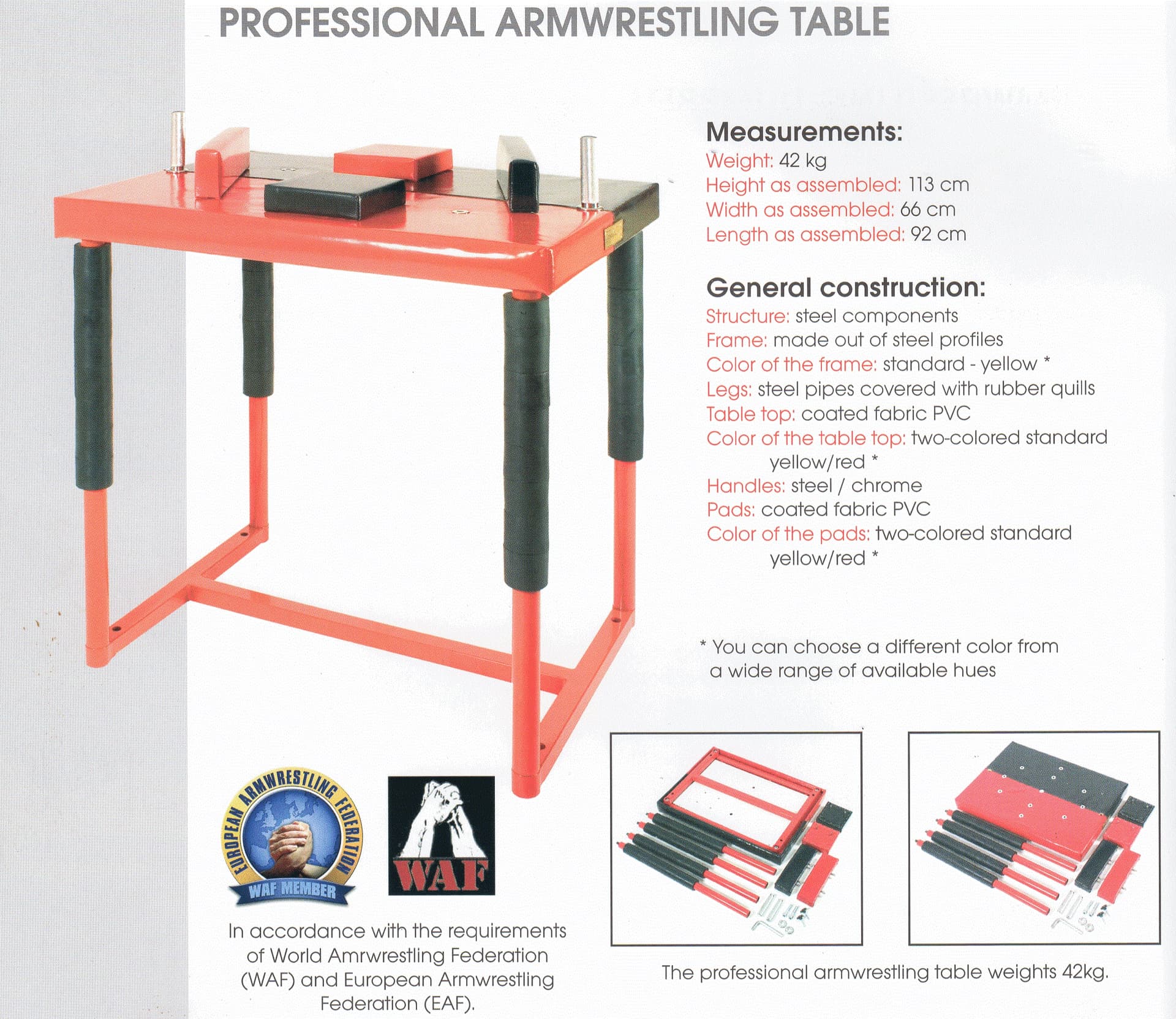
A sanctioned arm-wrestling table is its own piece of equipment, and the WAF rules treat it that way. The setup includes elbow pads, touch pads, hand pegs, straps, riser platforms, and certification standards for equipment. That level of specification is a reminder that the sport is measured down to the surface athletes push against, not left to whatever table happens to be available.
That equipment matters because small setup differences can change leverage, distance, and safety. The elbow pad keeps the planted arm in bounds, the touch pad marks victory conditions, and the hand pegs give competitors something to stabilize against before the start. The straps and risers are not accessories; they are part of how the federation standardizes the same test across every table.
Slips, straps, false starts, and elbow fouls are where matches swing
The clean pin is only one way a bout ends. Slips can force the action into a strapped restart, which changes the mechanics of the pull and often rewards different strengths than an open-hand exchange. That is why experienced pullers care so much about hand control, wrist position, and the first seconds of contact: a slip is not a reset to neutral, but a shift into a new technical phase.
False starts and elbow fouls can be just as decisive. The referee is watching for movement before the start and for a planted elbow that stays inside the pad area, and the warnings can tilt a match by forcing an athlete to play safer or risk a foul loss. For a first-time viewer, that is the part of the sport that usually looks invisible, yet it is often where a bout turns.
Team scoring reaches far beyond one match
A WAF championship is not only a collection of individual brackets. The rules define a team as all categories combined, including both left and right arm and both female and male divisions, and the team trophy is awarded based on total points accumulated across those categories. That means national federations are managing a points strategy across a full roster, not merely chasing a single headline match.
The scale of that system showed up again in 2025, when the World Armwrestling Championships in Albena, Bulgaria, brought together more than fifty national teams. That kind of turnout helps explain why arm wrestling has become a federation sport rather than a scene built only around local stars: nations are entering full squads, building medal plans across multiple ages, genders, and hand sides.
A sport with a larger international footprint
WAF is described in current reference material as having 82 member countries, a number that gives the federation reach far beyond the small-circle image many people still carry about arm wrestling. The organization’s presence in Sofia, its WADA compliance, and its GAISF recognition all reinforce the same point: this is a global rules-based sport with formal governance, not an informal sideshow.
That bigger footprint also affects funding and recognition. Once a federation has established rules, anti-doping compliance, and a world championship structure, it is in a stronger position for government recognition and sponsorship opportunities. In arm wrestling, those administrative details are not paperwork on the sidelines. They are part of what makes the sport possible at elite level, from Budapest registration pages for the 2026 European Armwrestling and Para-Armwrestling Championships to the world championship calendar that still centers the late-September season.
This article was produced by Prism’s automated news system from verified source data, official records, and press releases, then run through automated quality and moderation checks before publishing. The system is built and supervised by the people who set the standards it runs under. Read our full AI policy.
Did this article answer your question?