Over the Top world championship became arm wrestling's biggest stage
Over the Top turned arm wrestling into a traveling spectacle, then fed the sport back into Stallone's movie. The 1986 Las Vegas finale made a niche contest feel like a main event.

The biggest arm-wrestling event of the 20th century did not begin in a packed casino or on a movie set. It started with a qualifier in Beverly Hills in August 1985, then spread across North America and out to Europe, Israel, and Japan before ending in an 18-hour marathon at the Las Vegas Hilton on July 26, 1986. That is the whole trick of Over the Top: it did not just crown champions, it built a road show that made arm wrestling look large enough to deserve one.
A championship built like a prizefight
Over the Top worked because it borrowed the logic of boxing promotion and pushed it into a sport most people still associated with bars and back rooms. The event was not a one-night novelty; it was a year-long funnel of qualifiers that gave the final in Las Vegas a real sporting ladder and a national, then international, footprint. By the time the brackets reached the Hilton, the contest had already done the hard marketing work of making competitors feel like they had earned a spot in a championship ring.
That scale mattered because arm wrestling already had an organized competitive structure before Over the Top arrived. The World Armwrestling Federation was founded in 1977, and the first WAF World Armwrestling Championships were held in 1979 in Wetaskiwin, Alberta, Canada. Over the Top did not invent the sport. It gave it a bigger stage, a louder soundtrack, and a camera angle that made casual viewers think they were looking at a main event instead of a niche strength test.
The Las Vegas finale changed the money and the image
The final in Las Vegas was built to feel like a monster show. A circulated 1986 invitation says more than 800 armwrestlers qualified for the finale, and the superheavy winner got a $250,000 Volvo truck. For the era, that is not side-show money. That is major-event promotion, the kind of prize package that tells athletes, sponsors, and fans the sport is trying to play in a different weight class.
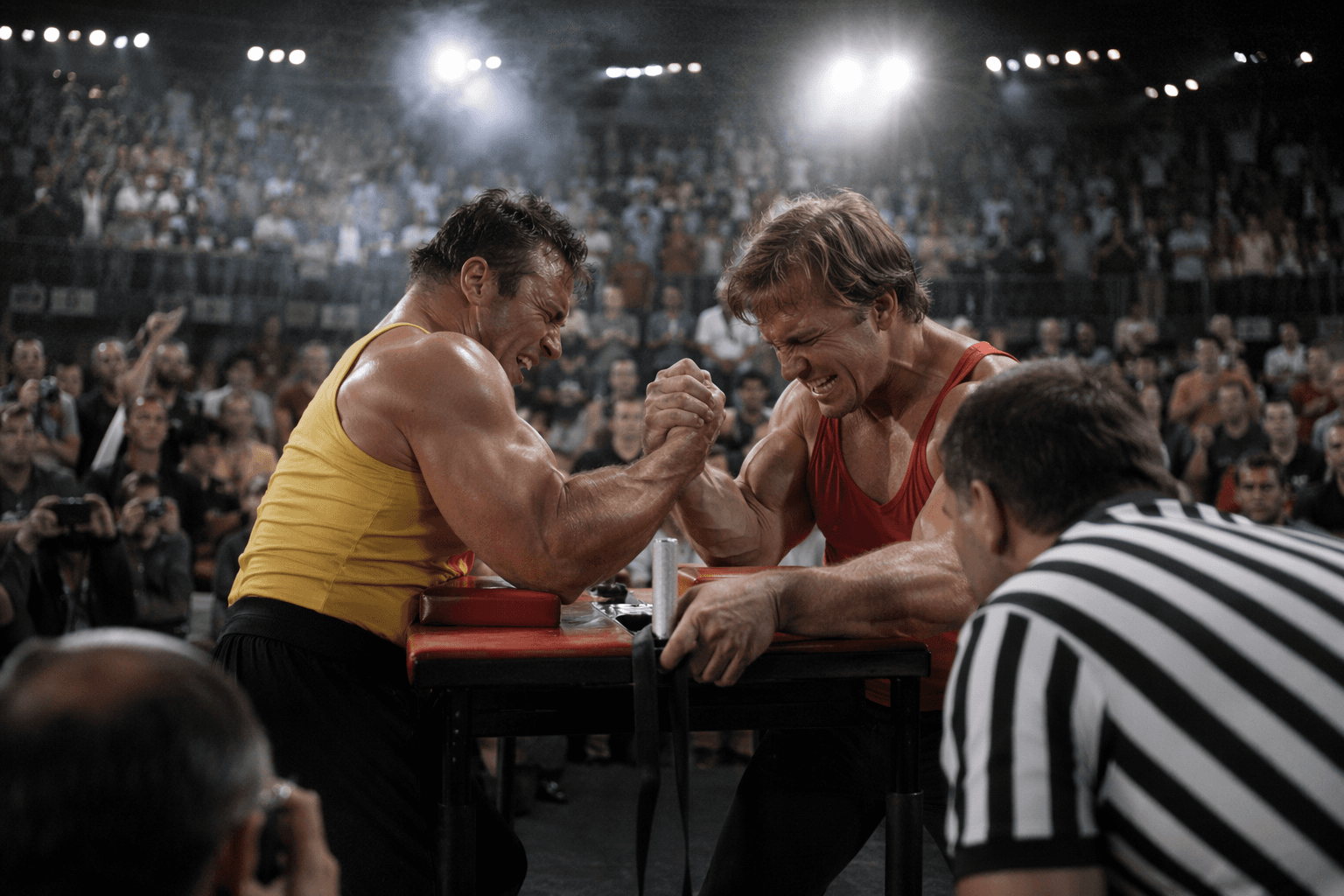
The Armwrestling Archives says the Over the Top purse eclipsed other major arm-wrestling prize money that year, including significant cash at the Stand-Up Nationals. That detail is the tell: the event did not simply outdraw other competitions in attention, it reset expectations for what arm wrestling could offer if someone treated it like a legitimate TV property. The Las Vegas Hilton finale turned the sport’s public image from local tough-guy pastime into something with lights, branding, and stakes big enough to attract outsiders.
The movie and the tournament fed each other
The next year, Sylvester Stallone’s Over the Top took that real championship energy and sold it to a mass audience. Warner Bros. frames the film around the World Armwrestling Championship in Las Vegas, with Stallone’s trucker Lincoln Hawk moving under the glaring lights of the event. The key is that the film did not just borrow the idea of arm wrestling as a dramatic device. It used footage from the actual tournament and featured many real-life armwrestlers, which gave the movie a rough authenticity that pure studio invention could not fake.
IMDb trivia adds one of the most revealing details in the whole story: Stallone’s own arm-wrestling scenes were filmed the day after the real finals, in the same location, with the same audience extras. That is not ordinary sports filmmaking. That is a feedback loop, where the live event and the fictional version of it blur into a single cultural moment. The tournament made the film look real, and the film made the tournament feel like the start of something bigger than a single championship.
The champions who gave the spectacle its weight
The spectacle would have collapsed without credible winners, and the 1986 results supply them. The Armwrestling Archives lists John Brzenk as the winner of the truckers superheavy division, Scott Norton as a winner in one of the superheavyweight divisions, and Christine Jaworski and Liane Dufresne among the women’s division winners. Those names matter because they prove the Las Vegas finale was not just a Hollywood prop dressed up as sport. It was a real multi-division championship with actual athletes whose victories still anchor arm-wrestling history.
Brzenk’s name, especially, is the kind of detail that separates lore from marketing. When a sport produces recognizable champions, the event stops being a stunt and starts becoming a reference point. That is what Over the Top left behind: not just a movie tie-in, but a results sheet strong enough to stand on its own.
Why Over the Top still sits at the center of the sport
The lasting lesson is simple. Over the Top understood that the public did not need a tutorial on elbow position or hand control before it could care about arm wrestling. It needed a frame, a venue, and a sense that the outcome mattered beyond the table. The Beverly Hills qualifier, the international expansion, the 18-hour Las Vegas finale, the $250,000 truck, and the film that followed all worked together to do one thing: make a niche strength contest look like a prizefight the whole country could understand.
That is why the event still looms so large. It gave arm wrestling a cinematic identity, a bigger paycheck, and a more visible cast of champions, then handed that image to a generation of fans who had never seen the sport treated with this much scale. Over the Top did not just become arm wrestling’s biggest stage. It taught the sport how to act like one.
This article was produced by Prism’s automated news system from verified source data, official records, and press releases, then run through automated quality and moderation checks before publishing. The system is built and supervised by the people who set the standards it runs under. Read our full AI policy.
Did this article answer your question?