Petaluma bar challenge sparked the world’s wristwrestling championship
A Detroit Tigers trainer’s bar-room brag in Petaluma became a March of Dimes match, then the blueprint for modern wristwrestling. Rules, officials, and annual titles turned it into a sport.

A bar-room boast in Petaluma did more than settle a grudge. It gave wristwrestling a repeatable format: a named challenger, a referee, a charity tie-in, a public venue, and a title worth defending. That is the Petaluma story in its cleanest form, and it explains why the sport moved from local dare to organized spectacle so quickly.
The challenge that changed the script
The spark came in late 1954 at Mike Gilardi’s bar in Petaluma, where Jack Homel, a Detroit Tigers trainer, kept saying he had never lost a wristwrestling match. Bill Soberanes, a local columnist and promoter, heard the claim, found rancher Oliver Kullberg as a credible opponent, and turned the showdown into a March of Dimes fundraiser on January 27, 1955.
The first match lasted nearly three minutes and ended in a draw. That mattered because it gave the contest an instant narrative: no fluke finish, no one-off stunt, just a tightly contested result that could be repeated under similar conditions. Soberanes, Gilardi, and Homel then formed a committee to plan future events, which is the moment the sport stopped being a bar challenge and started becoming a circuit.
Winter timing was not random. The archive record says organizers chose it because it fit the March of Dimes calendar and Homel’s offseason schedule, and Homel later served as contest referee in planning for subsequent events. That combination of charity, calendar, and officiating gave the event a structure that modern promoters would recognize immediately.
Petaluma’s annual model
The annual Petaluma tournament began in 1955, and that is the real pivot point. One match is a novelty. A recurring tournament is a sport with memory, records, and a future. The Armwrestling Archives lists yearly March of Dimes contests in Petaluma from 1955 through 1961, with champions including Cliff Parlee, Charley Petersen, Earl Hagerman, and Duane Benedix.
This is where Petaluma pulled arm wrestling out of the casual setting and into a public bracket. The event was no longer just about who could pin whom across a bar table. It had a calendar, an annual winner, and a local identity that could be sold, repeated, and covered. That repeatability is the mechanism that still powers modern arm wrestling events: consistent rules, recognizable divisions, and a title fans can follow from year to year.
The sport’s early geography shows Petaluma was part of a wider organizing wave, not an isolated oddity. The archives place the first known tournament in Montreal in 1905, note that basic rules were published by George Jowett in 1930, and identify annual tournaments in Holyoke, Massachusetts, beginning in 1958. Petaluma, though, was where the American version found a durable public home in 1955 and then built outward from there.
How a local contest became a world championship
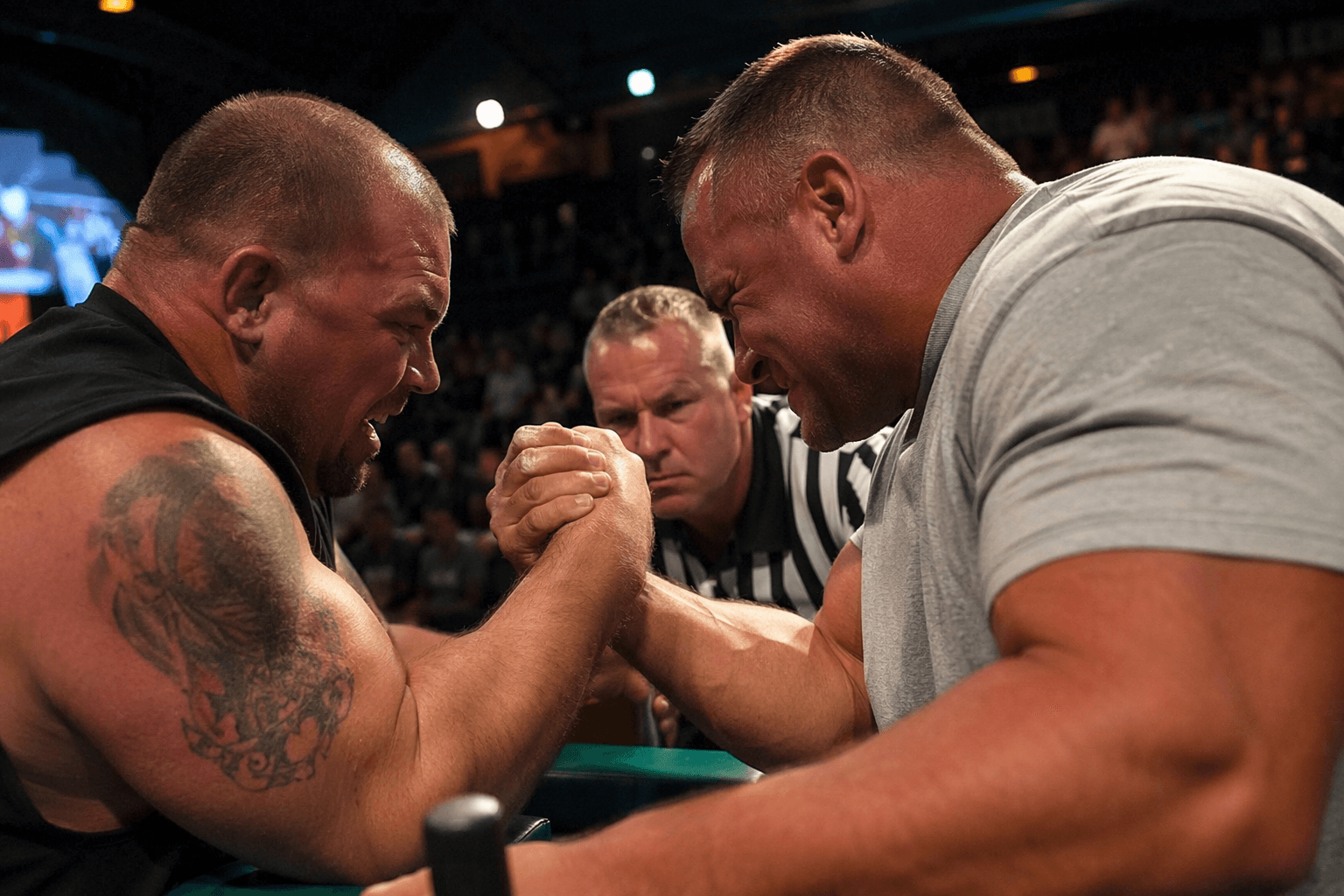
By 1962, the Petaluma event had outgrown its original frame and took on a bigger name: the World’s Wristwrestling Championship. That first world event was held at Hermann Sons Hall and drew about 1,000 spectators who paid $1 admission. Petaluma’s mayor, Everett Mantzen, formally opened the contest, which tells you exactly how far the sport had traveled from a tavern dare to a civic event.
The inaugural championship was still modest by modern standards. It had only one men’s right-hand division, a detail that cuts through any temptation to romanticize the early days. The format was simple because the sport was still defining itself, but that simplicity also made it portable. Once organizers proved they could sell a single clean bracket to a hall full of paying spectators, the model could expand.
That expansion came fast. By 1963, after the competition had outgrown the bar, it had moved to Hermann Sons Hall and been renamed the World’s Wristwrestling Championship. By 1964, the event had multiple weight classes and a women’s division, showing how quickly the sport developed a more formal competitive structure once the basic template was in place.
Why Petaluma mattered beyond the headline
The Petaluma formula had four ingredients that still define successful arm wrestling events today.
- Organized competition: the annual March of Dimes contests gave the sport continuity from 1955 onward.
- Codified rules and officiating: George Jowett’s 1930 rules provided an early framework, and Homel’s role as referee helped reinforce the idea that wristwrestling could be judged cleanly.
- Media appeal: Soberanes was a columnist as well as a promoter, which meant the story could be told as a local rivalry, a charity event, and a civic spectacle all at once.
- Local promoters and civic buy-in: Gilardi’s bar, Hermann Sons Hall, Mayor Everett Mantzen, and the Petaluma city government all helped convert a private test of strength into a public institution.
That mix is why Petaluma still stands out. Plenty of places hosted strength contests. Petaluma built a format around them. The bar was the seed, but the committee, the fundraiser, the hall, the admission price, and the championship label turned wristwrestling into something legible to fans and sponsors alike.
The title Petaluma claimed and made real
Bill Soberanes called Petaluma the “Wristwrestling Capital of the World,” and the city made that title official in 1969. That nickname was not just local boosterism. It matched the evidence on the ground: the annual tournament, the world championship branding, the growing bracket structure, and the kind of sustained public interest that could support about 1,000 people in a hall paying to watch.
The point of the Petaluma story is not that one bar match was famous. It is that the people around it made smart, practical choices that modern arm wrestling still depends on. They picked a charity hook. They chose a season that worked. They used a referee. They staged it in a public hall. They admitted a crowd for a dollar. They expanded the divisions when the field demanded it.
That is how a wager became a sport, and why Petaluma still reads like the place where wristwrestling learned how to sell itself.
This article was produced by Prism’s automated news system from verified source data, official records, and press releases, then run through automated quality and moderation checks before publishing. The system is built and supervised by the people who set the standards it runs under. Read our full AI policy.
Did this article answer your question?