Study compares arm wrestlers' elbow flexors with strength-trained athletes
Elite pullers do not just build gym strength. The comparison study points to a specialized elbow-flexor system, with forearm hypertrophy standing out against strength-trained athletes.
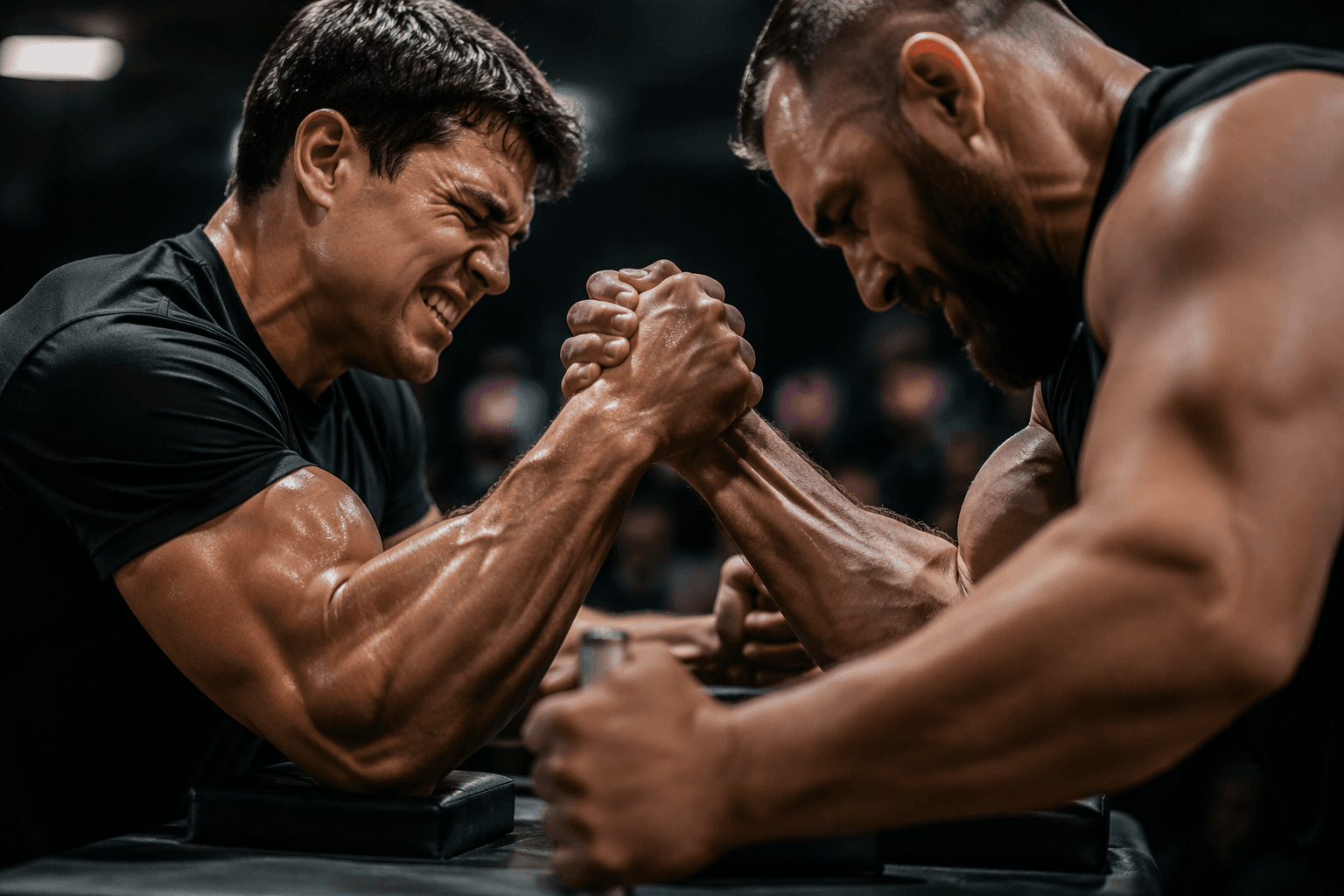
The comparative study indexed as PMID 40030076 found greater forearm hypertrophy in elite arm wrestlers, with p = 0.005 and an effect size of 1.54. Arm wrestling loads the elbow under unusual leverage, high tension and short-duration maximal effort, so the real question is not who can curl more weight, but who can keep producing force when the table stops behaving like a gym.
What the comparison is actually asking
Mauro Pascoa, Mirtes Stancanelli, Thiago F. Lourenço, Virginia Tessarotto, Gil Guerra-Junior and Fernanda L. Lazarim framed the study around three lenses: morphology, physiology and performance. Morphology covers how the elbow-flexor complex and the surrounding tissues are built. Physiology asks how that tissue behaves under strain. Performance shows who turns that structure into match-winning force at the table.
Arm wrestling is not a loose test of upper-body strength. The sport asks the elbow flexors to work in a confined range, resist counter-pressure, and stay organized while leverage changes in real time.
What elite pullers do differently at the elbow
Forearm hypertrophy is the clearest signal from the study. Bigger, denser forearm tissue gives arm wrestlers a better base for force transmission when the hand, wrist and elbow are all under stress at once.
Elite pullers do not merely develop general arm strength; they develop a local system tuned to the table. A conventional strength athlete can be impressive in the rack, on a barbell, or in a machine-based test, yet still lack the same elbow-flexor profile when the task becomes an isometric, opponent-driven battle.
Why ordinary strength training is not the same thing
The 2015 Journal of Physical Education and Sport paper approached the question from a different angle. In it, L.V. Podrigalo, S.S. Iermakov, M.O. Nosko, M.N. Galashko, N.I. Galashko and Assen Hadjitodorov reported higher strength in armwrestlers than in a control group of students who did not practice arm wrestling, with significance at p < 0.05 across all tested parameters.
A student control group and a training room lifter are not the same thing, and the armwrestling data keeps proving it. General strength work can build useful capacity, but it does not automatically create the exact elbow-flexor shape and output that arm wrestling rewards. For coaches, arm wrestling specialization is visible in the forearm and elbow flexors, not just in total gym numbers.
What this means for training, injury prevention and talent ID
The training takeaway is obvious: the elbow has to be trained as a sport joint, not just as part of a larger arm day. If the adaptation that shows up most clearly is forearm hypertrophy and forearm-specific strength, then the work has to respect table positions, joint angles and high-tension effort rather than chasing only broad upper-body size.
- Training should prioritize the kind of loading that matches the table, because the sport demands force in a short range and under live resistance.
- Injury prevention has to start at the inner elbow. A PMC narrative review treated arm-wrestling injuries as a recognized medical topic, and the unusual medial epicondyle break can hit teen arm wrestlers when growth and muscle force get out of balance.
- Talent development should look for athletes who add forearm size and sport-specific strength quickly, not just those who move the heaviest weights in a conventional gym setting.
For younger pullers, the medial epicondyle is the inner-elbow attachment point that can fail under the sport’s leverage, and that risk changes how aggressively youth programs can load the arm.
Why the sport keeps pushing the science forward
The World Armwrestling Federation was established in 1977, and the New Zealand ArmWrestling Federation’s history pages stretch from Ancient Times through the 1950s, the 1960s and into the modern era. India is set to host the World Armwrestling Championship from October 26 to November 7, 2026.
This article was produced by Prism’s automated news system from verified source data, official records, and press releases, then run through automated quality and moderation checks before publishing. The system is built and supervised by the people who set the standards it runs under. Read our full AI policy.
Did this article answer your question?