Why the WAF arm wrestling table is engineered for fair competition
The WAF table is not furniture, it is the sport’s rulebook in wood and steel. Every inch, from the 7-by-7 pads to the 1-inch peg, shapes fairness, safety, and legal technique.
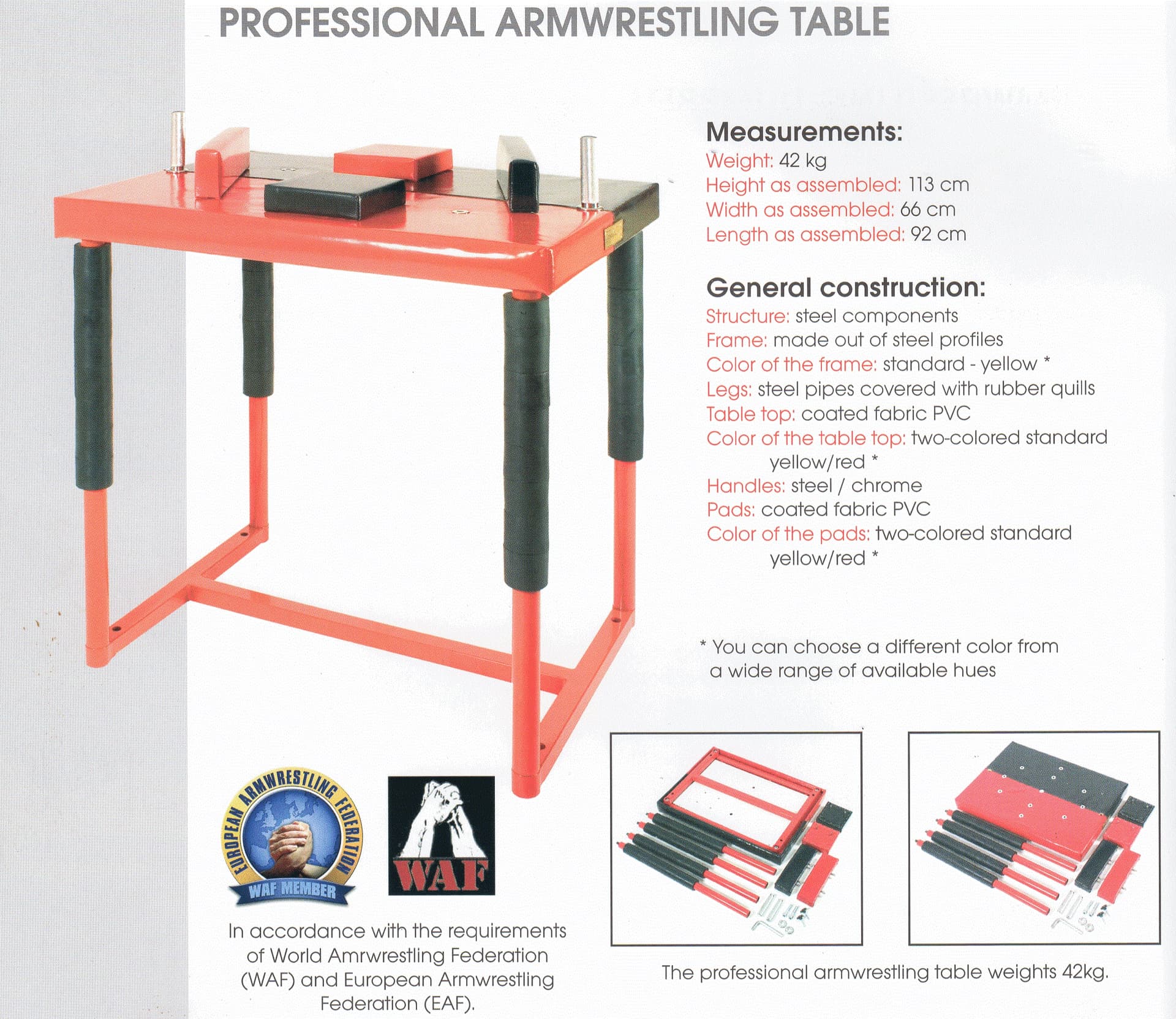
The cleanest way to understand arm wrestling is to stop looking at the biceps first and look at the table. The World Armwrestling Federation built the contest around a standardized apparatus, and that geometry is what keeps a match in Sofia, Wetaskiwin, or anywhere else on the calendar from becoming a different sport entirely. The table does not just hold the athletes up. It defines the start, the finish, the legal lane, and the level playing field.
The table is the sport’s hidden machinery
A WAF regulation table is specified down to the inch because the sport needs repeatability more than improvisation. The frame measures 28 inches wide and 19 inches deep, while the tabletop is 36 inches by 26 inches. The overall height is 40 inches from the floor to the top of the table, 42 inches to the top of the elbow pad, and 44 inches to the top of the touch pad. Those numbers are not decoration. They create the same contest surface for every elite puller, whether the match is in a local event or a world championship.
That consistency matters because arm wrestling is full of tiny leverage battles. A table that is too high changes shoulder angle. A pad that sits too low or too far apart changes how quickly an athlete can load the wrist, rise through the hand, or flatten into a press. WAF’s specs remove that drift and make the contest about execution, not about who got the friendlier setup.
Why the elbow pads matter more than casual fans think
The most important piece of the table is often the one casual observers barely notice: the elbow pad. WAF rules set each elbow pad at 7 inches by 7 inches and 2 inches thick, and the 2022 rulebook describes them as 17.8 cm square and 5.1 cm thick, made of heavy high-quality foam and covered in vinyl or rexin. Those pads are the launch point for every legal start. They give both athletes the same small zone of support and force the battle into a controlled space.
That control shapes technique from the first second. The athlete cannot wander, slide, or reset the elbow at will. Referees can see whether the elbow stays planted, whether the arm stays centered, and whether the wrist alignment is legal at the start. In a sport where a millimeter can decide whether a hook survives or a top roll collapses, the pad is not padding. It is enforcement.
The touch pads create a finish line that cannot be argued with
The touch pads are just as important because they turn a scramble into an unmistakable end point. WAF specs put them at 2 inches by 10 inches and 4 inches high. When a hand is driven to that pad, the match ends with a visible result instead of a subjective judgment about who had the better moment. That is why arm wrestling can look chaotic in the middle and still finish with a clean, referee-friendly decision.
The height matters too. At 44 inches, the top of the touch pad sits above the table surface in a way that helps officials and athletes read the pin line clearly. That visibility reduces confusion in fast presses and shoulder-driven finishes, where the hand can cover a lot of ground in a fraction of a second. The table gives the sport a finish line, and without it, the result would be a debate instead of a pin.
The hand peg turns the free hand into part of the rules
The round hand peg is another piece of equipment that looks simple but does real work. WAF tables use a peg that is 1 inch in diameter and stands 6 inches above the table. That peg gives the non-pulling hand a fixed, safe anchor instead of letting athletes brace on a slippery edge or invent their own support point. It keeps the free side of the body controlled, which matters when torque starts climbing through the shoulder and trunk.

That is also where the peg helps safety. A legal contest in arm wrestling is not only about force; it is about force applied inside a shape that referees can monitor. The peg gives competitors a stable point for balance while keeping both athletes from drifting into improvised positions that are harder to officiate and more likely to create unsafe body angles. In a sport built on maximal effort, that one-inch cylinder does a lot of quiet work.
Technique changes when the table is regulated
This is where the WAF table separates elite arm wrestling from a barroom pull. The rules require proper wrist alignment and a centered arm position at the start, and the table is the tool that makes those requirements visible. The athlete cannot hide bad positioning on a regulation surface. If the elbow creeps, the wrist collapses, or the start breaks down, the table exposes it.
That changes how elite pullers attack the match. A tighter elbow zone rewards containment and first-move control. A fixed peg rewards balance. A defined touch pad rewards clean finishing mechanics. The table does not eliminate style, but it channels style into a framework where a hook, a top roll, or a press can be compared from one event to the next without guessing what the equipment did to the outcome.
From one championship room to a global federation
The standard did not appear out of nowhere. The World Armwrestling Federation was founded in 1977, and the first WAF World Championship was held in 1979 in Wetaskiwin, Alberta, Canada. Historical records say that event drew four countries and nearly 75 total entries, which is a small field by modern standards but a crucial one for the sport’s formal growth. John Miazdzyk is identified as a host of that first championship and as one of the founding figures in the federation structure.
That history explains why the table matters so much. The early organizers were not just staging a contest; they were building a system that could travel. WAF is now described as having 82 member countries, and that kind of reach only works if the equipment means the same thing everywhere. A world title loses meaning if the table changes from country to country. The standardized table is what lets a championship in one nation speak the same language as a championship anywhere else.
Why the dimensions still tell the whole story
Every measurement on the WAF table points in the same direction: fairness you can see. The 28-by-19 frame supports the apparatus. The 36-by-26 top gives the athletes a consistent stage. The 7-by-7 elbow pads lock down the start. The 2-by-10 touch pads define the pin. The 1-inch peg keeps the free hand honest. Together, those parts turn raw strength into a regulated contest where technique, leverage, and control can be judged the same way every time.
That is why the table is the sport’s most important piece of equipment. It is the reason arm wrestling can be brutal, precise, and comparable at the same time.
This article was produced by Prism’s automated news system from verified source data, official records, and press releases, then run through automated quality and moderation checks before publishing. The system is built and supervised by the people who set the standards it runs under. Read our full AI policy.
Did this article answer your question?