Women’s arm wrestling follows the same rules, classes as men
Women’s arm wrestling isn’t a softer version of the sport. The same table, techniques and foul system apply, with fairness created by weight, age and impairment classes.
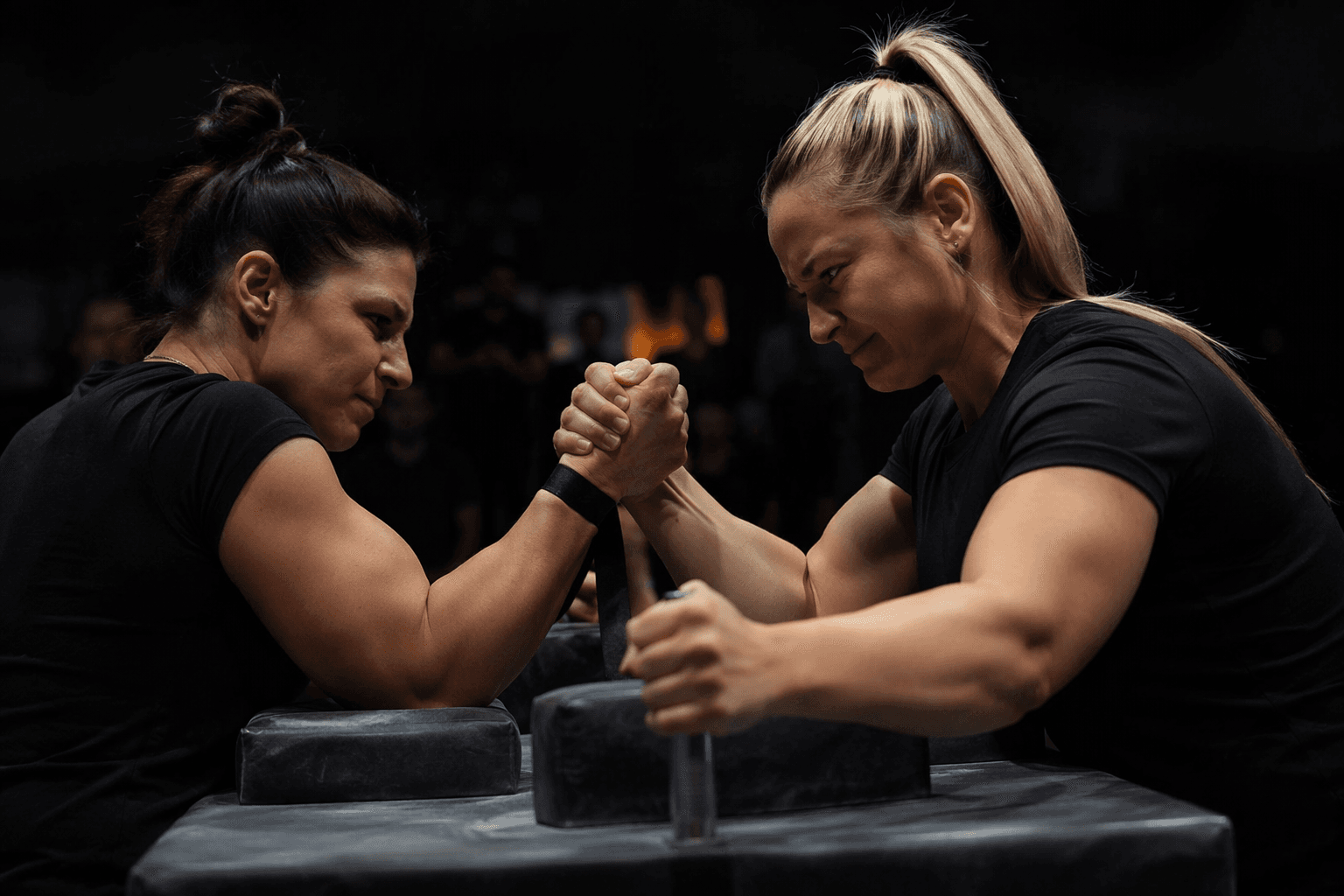
Women’s arm wrestling lives under the same competitive rules as men’s arm wrestling, and that is the point. The same table, the same equipment, the same hook, toproll and press techniques, and the same foul system all apply. What separates matches is not a different version of the sport, but the bracket system that sorts athletes by body size, age and impairment so the contest stays meaningful.
Same sport, same mechanics
The clearest misconception around women’s arm wrestling is that it needs its own rulebook. It does not. Athletes stand at the same regulation table, pull with the same straps and pads, and chase the same hand control, elbow position and finish that define the sport for everyone else. Right-arm and left-arm competition are split into separate classes, but the underlying mechanics do not change.
That matters because arm wrestling is built on technical variation as much as brute force. A hook, a toproll and a press are not gendered moves. They are the same tactical choices, judged by the same foul system, whether the pull comes from a women’s bracket, a men’s bracket or a para-class. The sport’s credibility comes from that consistency.
How fairness is actually created
Fairness in arm wrestling comes from classification, not from rewriting the game. The World Armwrestling Federation’s registration platform sorts athletes by gender, age, weight and impairment, and it uses the same competition infrastructure to place para-athletes, including Cerebral Palsy classes, into the event structure. That is not a side system tacked on after the fact. It is built into the way athletes enter, are assigned classes and are recorded for federation purposes.
The International Federation of Armwrestling shows the same logic at championship level. Senior women are divided into 52, 57, 63, 70, 78 and +78 kg classes. Masters women are separated into 63, 78 and +78 kg. Junior classes add age to the equation, then weight, while disabled classes are subdivided again, by whether athletes compete standing or sitting and by impairment type such as visual or hearing impairment.
That structure is why a women’s final is not a novelty act. It is a properly bracketed contest, with the sport narrowing the field until the matchup is close enough to test technique, endurance and table control. The more carefully the classes are drawn, the more the sport reveals skill instead of mismatch.
Para-armwrestling is part of the core calendar
The official calendars make that inclusion visible. The World Armwrestling Federation’s 2026 schedule lists the European Armwrestling and Para-Armwrestling Championships in Budapest, Hungary. The same registration system used for standard entry is used for athlete data and class assignment, which shows that para-armwrestling sits inside the sport’s main administrative flow.
The International Federation of Armwrestling’s 2025 world championship results in Baku went even further in showing how integrated the categories are. Team scores were published separately for disabled standing, disabled sitting, junior disabled standing and junior disabled sitting, alongside senior results. That kind of reporting makes the structure plain: para-classes are not hidden off to the side. They are part of the championship ledger.
For anyone who thinks arm wrestling is simply “men’s strength sport with women added,” the administrative record says otherwise. The same federation machinery handles gender, age, weight and impairment because the sport has already decided what fairness looks like.
A long history, not a modern accommodation
Organized, rules-based arm wrestling is a 20th-century development, and women have been part of that organized history for at least 50 years. Archival material points to women’s divisions at events such as the Petaluma World Wristwrestling Championship, along with other early women’s brackets that were already built into competition rather than appended later.
Separate archival results also document women’s classes in international competition in the 1980s. That history matters because it shows women’s arm wrestling did not emerge as a softened or promotional offshoot. It developed inside the same competitive culture that shaped the sport’s broader rules, tables and tournament formats.
The Canadian Armwrestling Federation’s results archive adds another layer of proof. Its records of World Armwrestling Federation results go back to 1979, offering a long paper trail for how deeply the sport has depended on structured classes and repeatable championship formats. The archive is a reminder that arm wrestling has long treated brackets as part of the sport’s identity, not as an administrative afterthought.
What the bracket system tells you when you watch
Once the divisions are set, the matches become easier to read. A women’s final is not asking viewers to learn a different sport. It is asking them to watch the same playbook in a bracket that matches the athletes in front of them. That means the same table setup, the same hand fights, the same fouls and the same attempts to drag an opponent off center or shut down a lane.
The class system also explains why international calendars matter. The International Federation of Armwrestling’s 2026 event listings include a world championship in Japan and European championships in Codlea, Romania. Along with Budapest’s European and Para-Armwrestling Championships, those dates show an active global circuit in which women, juniors, masters and para-athletes all compete under the same sport-wide architecture.
That is the real story of women’s arm wrestling. The sport does not become fair by changing the rules for women. It becomes fair by using the same rules, then separating athletes into the right weight, age and impairment classes so the contest can actually measure what matters.
This article was produced by Prism’s automated news system from verified source data, official records, and press releases, then run through automated quality and moderation checks before publishing. The system is built and supervised by the people who set the standards it runs under. Read our full AI policy.
Did this article answer your question?