Women’s arm wrestling pioneers and champions trace the sport’s early history
Women’s arm wrestling reaches from Petaluma’s 1964 world title to modern Hall of Fame careers, with a deep championship lineage already in place.
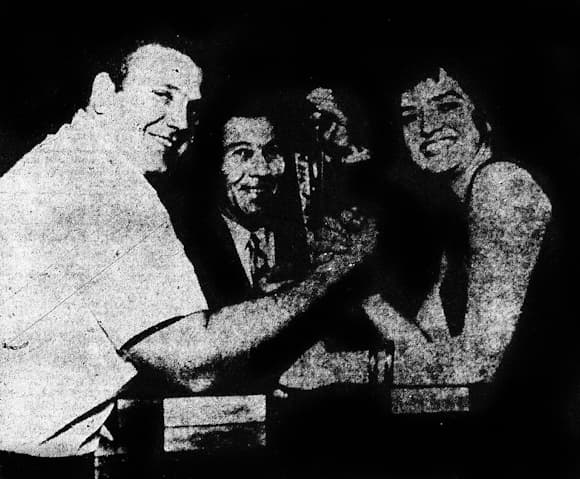
Women’s arm wrestling does not begin as a side note or a recent add-on. The record already reaches back to Petaluma, where the 1964 World’s Championship Wristwrestling Tournament crowned Barbara Sappington and left Skippy Johnson as runner-up, with a women’s division fully built into the event.
A lineage that was already organized
The early Petaluma scene matters because it shows structure, not novelty. The Armwrestling Archives trace the event from a March of Dimes wristwrestling fundraiser into a genuine world championship by the early 1960s, complete with established rules and a purpose-built table. That is the point too often missed in casual coverage: women were not waiting on a modern era to arrive before they had a platform.
The chronology preserved there also names an early chain of contenders and champions, including Barbara Sappington, Susan Dior, Mickie Novas, Linda Iverson and Emily Matterazzo. That list is important because it shows how quickly women’s competition formed its own competitive memory. By the time Sappington won in 1964, the women’s side already had recognizable names and a documented ladder of challengers.
The Petaluma result gives that lineage a hard benchmark. Barbara Sappington stands as the 1964 women’s division world champion, while Skippy Johnson’s runner-up finish confirms that the bracket was not ceremonial. It was a real title race, and it belongs in the sport’s core history.
Why the modern era is built on old talent
Joyce King gives the modern side of the story its strongest anchor. The New Brunswick Sports Hall of Fame says she came to arm wrestling almost by accident at age 30, then about 10 years later defeated a Russian rival superheavyweight to become the best female arm wrestler in the world. That arc is exactly what makes women’s arm wrestling so compelling: careers can begin late, peak across long stretches, and still produce world-class dominance.
King’s résumé is built for serious historical treatment. Her Hall of Fame profile credits her with 18 national championships, 18 World Arm Wrestling Federation medals, 12 world golds, 4 silvers and 2 bronzes. It also lists Women’s Arnold Classic Arm Wrestling Challenge victories in 2007, 2008 and 2016, which shows staying power across multiple eras of the sport rather than a single breakout season.
That breadth changes how the women’s division should be read. It is not a one-generation story; it is a sport where champions can stack titles across decades, move through elite circuits, and remain relevant as the competitive landscape expands. King’s path from late starter to global benchmark is one of the clearest examples of how deep the talent pool has become.
Builders matter as much as champions
Lori Pow adds the other kind of legacy that often gets overlooked. The Canadian Armwrestling Federation Hall of Fame says she was the first woman MAWA president and also served as a director, which means her impact ran through governance as well as competition. In a sport that depends heavily on organizing, class structure and event culture, that kind of leadership is part of the championship record.
Pow’s title haul gives the administrative role even more weight. The same Hall of Fame page credits her with 24 national championships and 7 World Armwrestling Federation world titles. That combination of officeholder and champion is a reminder that women did not just compete within the sport’s growth. They helped build its modern institutions.
That institutional footprint matters for the way the sport is remembered. A division with presidents, directors, world champions and long-running national title holders has already moved far beyond the novelty stage. It has a lineage that can be traced through both brackets and boardrooms.
The Canadian record book shows the depth
The Canadian record-holders page widens the lens beyond a few famous names. Josée Morneau is listed with 30 open and senior national titles and 56 combined national titles, a total that speaks to long-term dominance at multiple levels. Laura Webb is listed with 13 World Armwrestling Federation world golds, another clear sign that women’s arm wrestling has produced repeat winners rather than one-off champions.
The same page ties Joyce King for the most WAF world golds among Canadian women with 6, reinforcing how crowded and accomplished the top tier already is. These are not isolated accomplishments sitting in separate decades with no connective tissue. They form a record book dense enough to support debates about eras, regions and the evolution of training standards.
Taken together, King, Pow, Morneau and Webb show why the women’s side of arm wrestling is one of the sport’s most underappreciated talent stories. The names are not speculative. The titles are counted. The titles span national and world levels. The sport’s history is already full of women who have won often enough to define the standards around them.
A sport now divided into precise classes
The World Armwrestling Federation’s registration system shows how formalized the modern sport has become. Athletes are registered by gender, age, weight and impairment, which means today’s competition is carefully segmented rather than loosely organized. That structure makes women’s records easier to compare within class, and it also shows how much the sport has matured since the early Petaluma days.
This matters for performance analysis because title runs are now built within an increasingly specific framework. The modern women’s side is not a single open field. It is a structured competition system where weight, age and disability categories create multiple championship pathways, each with its own hierarchy of elite pullers.
That is one reason the women’s side deserves to be followed as a serious championship landscape. There is history at the start, depth in the middle and a detailed competitive architecture now. The sport did not just discover women’s arm wrestling recently. It has been documenting champions, building institutions and producing world titles for decades, and the record already proves it.
This article was produced by Prism’s automated news system from verified source data, official records, and press releases, then run through automated quality and moderation checks before publishing. The system is built and supervised by the people who set the standards it runs under. Read our full AI policy.
Did this article answer your question?