Axe throwing splits into three disciplines under WATL rules
WATL's rulebook turns axe throwing into three distinct tests: Hatchet, Big Axe, and Hatchet Duals. The split changes distance, equipment, pressure, and how champions are made.
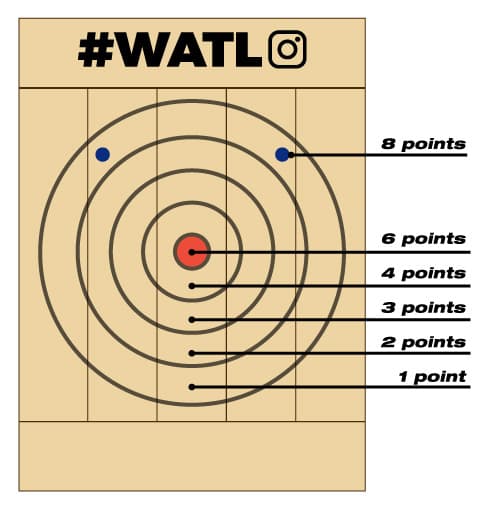
Axe throwing reads very differently once you stop treating it as one event and start treating it like three. Under World Axe Throwing League rules, Hatchet, Big Axe, and Hatchet Duals each reward a different kind of control, and a standard game still comes down to 10 throws, with points decided by where the axe sticks and ties broken in sudden-death Killshot throws. That structure is what gives the sport its edge as a real competition rather than a novelty: same target, different skill test.
Hatchet: the baseline every fan knows
Hatchet is the format most people picture first, and for good reason. It is the purest expression of the sport’s core rhythm: one thrower, one axe, one lane, one target, and a 12-foot fault line that keeps the release honest. The scoring is simple in concept but exact in execution, because every stick placement matters across the 10-throw frame.
That simplicity is deceptive. Hatchet is about repeatability under pressure, where a thrower has to match release, rotation, and pace over and over while the lane gets tighter emotionally with every throw. WATL’s rules make it the sport’s baseline discipline, which is exactly why it works as the anchor for the broader game.
Big Axe: heavier tool, longer line, narrower margin
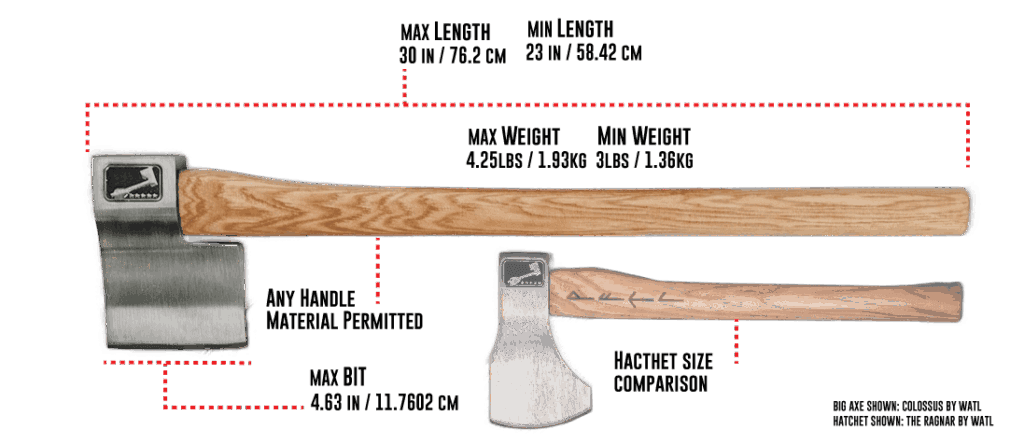
Big Axe changes the equation immediately. WATL’s Big Axe rules require competitors to throw from behind the 17-foot line, without crossing the 15-foot mark, and the equipment itself is tightly defined, with the axe weighing between 3.00 and 4.25 pounds, the head between 2.25 and 3 pounds, a wooden handle between 23 and 30 inches, and a blade no wider than 4 5/8 inches. Even the lane has a different footprint, with a minimum length of 20 feet, compared with 15 feet for a standard lane.
That is why Big Axe is not just Hatchet with more mass. The longer distance and stricter tool dimensions demand a cleaner rotation, a more repeatable release, and enough penetration to stay in the board once it lands. In practice, Big Axe turns precision into a different kind of test, one that punishes small errors in setup and forces throwers to solve a more demanding physical problem.

Duals: where the same target becomes a team sport
Hatchet Duals brings a second layer of pressure because the lane is no longer only about individual accuracy. WATL lists Duals as one of its three official disciplines, and official leagues require two teams of four throwers for the format, compared with at least four throwers for Hatchet and Big Axe league play. The target is still the target, but now coordination and match rhythm matter as much as the throw itself.
That team structure changes how momentum works. In Duals, the pressure is shared, but so is the responsibility, and the format rewards throwers who can settle quickly, keep a team in sync, and manage the emotional swings that come with a partner format. It is the closest axe throwing gets to the dynamics of relay sports, where timing and communication become part of the scoring environment even before the axe reaches the board.
Why the discipline split matters for the sport’s future
WATL’s identity has been built around standardization. The organization says it was founded in 2017, describes itself as the global governing body for the sport, and says its mission is to promote axe throwing as a professional sport, standardize rules and safety protocols, and support the World Axe Throwing Championships. Its affiliate network now stretches to 300+ venues across 20 countries, which shows how far the sport has moved beyond a bar-room sideshow into a structured competition with real commercial reach.
That growth depends on clear divisions between disciplines. When a sport has separate lanes for Hatchet, Big Axe, and Duals, it becomes easier to teach, easier to officiate, and easier to market as a legitimate circuit with distinct specialties. The split also gives venues more to build around, because a Big Axe lane needs different space than a standard lane, and team formats create different programming possibilities than solo play.
From leagues to championships, the ladder is real
The ranking structure gives the rules their teeth. WATL says sanctioned tournaments award points toward regional and national standings, and top performers advance through regionals to the World Championship on ESPN. The league also said the 2025 World Axe & Knife Throwing Championships were scheduled for April 3-6, 2025, in Appleton, Wisconsin, with a prize pool of more than $60,000, and its 2025 league seasons were stretched to 9-10 weeks to fit that championship calendar.
By the 2026 circuit rules, the three-discipline model is no longer optional at the top level. Sanctioned National tournaments must host Open Hatchet, Big Axe, and Hatchet Duals, which locks the sport’s structure into the competition calendar itself. That requirement makes the three-event framework feel less like a branding choice and more like the operating system of the sport.
The officiating structure tells the same story
The people around the sport reflect the same maturation. Benn MacDonald said he had been throwing since 2016 and coaching since 2017 after opening Far Shot Recreation, and WATL later named Tabitha Fisher Head Judge while Benn moved into the Head of Officiating role. Those titles matter because a sport does not stay standardized on branding alone; it needs judges, officiators, and league rules that make a lane in Tulsa feel the same as a lane in Stamford.
That is the real significance of treating axe throwing like track-and-field or swimming. Different disciplines are not a complication to be explained away; they are the sport’s competitive identity. Hatchet measures consistency, Big Axe measures control under a harsher physical setup, and Duals measures how well a thrower performs inside a team frame. Under WATL’s rules, axe throwing does not have one shape anymore, and that is exactly why it has become a serious sport.
This article was produced by Prism’s automated news system from verified source data, official records, and press releases, then run through automated quality and moderation checks before publishing. The system is built and supervised by the people who set the standards it runs under. Read our full AI policy.
Did this article answer your question?