Axe throwing’s roots trace back to logging contests and timber sports
Axe throwing was not born in a bar. Its modern lanes trace back to logger contests, broadcast sports, and the tools that built North American forests.
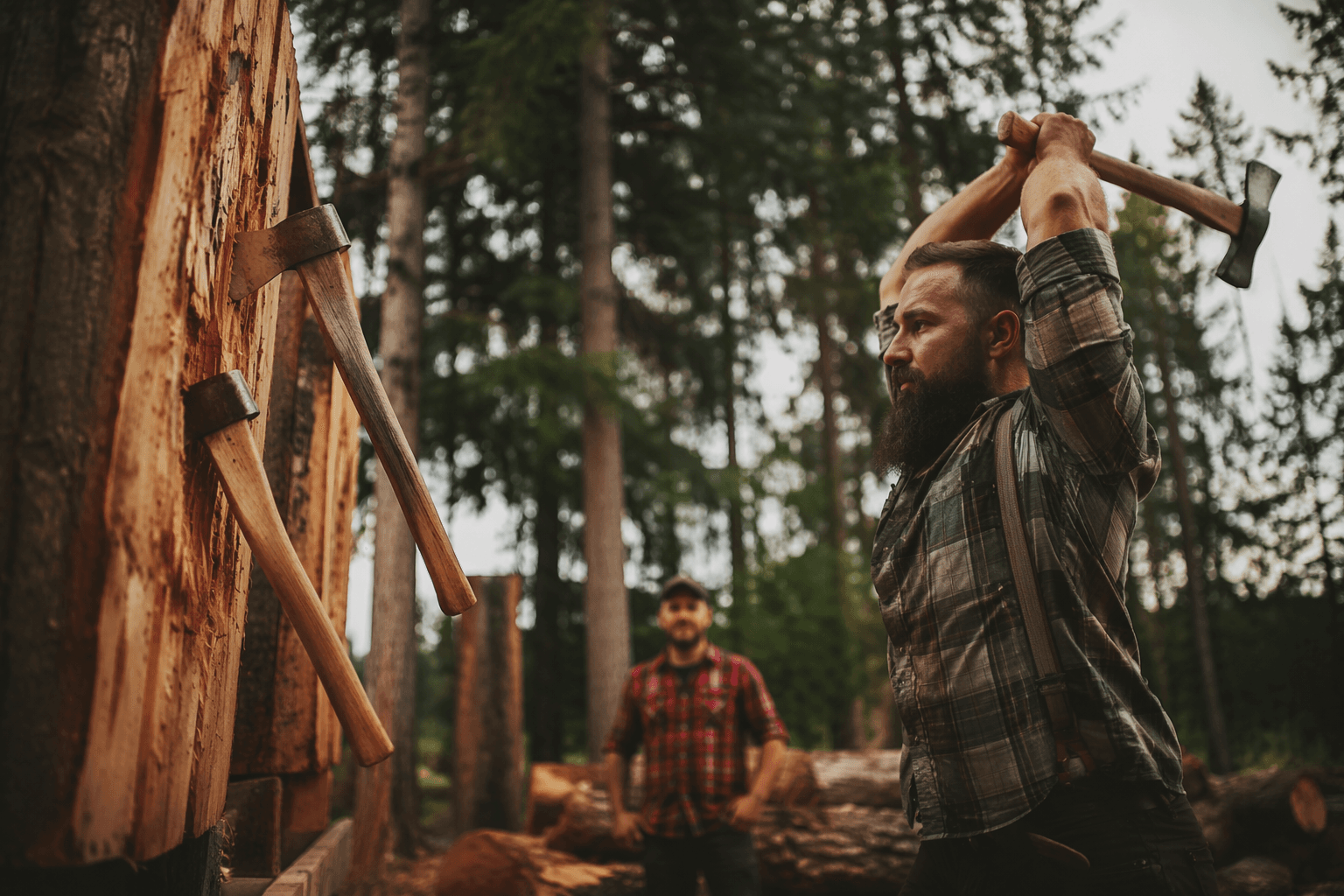
Modern axe throwing gets miscast as a novelty because the setting feels casual, but the sport’s real lineage is workwear, not gimmick. The same accuracy that once mattered in the woods now matters on a marked lane, where modern leagues have turned a labor skill into a repeatable, spectator-friendly contest built on precision, control, and pressure.
From forest tool to competitive discipline
The deeper story starts in logging culture, where axes were everyday tools long before they became sporting equipment. The Canadian Encyclopedia places the professional lumberjack’s emergence around the turn of the 18th century and notes that logging in North America stretched back thousands of years, beginning with Indigenous people and continuing after the arrival of Europeans.
That history matters because the tool itself shaped the sport. In the early 19th-century eastern forest industry, workers commonly used two basic axe types, including the poll axe, with a narrow head weighing about 1.5 to 2.5 kilograms. That weight range tells you this was never a toy version of a tool; it was a working implement built for power, balance, and repeatable cuts.
The sport’s first audience was the crowd, not the bar
Logger sports did not become organized by accident. STIHL TIMBERSPORTS® says the tradition runs more than 150 years and grew out of Australia and New Zealand before spreading to Canada and the United States, with early public competitions and wagers turning workplace skill into entertainment. One origin story points to Ulverstone, Tasmania, in 1870, while a public competition in Latrobe, Tasmania, in 1891 stands among the first recorded showcases.
That shift from labor to performance is the key to understanding modern axe throwing. Once the crowd started watching for technique, the measure changed from getting the job done to proving who could do it best, again and again, under pressure. The sport’s appeal has always been that blend of force and finesse: enough raw power to drive the blade, enough composure to place it exactly where it belongs.
Television gave the old craft a new stage
The modern identity of logger sport sharpened when it became broadcast-ready. STIHL TIMBERSPORTS® says its U.S. series launched with ESPN in 1985, helping create recognizable stars and a format that could be repeated, compared, and sold to viewers beyond the woods. That mattered for athletes such as Arden Cogar Jr., Matt Bush, David Bolstad, and Jason Wynyard, whose names became part of the sport’s mythology precisely because the events were public and measurable.
The structure also tells the story. Today, STIHL TIMBERSPORTS® organizes up to six traditional logger-sport disciplines, split between three axe events and three saw events. That is not a loose stunt circuit; it is a codified multi-discipline sport, with each event demanding a distinct mix of timing, rhythm, and efficiency.
How modern leagues rebuilt the sport for city venues
The urban version of axe throwing took the lumberjack instinct and remade it for indoor spaces, timed matches, and audience flow. BATL says it was founded in Toronto in 2006 by Matt Wilson and describes itself as the pioneer of urban axe throwing, with the story beginning among friends at a cottage outside Toronto before moving into commercial venues. BATL also says more than 2 million people have experienced axe throwing at its North American locations, a marker of how quickly the activity moved from novelty to mass participation.
That commercial expansion is part of the sport’s legitimacy. CBC reported in 2013 that axe throwing was already a growing sport in Toronto, and by 2015 the activity had spread to Hamilton through a Toronto transplant who had thrown at BATL. Those milestones show how a local scene turned into a regional culture before the broader league era took hold.
Rules, safety, and accessibility changed the look without erasing the roots
The modern lane is not a logging camp, and that is the point. WATL, founded in 2017, positions itself as the global governing body for the sport and says its network includes 300+ affiliated venues. Its materials also describe the league as spanning 20 countries on one page and 47 countries on another, a sign of how quickly the sport’s footprint has grown across different parts of its site and its membership ecosystem.
Those numbers reflect more than business momentum. Modern league play had to redesign the old skill for safety, accessibility, and spectator appeal, which means standardized lanes, controlled throws, and a format that can work in bars, dedicated venues, and tournament settings. The inherited element is obvious in the motion of the throw; the redesign is just as important in how the sport now protects players and makes the action legible to crowds.
What stayed the same, and what changed
The clearest continuity from logging contests to league play is the premium on consistency. Whether a competitor is splitting wood in the forest or trying to hit a target on a marked lane, the winning trait is repeatable control, not spectacle for its own sake. The sport still rewards the same basic qualities that made logger competitions compelling in the first place: steadiness, muscle memory, and the ability to stay composed when everyone is watching.
What changed is the environment around the throw. The axe is no longer primarily a trade tool, and the crowd is no longer gathered around an improvised wager. In place of the woods, there are organized venues; in place of one-off bragging rights, there are seasons, governing bodies, and recognizable stars. That is how axe throwing earned legitimacy: by keeping the old test of skill while building a modern structure that could survive in public, on camera, and across countries.
This article was produced by Prism’s automated news system from verified source data, official records, and press releases, then run through automated quality and moderation checks before publishing. The system is built and supervised by the people who set the standards it runs under. Read our full AI policy.
Did this article answer your question?