How axe throwing lanes and targets are built for precision
A sanctioned axe-throwing lane is engineered, not improvised. Exact dimensions, layered targets, and gear rules turn novelty into a repeatable sport.
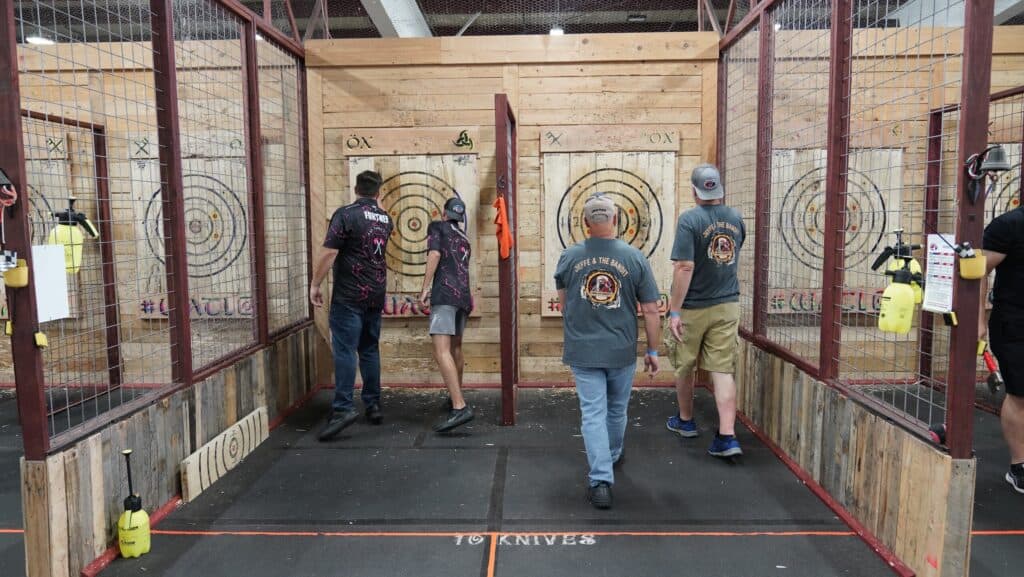
Only two throwers and a judge belong inside a sanctioned World Axe Throwing League lane. Two targets, fixed containment, and five feet of clear space behind the line keep the throw controlled, the scoring consistent, and the space designed around precision rather than improvisation.
The lane is the first piece of equipment
A WATL-sanctioned lane is not just open floor space facing a wooden wall. It requires fences or walls for containment and five feet of clear space behind the throwers. The league also sets a minimum ceiling height of 12 feet and a minimum lane width of 12 feet, with lane length minimums of 15 feet for hatchet lanes and 20 feet for Big Axe lanes.
The clear space behind the throwers gives each athlete room to reset without crossing into another person’s motion path, while the ceiling minimum protects both arc and recovery if a throw climbs high. The width and length minimums help keep one lane from influencing another, which matters when a match is decided by a few points and one misread stick.
For affiliated venues, those lane numbers are recommendations as long as the target itself follows gameplay rule target specifications. A venue can vary in layout, but if the target and throwing geometry stay within spec, the lane remains legitimate.
The target is built in three layers
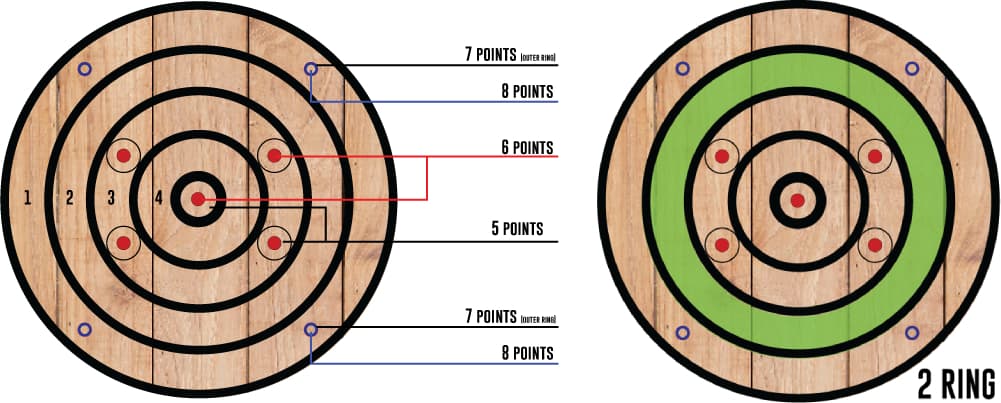
WATL specifies a three-layer construction: an OSB or plywood wall backing, horizontal 2x10 backboards packed tightly together, and the visible target boards that players actually strike. The board pieces are 4-foot 2x10 lumber, with dimensions of 1-1/2 inches thick, 9-1/4 inches wide, and 4 feet long.
The backing gives the target structure, the horizontal backboards create a stable strike surface, and the front boards provide the repeatable face that players train against lane after lane. A consistent board depth and layout reduce the guesswork in scoring, because the thrower learns one kind of rebound, one kind of bite, and one kind of wear pattern instead of adjusting to whatever wood happens to be on the wall.
Once the face starts to wear, the target changes behavior, and the sport’s margin for error shrinks. WATL’s layout is designed to keep that wear controlled, so a scorer, a coach, and a competitor all see the same target shape and the same playing surface.
Standardized gear keeps the release honest
WATL’s official rules set exact limits for a legal hatchet: no more than 3 pounds in weight, no longer than 19 inches from the top of the eye, and no more than 4 inches at the bit. The axe must have only one sharp bit, and it cannot have sharpened spikes or blades on the poll.
A heavier or longer tool changes rotation and timing, which would make competition less comparable from one athlete to the next. A single sharp bit and an unsharpened poll lower the chance of dangerous contact in a packed throwing area where only two throwers and a judge are supposed to be inside the lane.
The International Axe Throwing Federation uses a slightly different hatchet standard. Its standard-axe rules require a wood handle, a single-bit blade, and a handle length between 13 and 17 inches. That narrower handle window reinforces repeatability in grip and release, giving competitors a tool that behaves predictably under pressure.
Scoring and officiating depend on repeatable setup
WATL’s sanctioned competition is scored over 10 throws, and after those 10 throws the highest score wins. That only works if the surrounding infrastructure is standardized. If the lane is too short, the target too uneven, or the gear inconsistent, the score stops meaning the same thing from match to match.
WATL gives the Head Judge authority to interpret and apply rules in the interest of fair play, which makes officiating part of the competitive structure rather than an afterthought. In a sport built around precision, the judge becomes the final guardrail that keeps a close match from becoming a debate over setup or equipment.

The official rules cover sanctioned hatchet, Big Axe, and hatchet duals competition in one system.
Why these standards gave the sport its credibility
The modern governance of axe throwing is recent. WATL was established in 2017 and has more than 300 affiliated venues across 20 countries. Its mission is to elevate axe throwing into a legitimate global sport, and its competition pathway runs to the World Axe Throwing Championship.
The International Axe Throwing Federation was established in 2016. Its rule system dates back more than 16 years and supports league play for more than 20,000 competitive axe throwers, with regional championships feeding into the International Axe Throwing Championship. The federation focuses exclusively on developing the competitive sport among independent organizations.
This article was produced by Prism’s automated news system from verified source data, official records, and press releases, then run through automated quality and moderation checks before publishing. The system is built and supervised by the people who set the standards it runs under. Read our full AI policy.
Did this article answer your question?