WATL explains circuit points, bids and prize pool rules for tournaments
WATL’s 2026 circuit rewards planning as much as throwing, with clear bid paths, Circuit Points, and tier rules shaping every season decision.

WATL’s 2026 circuit is built to reward precision before the first blade leaves the hand. The new system ties bids, Circuit Points, and tournament tiers into one ladder, so the smartest season plans now start with where to throw, when to travel, and which discipline to chase for the best shot at WAKTC.
The circuit is now a map, not a maze
The biggest shift is structural: WATL says the 2026 qualifying system was shaped by several seasons of committee review and community feedback, with the goal of making qualification clearer and more transparent. That is a real change in how the sport functions, because it replaces older trickle mechanics with published benchmarks that competitors can track all year.
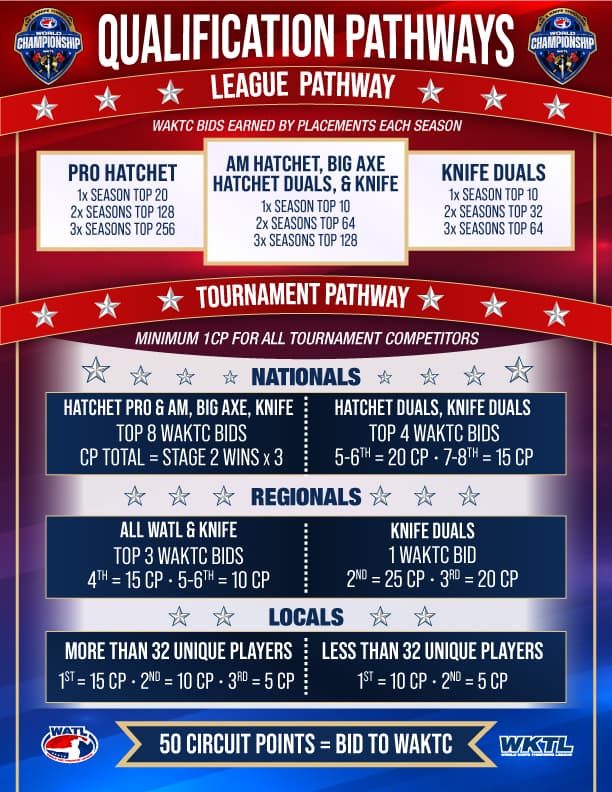
The league’s tournament circuit is split into three tiers: Nationals, Regionals, and Locals. Those tiers do not just label event size, they define how far a thrower can move up the board, how many bids are available, and how much weight each result carries in the season-long chase for championship access.
How bids and Circuit Points actually move
Every sanctioned tournament now feeds the same larger system. WATL says all tournaments, regardless of tier, provide Circuit Points based on participation, and each division or discipline must have at least 8 competitors or 6 teams to be considered for bids or Circuit Points. The rules update also says Circuit Points go to the top 40 percent of finishers in each division, and completing at least 2 games in any sanctioned WATL tournament earns 1 Circuit Point.
That means even a smaller result can matter, but only if you keep showing up in the right fields. Local events over 32 competitors in a division are eligible for bids and Circuit Points, while smaller locals still award points at reduced levels, so a busy local schedule can keep your season alive without forcing constant long-haul travel.
Regionals sit above that layer and sharpen the stakes. They award bids and points at the top of the field, while Nationals carry the strongest bid payouts, including direct WAKTC bids for top finishers in hatchet, big axe, and duals divisions.
What Nationals and Regionals demand from your calendar
WATL has tightened the calendar as part of that structure. The 2026 circuit has only one National per season and three Regionals per season, and Nationals and Regionals may not be scheduled within a 6-hour drive of each other or in the same region within a 2-to-3-week window, depending on region and thrower density.
That spacing changes travel strategy immediately. If you are chasing points, the smart move is no longer to stack every marquee event you can reach, but to choose the region where your schedule, budget, and division depth line up best. The National application window ran from October 1 to October 15, 2025, with the final National schedule due by November 1, 2025, while Regional applications ran from October 15 to October 31, 2025, with later reopening windows on January 5 to 22, April 1 to 17, and July 3 to 17, 2026.
For the championship stage, Nationals award 3 WAKTC bids each in Open Hatchet, Big Axe, and Hatchet Duals, plus 8 Amateur Championship bids. WKTL Nationals award 3 WAKTC bids each for Knife and Knife Duals, keeping the knife side of the sport on the same formal path into the biggest event on the calendar.
The prize pool rule is part of the competitive bargain
The money side of the circuit is more disciplined than flashy. WATL says all WATL and WKTL discipline prize pools, except Amateur Hatchet, require at least 50 percent of entry fees plus at least $1,000 in added cash overall, or an equivalent amount.
That requirement shapes how events are built and marketed, especially for competitors deciding where to spend time and entry fees. It also adds a measure of seriousness to the larger stops on the circuit, because prize support is not left to chance or vague promises, but tied to a published floor that event organizers must meet.
Know the discipline rules before you commit
The registration rules matter just as much as the points table. Recreational and Amateur Hatchet competitors may enter either Open Hatchet or Amateur Hatchet, but not both at the same tournament, so division choice becomes a real season decision rather than a casual side note.
Head Judge rules are just as strict. Every tier requires a WATL or WKTL certified Head Judge, and while one Head Judge can cover multiple disciplines, that person cannot serve as Head Judge in a discipline in which they are competing. WATL’s recommended Nationals schedule also reflects the competitive flow of the weekend: Knife and Knife Duals on Friday, Amateur Hatchet and Open Hatchet on Saturday, then Big Axe and Hatchet Duals on Sunday.
The season path to WAKTC is now explicit
The league side of the system is just as defined. WATL says it runs 4 official seasons per year with 8 weeks of gameplay each, weeks 1 through 7 count for season score, and week 8 is reserved for playoffs. Only a competitor’s top-performing sanctioned league per season counts toward the global leaderboard and Circuit Points, so one strong league run can outweigh a weaker second schedule.
Minimums are firm there too. Official leagues must have at least 4 Hatchet competitors, 4 Big Axe competitors, or 2 Hatchet Duals teams, and competitors must complete at least 12 games for a league to count toward those minimums.
The updated championship pathway began in Season 1 of 2026 and sets clear milestone bids by discipline. Pro Hatchet bids can be earned by finishing any 1 season in the top 20, any 2 seasons in the top 128, or any 3 seasons in the top 256. Amateur Hatchet, Big Axe, Hatchet Duals, and Knife use top 10, top 64, and top 128 thresholds across one, two, or three seasons, while Knife Duals uses top 10, top 32, and top 64.
There is one more sharp edge to the system: ties are not broken for these leaderboard milestones, so every competitor tied at a qualifying score receives the same bid. WATL also says there are no trickled bids, which closes the door on unofficial spillover and leaves every qualification slot tied to the published structure.
What the new system does to the sport
WATL says it now has 300-plus affiliated venues across 20 countries, and that scale is exactly why this structure matters. A global circuit only stays credible when a thrower in one region understands the same rules as a thrower halfway around the world, and the 2026 format pushes axe throwing in that direction with cleaner thresholds, tighter tournament tiers, and clearer reward paths.
For competitors, the takeaway is straightforward: prioritize events that can actually move your season, not just fill your calendar. Chase the right Regional if you need points, target Nationals if your division can break into direct bid territory, and build your league season around the milestone thresholds that match your discipline.
This article was produced by Prism’s automated news system from verified source data, official records, and press releases, then run through automated quality and moderation checks before publishing. The system is built and supervised by the people who set the standards it runs under. Read our full AI policy.
Did this article answer your question?