WATL outlines clearer path from league nights to World Championship
WATL is tightening the ladder from league night to the World Championship, with seasons, scores and bids now feeding one clearer pathway.
WATL has turned league night into the first step on a much bigger map. The sport’s governing body now treats weekly play as the base of the competitive pipeline, with scores feeding the global leaderboard, Circuit Points and ultimately the road to the World Championship on ESPN.
The weekly grind that now matters
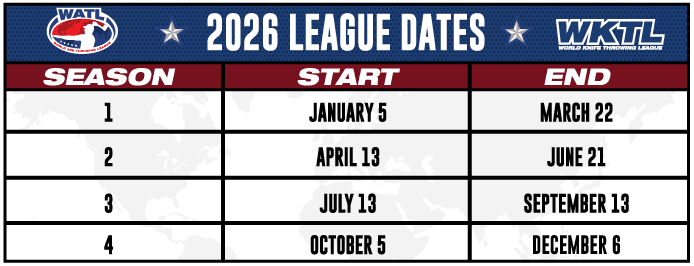
The core structure is straightforward, but it is no longer casual in practice. WATL sanctions four official seasons each year, each one built around eight weeks of gameplay and breaks between seasons. Weeks 1 through 7 are the scoring weeks, and week 8 is reserved for playoffs that crown the local champion.
That means the regular season is not just about showing up once in a while and hoping to peak at the right time. Every competitor gets four games per week, and week 7 has to be completed by the season-end date for the scores to count toward sanctioning. If you want league nights to translate into something bigger, the weekly routine has to become the backbone of your training cycle.
How multiple leagues fit into one leaderboard
WATL’s updated structure gives venues room to grow without muddying the records. A sanctioned venue can host any number of leagues in a season, and a thrower can compete in multiple leagues, but only the top-performing league per season counts for Circuit Points and the global leaderboard.

That detail matters because it rewards depth without letting players stack up duplicate paths to the same reward. WATL also requires the same Player ID across all leagues, which keeps records clean across venues and prevents duplicate tracking problems. Exclusive leagues are limited to recreational status, so the official points path stays tied to open sanctioned competition.
For a competitor trying to climb, this means the choice of league is part of the strategy. It is not enough to just find a weekly lane and throw a few decent cards. You need the league that gives you the best legitimate score line, the cleanest record and the most reliable shot at advancement.
What a sanctioned night has to look like
The operational standards are just as important as the competitive ones. WATL’s guide sets minimum participation thresholds of four competitors for hatchet, four for big axe, and two teams, or four competitors total, for hatchet duals. It also requires competitors to finish at least 12 games to qualify toward league minimums.
There is another hard boundary that serious throwers cannot ignore: no one is allowed more than eight solo games in a single league season. If a competitor goes beyond that limit, every solo game after the eighth becomes an automatic zero. The message is blunt, and it is designed to force consistency rather than gaming the schedule.

WATL also requires scores to be uploaded to the app in real time and provides venues with an absence-policy framework for missed games, makeups and zeros. That turns league nights into a record-keeping exercise as much as a competition, because the path upward depends on clean data, not just hot streaks.
From local nights to championship weekends
The broader ecosystem has been built to make the ladder visible. WATL says it was founded in 2017 and now has 300-plus affiliated venues in 20 countries, with more than 85,000 competitors equipped. Its tournament structure runs from local events to regionals and then to the World Championship on ESPN, giving the sport a clear progression instead of a one-off tournament culture.
That structure has been moving toward a more formal championship weekend for several seasons. WATL announced that the 2025 league calendar would stretch to 9 to 10 weeks because of weather and unexpected delays, with a longer break between Season 1 and Season 2 to accommodate the World Axe and Knife Throwing Championships from April 3 to 6, 2025. It also said the Amateur Championship would join the WAKTC weekend starting in 2026, cutting down on travel costs, duplicate hotel stays and missed work for participants.
The 2026 Amateur Championship plan shows how tightly the pieces now connect. WATL said it would be based on Circuit Points earned in the 2025 qualifying season, with the top 110 CP earners invited and 32 bid winners coming from four National Amateur tournaments. That is not an abstract development path anymore; it is a precise funnel.

Why the 2026 rules update changed the climb
On Feb. 24, 2026, WATL said it was introducing an updated Path to WAKTC beginning in Season 1 of 2026. The stated goal was to simplify qualification across disciplines, remove trickle mechanics and create realistic, tangible targets for earning bids. WATL also said the change came after long-running feedback from competitors, venue owners, industry staff and volunteers who wanted the road to be clearer and more transparent.
The result is a ladder that rewards planning as much as raw score. WATL says competitors may enter as many sanctioned leagues as they want, but only their top-performing league per season counts for the global leaderboard and Circuit Points, and League Circuit Points apply to Big Axe, Hatchet Duals and Amateur Hatchet only. The update also set league bid benchmarks, including top 20, top 128 or top 256 for Pro Hatchet depending on the number of seasons, plus discipline-specific marks in the amateur and knife divisions that range through top 10, top 32, top 64 and top 128.
For a serious thrower, the practical takeaway is simple: the weekly league is now the foundation, not the side quest. Better scores matter, but so do attendance, eligibility, app accuracy, travel planning and the discipline to build a season around sanctioned competition. WATL has made the road from a Thursday night card to the World Championship more legible, and that makes the gap between casual participation and true contention harder to ignore.
This article was produced by Prism’s automated news system from verified source data, official records, and press releases, then run through automated quality and moderation checks before publishing. The system is built and supervised by the people who set the standards it runs under. Read our full AI policy.
Did this article answer your question?