PDGA course design shows how land use shapes disc golf courses
Disc golf course design starts with land, not arm speed, and the best layouts reveal their audience through tee sets, pin options, and fairway shape.
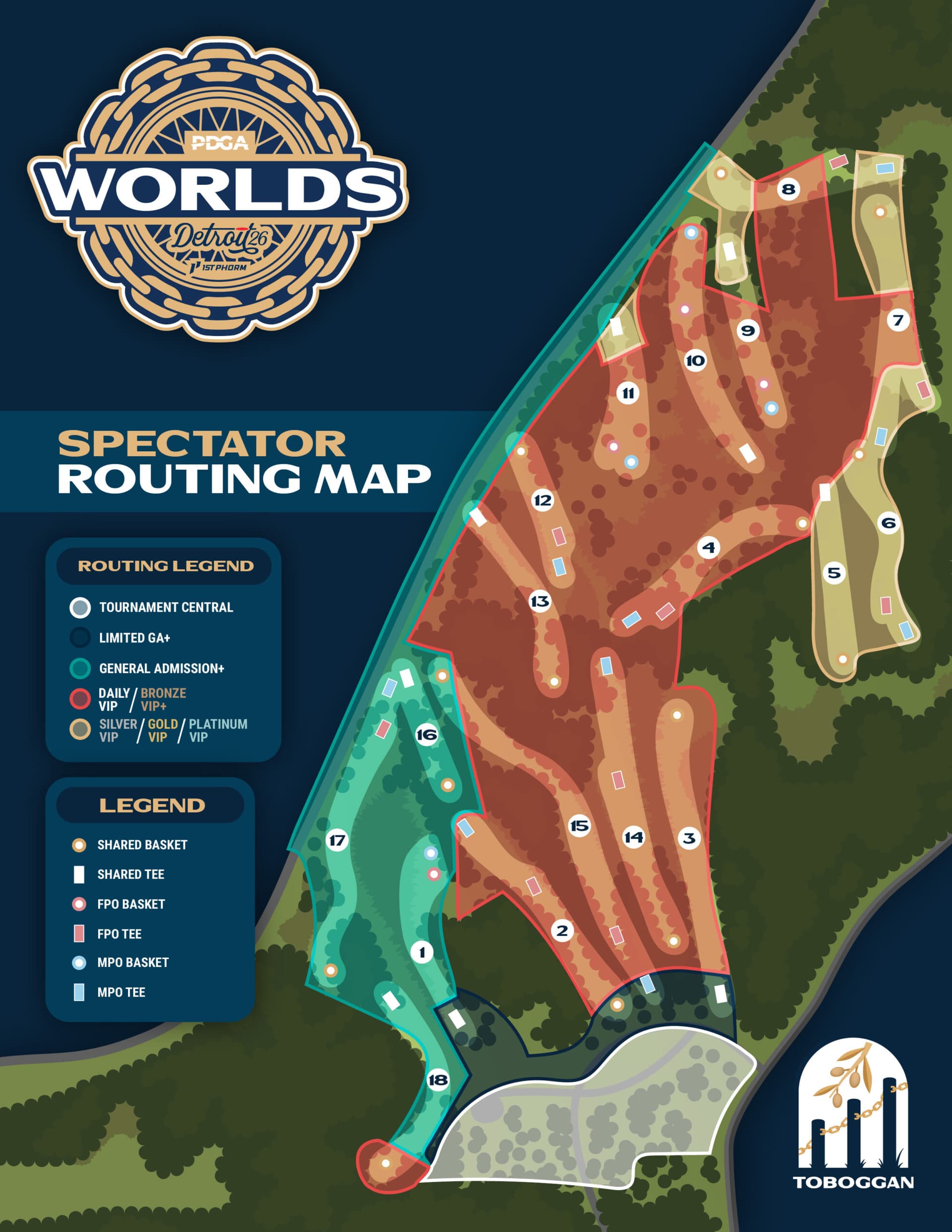
Wooded property often works best for disc golf courses because trees can create safe buffers between fairways. The first decision is whether enough space exists for the type of course you want. That is why disc golf thrives in parks, forests, and awkward leftover parcels that would never suit a football field or baseball diamond.
Land use sets the ceiling
PDGA acreage guidance makes the tradeoff plain: a shortest beginner course may need only about half an acre per hole on average, while championship layouts can demand more than one acre per hole depending on how wooded the site is. That range explains why two courses can both claim to be 18-hole layouts and still feel completely different on the ground. One can tuck into a compact public park with tight routing and shorter throws, while another can spread across a larger wooded property and ask for longer shots, wider landing windows, and more room between lines of play.
That space question also controls how welcoming a course feels. If a designer has enough acreage to separate fairways and give players clear landing zones, the course can challenge without becoming punishing. If the land is cramped, the same basket count can turn into a narrower, more technical test where every miss risks the next hole, which is exactly where wooded buffers and careful routing matter most.
Tees and pins reveal the intended audience
A course shows its audience in the tee pads before it ever shows it in the baskets. Many new courses use two or more sets of tees, and some add alternate basket positions as budgets allow, because one layout rarely serves every skill level well. Public courses often combine Blue and Red tees or White and Red tees, while the longest and most difficult versions may justify permanent Gold tees, ideally paired with shorter options for less advanced players.
The rating bands make that logic concrete: Gold is 970 and above, Blue is 925 and above, White is 875 and above, Red is 825 and above, and Green is under 825. For high-level Pro events, Gold is the primary guideline for Open and Masters 40+, while Blue is the primary guideline for Pro Women when possible. When a course needs hole-by-hole adjustment, designers should sometimes plan for four to six different holes for lower-skill groups.
Length, shape, and scoring par tell the real story
Hole length is one of the quickest ways to read a course’s intent. Beginner-friendly par 3 holes rarely average more than 250 feet, while a standard 18-hole par 54 course can be about 4,500 feet. A land-constrained 18-hole public par 3 course may come in around 3,600 to 4,300 feet.

The hole count matters too. Most courses are 9 or 18 holes, but 12, 24, and 27-hole layouts exist, and 18-hole sanctioned tournament layouts remain the standard expectation.
A layout built around 250-foot par 3s usually rewards clean placement, simple angles, and repeatable control. A par 54 stretched to 4,500 feet starts to reward distance, shot-shaping, and the ability to recover after a mistake, because the course is asking for more than one route to birdie and more than one decision point before the green.
Validation is turning design into a skill calibration tool
The PDGA’s design validation work has made course design more precise than it used to be. The association says validation is a relatively new concept, developed in the past eight years, and a course can be measured against the divisions it claims to serve instead of being judged only by feel. A layout that looks polished on day one can still be mismatched if its tees, distances, and landing zones do not line up with the intended player ratings.
In practice, validation gives designers a language for calibration. Instead of asking only whether a course is hard, the better question becomes whether it is hard for the right group, whether the Gold lines truly test elite players, and whether the shorter tees let newer players finish with confidence instead of frustration.
From Oak Grove Park to a global map
Oak Grove Park became the first official disc golf course in 1975. The PDGA was founded in 1976, and Steady Ed Headrick patented the Disc Golf Pole Hole in 1977.
The scale-up came fast. The PDGA says it had over 1,000 courses in its directory in 2000, over 3,000 in 2009, over 5,000 in 2015, and over 7,500 in 2017. It also passed 100,000 members in 2017, and its membership operations now manage 10,000-plus competitive events worldwide, 108,000-plus active members, and an online course directory with more than 11,000 entries.
This article was produced by Prism’s automated news system from verified source data, official records, and press releases, then run through automated quality and moderation checks before publishing. The system is built and supervised by the people who set the standards it runs under. Read our full AI policy.
Did this article answer your question?