PDGA explains out-of-bounds rules, penalties and lie placement
One OB call can flip a card from par to bogey, and the PDGA’s rule language shows why the lie, the line and the last in-bounds crossing matter.
The biggest OB questions in disc golf are also the ones that swing scores the fastest: where the lie is marked, when relief applies, and whether a painted line, shoreline or sidewalk counts as in or out. The PDGA’s official guidance makes those calls decisive, and in tournament play the difference is often a single stroke, or more, before the next throw is even made.
Where the disc is ruled out
The PDGA’s out-of-bounds FAQ starts with the core test: a disc is out-of-bounds if it is clearly and completely surrounded by an out-of-bounds area. That means the ruling is not just about where the disc first landed, but about how it finishes its movement and where it ultimately comes to rest. The rule language also makes the line itself part of the out-of-bounds area, which is why a disc on the wrong side of a marked boundary can be dead to rights even if it looks only partly over.
That detail matters on the shots players argue about most: water carries, sidewalk skips, road kicks and skips along painted edges. A disc that appears safe on a broadcast angle can still be OB once the boundary is checked on the ground, which is why live coverage and cardmates often depend on the course markings more than the camera angle.
How the lie is marked after OB
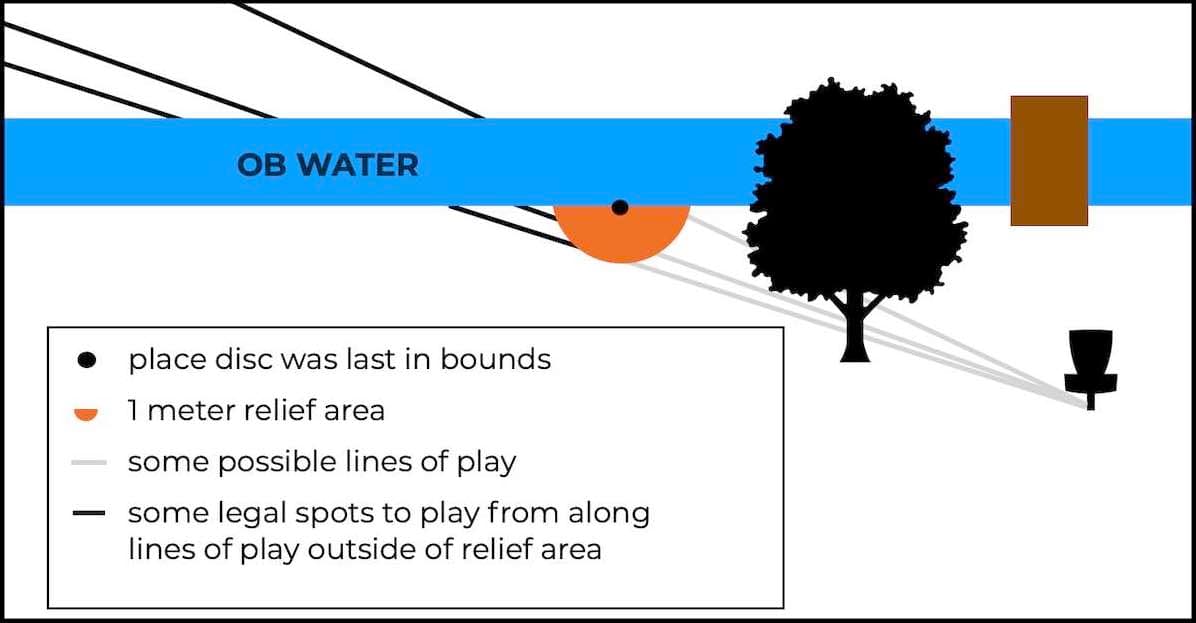
Once a disc is ruled OB, the last in-bounds crossing becomes the pivot point for the next shot. That is the point the card uses to determine where the lie is marked, and it is why players care so much about whether a disc barely cleared a line, skimmed a road edge or slid down into a hazard after crossing the boundary. In practical terms, that one crossing can turn a bold attack into a safer reset from a much tougher spot.
If the disc cannot be found, the PDGA says it is only treated as out-of-bounds if there is reasonable evidence it came to rest in an OB area; otherwise it is considered lost. That distinction keeps the penalty tied to evidence, not speculation, and it can be the difference between a simple stroke penalty and a more severe result when the throw disappears into rough, water or thick course edges.
Penalty strokes and relief choices
OB is not just a boundary call, it is a scoring mechanism. The standard consequence is a penalty stroke, and the player must then take the next throw from the marked lie or from the relief option allowed by the rules and the course setup. In tournament play, that penalty can change an aggressive birdie look into damage control fast enough to alter the rest of the round.
Later PDGA materials also show that relief has not stayed static. A 2022 rules-related update highlighted by third-party coverage gave players more flexibility in how they take meter relief from OB, and the PDGA’s 2024 rule book and competition manual continued that pattern of revision. The governing body keeps refining the language because those details shape how the rule works on real courses, not just on paper.
Why tournament OB changes strategy
OB is one of disc golf’s clearest course-design tools, because it does more than punish mistakes. It protects roads, parking lots and sensitive areas, while also forcing a real choice between a conservative placement shot and an aggressive line that can produce a better score or a bigger number. The same rope or painted stripe that keeps players safe can also change how a hole plays from the tee.
That strategic layer is why OB belongs as much to course architecture as to scoring. A hole with a tight road boundary, a shoreline carry or a hard line around a green asks for different decision-making than an open fairway with no penalty edge. In competition, the entire shape of a hole can change when the penalty is severe enough that par becomes the smart target instead of the birdie attempt.
Why the confusion never goes away
The rule is old enough to have a long paper trail of debate, and the questions have barely changed. A PDGA discussion-board archive from 2005 shows the association already considering stroke-and-distance changes for some situations, while a 2006 archive shows players debating whether water, sidewalks and painted lines counted as OB. That is the same confusion players still bring to cards today, only now the decisions are watched on camera and checked against more formal course maps.
Live-event spotters have become part of the answer. UDisc notes that at the 2018 Glass Blown Open, spotters helped pros determine whether shots stayed in bounds, a practical reminder that OB rulings can hinge on eyes on the ground when the flight is too close to call from the tee. In a sport where one skip can change a scorecard, spotters, line paint and local course definitions matter as much as arm speed.
A rule that keeps evolving with the sport
Innova Disc Golf framed the 2024 rules updates around a simple reality: disc golf is a young, developing sport, and the rules keep adjusting as player numbers and money increase. That growth explains why the PDGA revisits the rule book annually and why OB language gets clarified rather than left to habit. The more competitive the sport becomes, the more a boundary line has to do.
The result is a rule that is easy to understand in principle and still complicated in practice. A disc is out when it is clearly and completely surrounded, the line counts as part of OB, the lost-disc standard depends on reasonable evidence, and relief can change the next shot’s value by a full stroke. That is why OB remains one of the sport’s sharpest competitive tools: it protects the course, shapes the strategy and turns a painted line into a real scoring event.
This article was produced by Prism’s automated news system from verified source data, official records, and press releases, then run through automated quality and moderation checks before publishing. The system is built and supervised by the people who set the standards it runs under. Read our full AI policy.
Did this article answer your question?