PDGA rules evolve from Steady Ed notes to 2026 rulebook
Disc golf’s rulebook grew from founder-era notes into a formal 2026 code as the sport kept turning gray areas into written law.
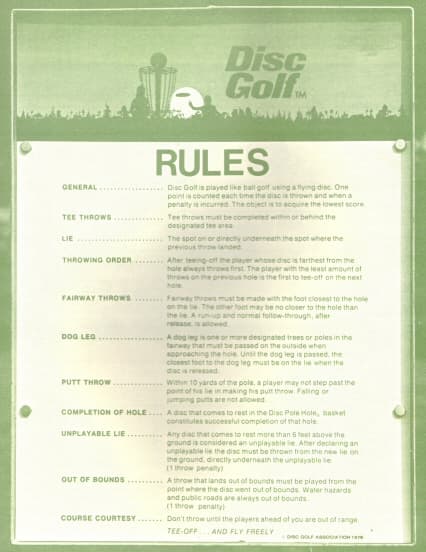
Disc golf’s rulebook did not start as a polished governing manual. It began as notes kept by Steady Ed Headrick, then steadily hardened into a code that now covers nearly every live issue a tournament can produce, from calls at the tee to relief, scoring, and equipment. The 2026 edition is the latest proof that the sport’s growth has been measured not just in baskets and fields, but in the language needed to govern them.
From Steady Ed’s notes to the first published book
The PDGA’s rules history traces the first known disc golf rules to 1982, when Headrick’s notes were rediscovered in the files of the sport’s founder. The 1986 update became the first published rulebook distributed to PDGA members, which is a meaningful line in the sport’s history: that is the moment disc golf moved from improvised local understanding to an official member-facing standard.
The history page then maps a steady cadence of revisions in 1990, 1997, 2002, 2006, 2011, 2013, 2018, and 2022, with the 2022 book described as the tenth version. That timeline matters because it shows the rulebook evolving in step with the game, not sitting still while tournament play became faster, more technical, and more nationally organized.
Why the gray areas forced the book to grow
One of the clearest early examples of that maturation came with the foot fault rule. A 2009 PDGA staff history piece notes that the 1990 rule book did not allow a player to call a foot fault on their own throw, only to second a call made by another player in the group. In practice, that left room for what the same piece called a free “mulligan” on a slipped tee shot, a telltale sign that the sport was still closing loopholes as competitive stakes rose.
That same historical note also points to a broader structural shift: the 1982 book blended game rules with event-running procedures, but by 2006 the PDGA had begun moving player classifications and other tournament administration into the Competition Manual. That separation is the mark of a mature sport. It tells you disc golf was no longer just writing down how to play a hole; it was building a system for how to run sanctioned events, manage fields, and keep tournaments comparable from one stop to the next.
Another clue to the sport’s expanding vocabulary is the old name for what became the Two Meter rule: “Unplayable Lie.” The shift in terminology captures how disc golf’s rules language has become more precise over time, replacing informal descriptions with terms that can hold up under tournament pressure and official interpretation.
What the 2026 code actually covers
The current online rulebook is the authoritative version, and the PDGA says major revisions are generally effective on January 1. The print outline for the 2026 edition is effective January 1, 2026, while the online version remains the version to follow when print and web differ. That alone tells the story of a sport with a live, maintained code rather than a static annual booklet.
The outline itself shows how far the sport has traveled from those early notes. It now runs through:
- application of the rules
- throwing
- obstacles and relief
- regulated routes
- regulated positions
- regulated areas
- completing the hole
- scoring
- other throws
- interference
- misplay
- courtesy
- equipment
The appendices extend the system further, with separate sections for match play, doubles play, adaptive rules, and team play. That breadth is what turns disc golf from a casual throwing game into a formal competitive structure. Once a rulebook needs separate lanes for doubles, adaptive competition, and team formats, the sport has clearly outgrown a one-page code.
The 2026 revisions show where modern disputes live
The most revealing 2026 change is in enforcement. The PDGA says the update to 801.02 was made because some players refused to make calls by claiming a “benefit of the doubt,” while others tried to lobby their group for a favorable determination after a questionable shot, including out-of-bounds plays. The new language removes the thrower from the initial vote and makes clear that group determinations are mandatory, which is exactly the kind of fix that only comes after real tournament friction exposes the gray area.
The 2026 update also tightens smaller but still important pieces of tournament language. It adds “required” to “relief area” in both the rules and misplay sections, and it adjusts match play language so a hole can end by halving when both players do not hole out. It also clarifies how time extensions work in playoff situations and codifies long-standing practices at PDGA Major events in the Competition Manual. Each change is modest on paper, but together they show a governing body refining the edges of competition rather than reinventing the game.
That is the real through-line from Headrick’s notes to the 2026 rulebook. Disc golf did not become formal by accident. It became formal because every season exposed another place where the sport needed a cleaner answer, and the PDGA kept writing those answers down. The result is a rules book that now reads like the record of the game becoming fully grown.
This article was produced by Prism’s automated news system from verified source data, official records, and press releases, then run through automated quality and moderation checks before publishing. The system is built and supervised by the people who set the standards it runs under. Read our full AI policy.
Did this article answer your question?