UDisc explains disc golf stats behind putting, drives and scrambles
UDisc's stat system turns disc golf into a shot-by-shot read, and Eagle McMahon's 2020 Great Lakes Open putting line shows why score alone misses the separation.
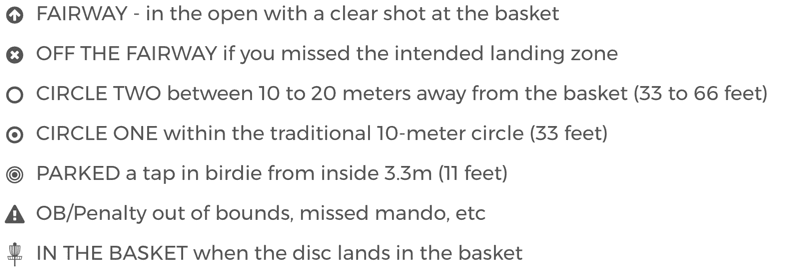
UDisc’s Version 9.0, released on June 5, 2018, added scorecard symbols for landing zones and what happened on each throw. Elite disc golf rounds can now be read as sequences of tee shots, approaches, putts, and recovery throws.
Reading the modern scorecard
The broader scoring and stat system changed the way rounds could be tracked.
The scoring-and-stats update the next day could calculate putting percentages, driving numbers, greens in regulation, scramble rates, and more. Disc golf rewards very different skills on different parts of the hole, and a single total cannot show whether a player won with clean tee shots, sharp circle putting, or repeated escapes after mistakes.
The handful of stats that actually matter
The cleanest way to understand a round is to focus on the stats that describe how a player moved from tee to basket. Circle 1 putting measures putts made from inside the traditional 10-meter, 33-foot circle, while Circle 2 putting covers 10 to 20 meters, or 33 to 66 feet. UDisc’s scorecard symbols also define Circle 1X putting as putts from 3.3 to 10 meters, 11 to 33 feet, excluding tap-ins.
Driving accuracy is the simplest of the driving metrics, measuring the percentage of drives that land on the fairway. The stats also use a broader landing-zone language, and that matters on longer holes: on a par 5, the first and second throws both count as drives, so one player can shape a hole with two precise placement shots before the scoring phase even starts.
Greens in regulation, or circles in regulation, show whether a player reached a putting position with two throws remaining for par. Scramble rate fills in the other side of the game, counting only when a player saves par or better after missing Circle 2 in regulation.

Why strokes gained changed the conversation
Strokes gained is the stat that pulls all of that into a single field-based comparison. UDisc brought strokes gained to UDisc Live in 2021 to show how many strokes a player gained or lost relative to the field off the tee and on the putting green. The key idea is expected value: a player is not just judged by whether a putt went in, but by whether that result beat what the field typically does from the same spot.
A player who gains strokes on the field is doing more than piling up makes, because the metric tracks how those makes and misses translated into real separation on the leaderboard.
The best example is the 2020 Great Lakes Open. Eagle McMahon gained 9.73 strokes on the putting green, while Chris Dickerson gained 7.59, and McMahon posted a 93 percent Circle 1X putting performance plus 45 percent from Circle 2. On the page, both players look strong. In context, McMahon was producing more value from the green, and the gap only becomes obvious when the round is measured against the field instead of just reduced to made and missed putts.
Ellen Widboom’s win at the 2020 Idlewild Open was another example of strokes gained in action.
What a score can hide in a single round
A round like McMahon’s at the Great Lakes Open shows why score alone is too blunt for modern disc golf. If you only look at the card, you see a finished round. If you look at the stat line, you see that McMahon was converting from Circle 1X at a high clip, still scoring from Circle 2, and creating more value on the putting green than Dickerson.
That same logic applies to every part of the hole. A player can miss a fairway and still salvage par with a clean scramble, or hit the fairway and leave a long, difficult putt that drags down the score despite strong tee play.
How the sport’s history makes the numbers matter now
Disc golf’s numbers did not appear in a vacuum. The Professional Disc Golf Association was founded in 1976, and the first official disc golf course, Oak Grove Park, opened in 1975. The PDGA Player Ratings system has been used to group amateurs into divisions since 2002, which helped keep competition fair and avoid sandbagging, and a 1000-rated player is considered a scratch player who averages the course SSA.
The PDGA also requires each player to keep an independent scorecard and record scores after each hole, and a hole score is the total number of throws, including penalty throws.
How to watch elite disc golf now
- Fairway hits, because clean tee shots create easier second and third looks.
- Circle 1X and Circle 2 putting, because they show whether a player is finishing from the ranges that separate the field.
- Scramble rate, because elite players still save pars after misses, and those saves keep a round alive.
- Strokes gained off the tee and on the green, because those numbers show who is actually beating the field rather than just surviving it.
When you are watching a top card, the best read comes from a short checklist:
This article was produced by Prism’s automated news system from verified source data, official records, and press releases, then run through automated quality and moderation checks before publishing. The system is built and supervised by the people who set the standards it runs under. Read our full AI policy.
Did this article answer your question?